
Resistor to dim LED's

Andrew_Trayfoot

Well-Known Member
Joined
11 Oct 2007
Messages
674
Visit site
Have some rather flashy switches on my new switch panel with indicator LED's on the end.
Only problem is that they are a bit bright.
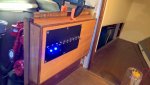
Optimized-WP_20170225_16_36_02_Rich_LI.jpg
Any recommendation for the spec. of a resistor to dim them?
Ohm value/rating etc...
Thanks,
Andrew
 
Impossible to say with any certainty without seeing the circuit diagram and knowing the type of LED in use. I would expect that you are looking at values around 100 ohms to bring the brightness down - and the power rating will be very low. Get a selection of resistors from Maplins between 47 ohms and two or three hundred ohms and experiment.
 
A lot of common indicator LEDs are run at 30mA.
A blue led willl have a Vf of say 3V. so the existing resistor will be dropping around 9V. which suggests the existing resistor will be about 300ohms.
Putting something similar in series would be a good place to start. Or even higher.
1kohms is not out of the question.
 
many thanks
will pop into Maplin on Friday...

If you've got a multimeter and don't mind a bit more work you could always buy a 1 or 2 kOhm potentiometer, solder it in, set it to give the brightness you like and then take it out and measure it before going back to Maplins for a set of the closest available fixed value resistors.
 
If you've got a multimeter and don't mind a bit more work you could always buy a 1 or 2 kOhm potentiometer, solder it in, set it to give the brightness you like and then take it out and measure it before going back to Maplins for a set of the closest available fixed value resistors.

That is a top suggestion !
 
If you've got a multimeter and don't mind a bit more work you could always buy a 1 or 2 kOhm potentiometer, solder it in, set it to give the brightness you like and then take it out and measure it before going back to Maplins for a set of the closest available fixed value resistors.

A lot depends on LED spec, to dim the blue ones I use on my panels needs a 91K resistor, the white on the yacht mimic 140K, but the red circuit breaker trip warning 1.6K.

Get a 100K miniature preset, you can then adjust for brightness, remove and check resistance value.

Brian
 
A lot depends on LED spec, to dim the blue ones I use on my panels needs a 91K resistor, the white on the yacht mimic 140K, but the red circuit breaker trip warning 1.6K.

Get a 100K miniature preset, you can then adjust for brightness, remove and check resistance value.

Brian

Must have those numbers (decimal points ) wrong. A 91k (91000ohm) resistor will allow at 9 volts drop .1 milliamp which would make LED pretty dim. A 910 ohm resistor would allow 10 milliamps which might be more like a suitable dimness.
Likewise the 140k resistor. Check the resistors with DVM sometimes a "K" means something different from 000 multiplier. olewill
 
Must have those numbers (decimal points ) wrong. A 91k (91000ohm) resistor will allow at 9 volts drop .1 milliamp which would make LED pretty dim. A 910 ohm resistor would allow 10 milliamps which might be more like a suitable dimness.
Likewise the 140k resistor. Check the resistors with DVM sometimes a "K" means something different from 000 multiplier. olewill

I know what K means, even with these values I consider some of them a little bright for nav stations at night.

Brian
 
Surely the point is that the OP is not asking for advice on building a new solution - he has something that is working but is too bright. He's looking for suggestions for an additional resistor to bring the brightness down and that will be a significantly lower resistance than what is already installed. The other question is what voltage is driving the LED/resistor combination? Is it coming directly from a switched 12v circuit or from lower voltage electronics such as the nominally 3v output of a modern microprocessor? That will have a big impact on the resistor value required.
 
Surely the point is that the OP is not asking for advice on building a new solution - he has something that is working but is too bright. He's looking for suggestions for an additional resistor to bring the brightness down and that will be a significantly lower resistance than what is already installed. The other question is what voltage is driving the LED/resistor combination? Is it coming directly from a switched 12v circuit or from lower voltage electronics such as the nominally 3v output of a modern microprocessor? That will have a big impact on the resistor value required.
Looking at the OP's picture I think we can be fairly certain it is simply 12V, lower voltage from a processor or otherwise seems highly unlikely. Also he needs to INCREASE the series resistance to reduce the drive through the LED. As others have suggested a temporary pot/trimmer is the best way to visually see the desired effect under various lighting conditions. Normally I would use a 1K resistor (at 12V) but that very much depends on colour/type of LED and viewing conditions.
 
A lot depends on LED spec, to dim the blue ones I use on my panels needs a 91K resistor, the white on the yacht mimic 140K, but the red circuit breaker trip warning 1.6K.

Get a 100K miniature preset, you can then adjust for brightness, remove and check resistance value.

Brian

Just had a fiddle with a blue LED I had handy.
In a darkish room, 33k was reasonable. So I can see that 91k could well be in range for a different LED.
In a bright room, 33k was visible but a bit limp.
I guess we rarely need to see thee thigns in direct sun?

When blue LEds were really new, I was working in a lab where they bought a fancy new piece of test equipment, with an annoyingly bright blue LED. We stuck a post-it note over it.
 
Just had a fiddle with a blue LED I had handy.
In a darkish room, 33k was reasonable. So I can see that 91k could well be in range for a different LED.
In a bright room, 33k was visible but a bit limp.
I guess we rarely need to see thee thigns in direct sun?

When blue LEds were really new, I was working in a lab where they bought a fancy new piece of test equipment, with an annoyingly bright blue LED. We stuck a post-it note over it.

The old ( like 1980 ) type red and green LED were happy with around 1K resistor, but the new blue and white are in the cd range while the old were mcd, so are blinding. Useful as the new ones give that much light at minute amps I can use a 100 on a switch panel without worrying about power usage.

Brian
 
PWM is the best way to dim leds, resistors make a bit of difference but not much before the led goes off entirely, with pwm you can get them down to barely a glimmer.

But does it not introduce interference in adjacent electronics?

I have some led "ceiling" lights in my camper. The mains driven radio goes bananas when they are on. There is no interference when the SMD resistor driven less are on.
 
System is straight of the 12v.
Might get a variable resister at Maplin tomorrow.
I cant see any reason why it can't be left place permanently
 
Andrew reading two of your posts you could be assuming a single resistor for the panel. For the avoidance of doubt, you need one per LED.
Apologies if I am teaching you to suck eggs.
 
Top