
Resistor to dim LED's

The Switches are wired up as shown in the picture below:
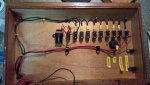
Optimized-WP_20170303_18_39_30_Pro.jpg
The +ve supply for the LED is taken from the switch.
The -ve comes from an extra terminal on the switch which I have wired via a common loom along the top of the picture back to the boat -ve terminal bar.

Can't see why I need more than one resistor in the -ve line between the switches and the boat -ve terminal bar.

PS switch on the left end is for an ammeter that needs an independent supply - hence the PP3 battery.
 
The Switches are wired up as shown in the picture below:
View attachment 62971
The +ve supply for the LED is taken from the switch.
The -ve comes from an extra terminal on the switch which I have wired via a common loom along the top of the picture back to the boat -ve terminal bar.

Can't see why I need more than one resistor in the -ve line between the switches and the boat -ve terminal bar.

PS switch on the left end is for an ammeter that needs an independent supply - hence the PP3 battery.

You need a resistor per LED, a single common resistor will pass the total current drawn by the LED's and therefore produce a voltage drop dependent on the number of LED's illuminated. In other words, the brilliance will vary depending on the number of switches/LED's selected, becoming dimmer as more are activated.
Hope this helps.
Richard
 
.The voltage comes directly from the battery and is fed to each individual switch. There is probably a resistor feeding the LED on each Switch. Read the colour code on the resistor to get the resistor value or pull the fuse to the switch and measure across the resistor with an ohm meter to get the value used. As per Ohms Law, the higher the resistance the lower the current so try a resistor that is 10% higher than the original and see how it works. Unfortunately you will have to replace the resistors on each switch.

Kinsale 373
 
Top