richardh10
Well-Known Member
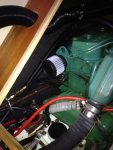
The air filter on my Volvo D2-40F is due for replacement and I would prefer to replace it with a filter which is reusable if possible. Has anyone done this, or know the best way to source one?



My Perkins M92b has a high performance air filter. It is a fine filter inside a coarse filter. Two separate replaceable parts. After a season the coarse filter is noticeably dirty. Having seen that I am certain there is a benefit in running air filtration on a marine engine. I don't suppose Perkins Sabre put it there by accident.You may consider not bothering. In a typical yacht installation a filter is really not necessary as the atmosphere is pretty clean. It is there mainly as a silencer. I suspect if you open it up (which of course destroys it) you will find it is like new. Just read coopec's link which suggests exactly the same. Pretty sure though that you will find a K&N to fit the spigot - I have one on my 2040.
My Perkins M92b has a high performance air filter. It is a fine filter inside a coarse filter. Two separate replaceable parts. After a season the coarse filter is noticeably dirty. Having seen that I am certain there is a benefit in running air filtration on a marine engine. I don't suppose Perkins Sabre put it there by accident.

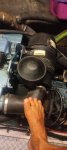
How do you know? Where does the combustion air come from? We have no noticeable dust in our engine room. It's not somewhere I get the feather duster out but the filter certainly finds some. I only change it about every 2 years when it looks dirty. This is what Perkins Sabre decided was appropriate. Foot for scale. The filter is hugeThere's not much dust around in my engine bay so I agree the air filter is probably not needed.
That may be so, but we are talking about a new Bavaria with just the engine in its own self contained and vented compartment. One of the posts in the thread linked to above reported that after 2000 hours the casing was opened up and in his opinion the element would not need replacing. This is a common experience with these modern small engines in clean dry boats. The engine compartment of my boat after 6 years was as clean, dry and free from dust as it was when new.My Perkins M92b has a high performance air filter. It is a fine filter inside a coarse filter. Two separate replaceable parts. After a season the coarse filter is noticeably dirty. Having seen that I am certain there is a benefit in running air filtration on a marine engine. I don't suppose Perkins Sabre put it there by accident.
Maybe we make more dust as we are onboard for at least 9 months of the year. Funny how Perkins Sabre knew we would be so fitted a high performance filter.That may be so, but we are talking about a new Bavaria with just the engine in its own self contained and vented compartment. One of the posts in the thread linked to above reported that after 2000 hours the casing was opened up and in his opinion the element would not need replacing. This is a common experience with these modern small engines in clean dry boats. The engine compartment of my boat after 6 years was as clean, dry and free from dust as it was when new.
You are just proving my point! This post is about a small diesel running in a clean environment for relatively few hours a year. Of course there are operating environments where air filtration is essential. The same basic type of engine is used in industrial, agricultural and construction equipment and on these versions you will find much more robust air filtration. My mate has a digger with the same base Kubota that my new Beta uses. It has a huge air filter compared with the little one tacked in the back of the Beta. He runs the digger for hours at a time in a dusty atmosphere. By comparison yacht engines live a life of luxury - as I said engines in modern small boats live in their own engine compartments with nothing else to go wrong and produce harmful dust. If you are going to put an engine in a boat that does have these risks as many Perkins engines of the size of yours are, then you equip it accordingly. BTW the 8-10000 hours is commonplace as design life for small diesels these days. The digger is well into the second half of this life and still going strong.Maybe we make more dust as we are onboard for at least 9 months of the year. Funny how Perkins Sabre knew we would be so fitted a high performance filter.
How much contamination in an engine is bad? Our engine is specified to use high performance engine oil. It has high performance air filtration and it's up to 500 hrs between oil changes. The rocker box says useful engine life, 10000 hrs.
Anything that goes wrong in an engine room will be sucked into the engine if it has no filtration.
Parts of Europe and the Caribbean fairly regularly get hit with huge Sahara dust clouds. The last one that hit here caused so much loss of visibility that we could hardly see across the bay. The boat was covered in dust. Where do you think this goes if you happen to be using the engine?

 .
.
Our generator is the same engine as a Volvo 2010. It had no filter but it has a box that reduced induction noise. I added a filter to the inlet to the box. The generator has always made lots of belt dust. It doesn't go in to the engine anymore. Having seen the dust on our main engine filter after a couple of seasons it made sense to me. It's a great little engine. 27 years oldI have an air filter box as it makes a huge difference to silencing the engine but no filter.
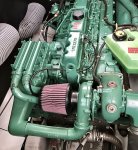
The pictured k&n type vastly increase induction noise but no problem if you've a well insulated engine compartment.