Replace Genoa Cars with Barber Haul entirely? How does that work?

DangerousPirate

Well-Known Member
Joined
24 Feb 2020
Messages
981
Location
N. Ireland
Visit site
I have been reading about barber hauling systems for a while now. This might be my next project. I just struggle imagining how many sheets are needed to connect to the low friction rings and how the adjustments work.

There definitely needs to be a line to pull the jibsheet down (Y-Axis) and another one to pull it in (X-Axis). But how do I position the friction ring at the right point along the jibsheet? Do I need another sheet to adjust how far out (lengthwise) I let the barber hauler (Z-Axis)? Is this why it's called 3D Sheeting? How do I do that then?
 
Yes, 3D sheeting or 3D leads.

BTW, it is Barber hauler, since it is named for the Barber brothers who introduced it in the Lightning class.

Barber hauler--short article

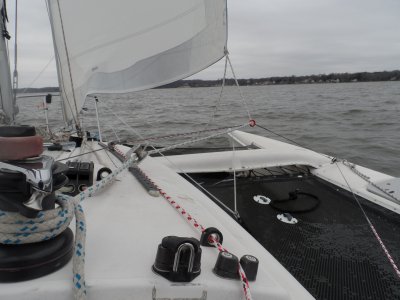
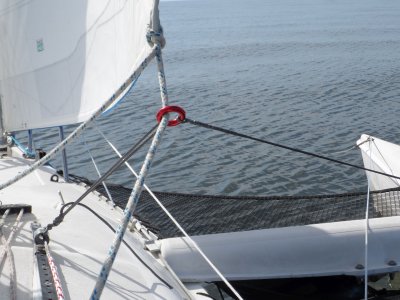
The low friction ring (LFR) floats on the sheet, finding its own place (can be a ball bearing block but LFRs bang around less). Normally the Barber hauling as far aft as the farthest aft position you use to windward and inboard at least a few feet. The out-hauling (Barber hauling is technically inhauling) possition is slightly forward of the farthest forward lead position you would use. Yes, this may be slightly forward of the close hauled clew, but it is only hauled out when the sail is eased. It is as far outboard as possible.

The inhauling line can require 2:1, 4:1, or greater purchase, depending on the size of the boat. The outhaul line requires less purchase, because it is used off the wind. I have 1:1 on the outhaul and 2:1 on the in/down haul. (In my case I do not haul in, only down/forward, since the track is far enough inboard that farther inhauling would be counter productive).

If possible, jury rig a test set up using the mast base, stanchion bases, and the track as anchor points to see what dirrections and positions best fit your boat and sails. This is the best way.

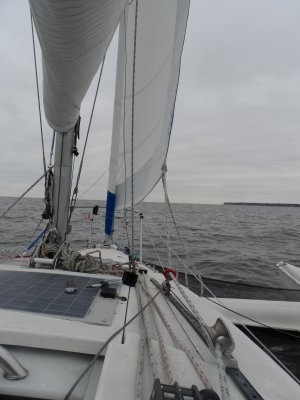
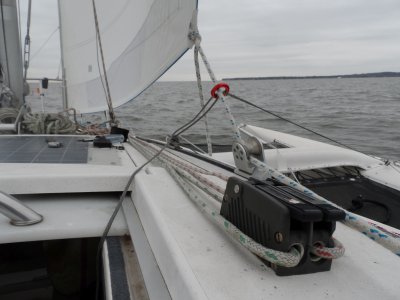
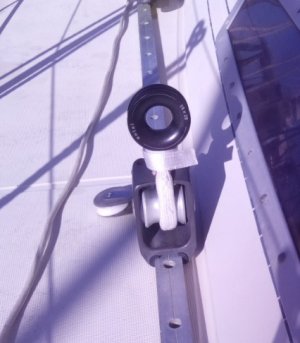
Note that my forward anchor point is an extra car I added to the track. The existing lead block is my "standard" aft windward setting, no hauling required. I never move the car; the leads do the adjusting. Very fast, very adjustable.

Pulled out for deep reaching.
1767456356484.jpeg

Forward for reefed jib.
1767456418282.jpeg

Forward and out for close reaching.
1767456460792.jpeg
 

Attachments

  • 1767456317550.jpeg
    1767456317550.jpeg
    1 MB · Views: 8
Other thoughts.
  • Solid rings can work better than LFRs. More space for the rigging. In fact, mine are climbing rappel rings, which are cheap and perfect for smaller boats, up to about 30 feet. I used LFRs for the outboard turning blocks.
  • Dyneema sheets work best, but polyester is OK, since the angles are not too great. You can always change to a ball bearing block if the friction is too great, but they do bang around more. I have used ball bearing blocks on other boats (the lightest block that will fit--low load)
  • Dyneema control lines are best (much lower friction around the ring). Cover the sections that will be in cam cleats (the Dyneema is gray, the covers are red/white/black) with polyester. Or you could use strippable line.
 
Make sure any rings can’t bash into cabin windows.
On a race when doing a lot of tacks, after one slow tack when the sheet was not nipped in fast enough the flogging jib sheet smashed the ring through the cabin window.
One way to call the off watch crew adeck.

But yes, the pictures are helping. So you just position the jib car at the furthest aft position, fit a line at the most forward position, and depending on how much you pull the ring in, it'll adjust the angle. If I got that right?

Note: I have a monohull so I can't copy the rig entirely. Probably should have mentioned that in my initial post.
 
The multiple ropes (in hauler, out hauler, down hauler) are an ideal system for a race boat. Absolute 3D positioning and light weight.
But personally I am not convinced they are optimal for a cruiser, even one like us who enjoy good sail trim.
Lots of extra trip hazards going forward, as well as the window risk. I will stick with our “towable” jib cars which are fine for us - plus a single detachable LFR which very occasionally rig to the centre cleat if white sail reaching for a very long distance (several hours).

Already have the detachable LFR often used for the asymmetric spinnaker sheet when hoisted.
 
Make sure any rings can’t bash into cabin windows.
On a race when doing a lot of tacks, after one slow tack when the sheet was not nipped in fast enough the flogging jib sheet smashed the ring through the cabin window.
It may depend upon the deck shape but yes sometimes some sort of upwards component is needed, fwiw absolutely necessary on my boat. I tried to use floating rings for the inner foresail, while tacking or when the sheet was flogging the ring became crazy and needed too many lines to be restrained or it would have destroyed everything around, also did not fancy having a cobweb of lines mid deck; I ended up making two tight strops + rings to be used over the existing genoa travellers, they can be flipped over the side so both jib and genoa sheets remain available, but of course the traveller is still there.
ring.jpg
 
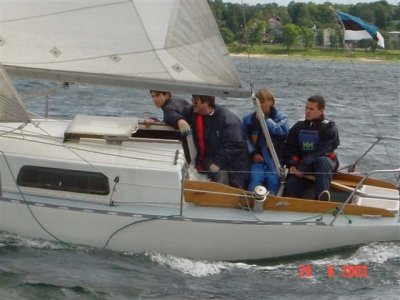
The most simple BH is to just have a single line through a small block on the sheet ... the use then pulls the sheet DOWN and IN ....

I used it on a previous boat - sheet through small block of the BH line then set from deck at suitable point ... this way - I could alter the angle much finer than with just a car / track setup.

Here is a photo of it use - Saaremaa 1/4 tonner - photo taken by boat we were just passing - a race we won - Baltic Regatta Tallinn 2003....

Eola 2003 baltic Regatta.jpg
 
The most simple BH is to just have a single line through a small block on the sheet ... the use then pulls the sheet DOWN and IN ....

I used it on a previous boat - sheet through small block of the BH line then set from deck at suitable point ... this way - I could alter the angle much finer than with just a car / track setup.

Here is a photo of it use - Saaremaa 1/4 tonner - photo taken by boat we were just passing - a race we won - Baltic Regatta Tallinn 2003....

View attachment 204420
Yeah that looks very simple. I think I could rig that up on my boat in 15 minutes. Somehow I thought it needs more control lines.
 
On multihulls we take the outhaul function to extreme, eliminating the need for a reaching pole or whisker pole.

But the above comments reflect why I suggested testing some positions before rigging anything permanent. If there is no anchor point near the correct location, can you rig a tight line across the deck and used that as a test anchor point? It's doesn't have to be pretty or very good, just the right place.

I don't think this is a racer/cruiser thing as much as a boat geometry thing. On three boats I have had three very different systems. On my cruising cat I opted for a second set of sheets for the genoa instead; the cap shrouds got in the way of any outhaul system and it kept the side deck clear. Try positions and figure out what gets the trim you want through the range of conditions and possibly sail changes. Then work out the tripping problems. The window bashing is a good example; I've never had them in a place where that was possible, just due to the positions of things. Further forward and higher up might have prevented the problem. In my case, the "standard" position has always been set by the existing lead, so the ring is well above the deck and farther forward.

Particularly for cruisers, It's boat specific IMO. It can really improve trim, sort of like a vang or traveler for the jib.
 
Yeah that looks very simple. I think I could rig that up on my boat in 15 minutes. Somehow I thought it needs more control lines.
That is a downhauler. No inhaul, no outhaul. Maybe that is all you want and need, and it avoids having to move the car forward, but it's not a 3D lead.

Many racers only worry about up wind and down wind. Upwind they need in and forward. down wind they use a chute or whisker pole. Cruisers, on the other hand, often want to tweak for even break all the way up and down, and a flatter sail, on a tight reach, and that takes 3D leads. It all depends on your sails, how they set, and your needs. Personally, I really like and out and down haul to get a flat sail with controlled twist for reaching, and I don't race, not in 40 years. But I do like good trim.
 
The single line as on my EOLA .... is a good starting point .... its easy enough to then add to it if another angle function is required ...

BUT contrary to 'thinwaters' comments - quite often there is no need for 3D ... the matter is solved by setting the mount point on the deck ..... various boats I have suggested and got owner to try - have used the car on the track as deck point ... giving not only the haluer function but also the fore - aft mount point depending on which sail (hanked) or part furled.

KISS ..... it works quite often !!
 
The single line as on my EOLA .... is a good starting point .... its easy enough to then add to it if another angle function is required ...

BUT contrary to 'thinwaters' comments - quite often there is no need for 3D ... the matter is solved by setting the mount point on the deck ..... various boats I have suggested and got owner to try - have used the car on the track as deck point ... giving not only the haluer function but also the fore - aft mount point depending on which sail (hanked) or part furled.

KISS ..... it works quite often !!
I am not trying to be the fastest boat in a regatta, but I do not like fluttering sails for obvious reasons and the jib cars are always a nuisance to operate alone under sail. Also it seems that a smooth adjustment is better than rigid points.

It is really easy, a lot easier than I thought, to just install this downhauler point. That should do 90% of the trick. The rest, for what I need, can be done with a second inhauler line, when I want to sail REALLY close to the wind, which is rare but has its advantages. Something I couldn't do with my current set up.

So it was either a barber hauler system or a jib car with block adjustment (instead of the pin and hole system that is so common). And BH just seems simpler to me and also cheaper.
 
The single line as on my EOLA .... is a good starting point .... its easy enough to then add to it if another angle function is required ...

BUT contrary to 'thinwaters' comments - quite often there is no need for 3D ... the matter is solved by setting the mount point on the deck ..... various boats I have suggested and got owner to try - have used the car on the track as deck point ... giving not only the haluer function but also the fore - aft mount point depending on which sail (hanked) or part furled.

KISS ..... it works quite often !!
Yes. Kiss. I didn't drill any holes, other than for cam cleats.

The downhaul point on my F-24 is an added (fixed) car. I actually got the cars for free (someone put them in the freecycle hopper).

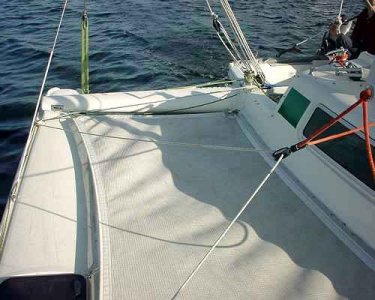
The outhaul point is preexisting bolts on the forward aka (beam). I fitted that in 20 minutes. I started with just the outhaul, using low friction rings on line I found in the locker. Easy. I later adding the down haul when I realized moving pin-cars is a pain in a breeze. It was simpler than towing the cars. I switched to rappel rings because there was more room for the control lines, but LFRs work.

A down haul or in haul should not add any tripping hazards. Out haul can take some figuring. On my first cruising cat it was not a problem, on my second we did something different, and on my tri we just don't walk on the nets that often (at dock or anchor the lines are slack and lay on the nets--no problem), and going forward to the mast it isn't in the way.

---

Another note. The purchase on the down haul is sometimes set up as a cascade. This depends on the amount of travel required and the room (length) available.
 
O(f course an answer given your last post #13 ... would if you wanted to invest time / money and some work - is a self-tacker ...... with a decent cut sail to match and a furler ... the ST is a real eye-opener in convenience.

For general sailing - I love it on my racer ... I can set my foresail from out to inline with C/L of boat .....

But a ST is another story !!
 
O(f course an answer given your last post #13 ... would if you wanted to invest time / money and some work - is a self-tacker ...... with a decent cut sail to match and a furler ... the ST is a real eye-opener in convenience.

For general sailing - I love it on my racer ... I can set my foresail from out to inline with C/L of boat .....

But a ST is another story !!
I'd be careful. It seems convenient, but a friend of mine had one and regretted it. Apparently it's terrible for anything else besides tacking. It also doesn't work so well with genoas.

I'll play around with the barber haul soon. :)
 
I'd be careful. It seems convenient, but a friend of mine had one and regretted it. Apparently it's terrible for anything else besides tacking. It also doesn't work so well with genoas.

I'll play around with the barber haul soon. :)

It was just a comment .. and the 'hauler' kept simple and easy to work is an excellent 'tool'.

Its a pity that you lot are so far away - I would take you out for a sail and show what the ST can do ... when its cut correct for the boat ...

Also the way the ST track is setup ... many I see are short across the boat forcing the clew to be inboard too much when you want to slack off and let sail catch wind on downwind legs .... a few boats I've noted had normal sheets rigged ready to clip onto the ST and release the ST control sheet ..

The average difference of the ST - to my usual race genny is about 0.5kts to 1kt depending on wind strength / angle. But i love the convenience and ease it affords .... while still giving me reasonable performance ..
 
I am not trying to be the fastest boat in a regatta, but I do not like fluttering sails for obvious reasons and the jib cars are always a nuisance to operate alone under sail. Also it seems that a smooth adjustment is better than rigid points.

Would it not easier to install ‘towable’ jib cars instead?
 
The Dragonfly has large LFRs with both the jib sheet and barber hauler simply passing through. This photo shows double blocks, but the newer boats just have rings. But if anyone wants blocks like that, I have 2 going spare. Fredrikksen ball race ones.
IMG_0380.jpeg
 
Top