Removing boat divot

Joined
15 Dec 2023
Messages
1
Visit site
I'm wondering if anyone here as some knowledge or insight on the removal process of a divot, I know there's a industry way to do it probably a land crain or one on a barge or boat, but that's just not going to happen in this case, I can remove it by cutting it in little sections at a time but I would like to keep the strength integrity of the divot as a whole, so any knowledge /ideas on how this can be accomplished would be much appreciated I cannot post a picture until more posts but the davit is a big one electric motor about a 10foot boom mounted with about 12 one inch bolts to a slab on concrete, is there a way to find center weight of the boom arm ??iMarkup_20231214_235842.jpg
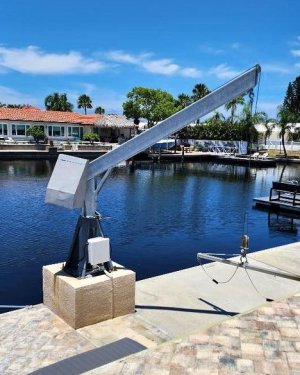
I am to cause no or little damage to area around this
 
I know of a boat moored near mine that has a divot on it. The whole pontoon would derive great benifit by this particular divots removal, and we would sleep easier knowing he and his boat were not navigating the river and crashing into ours.

However, on re-reading the OP I see it is a miss spelling of "Davit, although it looks more like a small crane.

That should be easier to remove by mechanical means.

I suggest you advertise it with the proviso 'buyer removes'.

It looks a useful bit of kit. Someone will want it.
 
Welcome to the forum

First thing, that is not a "divot" which is a hole in the ground for example made by a golf club when hitting the ball badly. It could be called a "davit" which is similar to your phot but smaller and mounted on the back of a boat.

Normally that would be simply called a crane or possibly a derrick, but the latter are usually manually operated.

As to removing it, i would guess it is assembled out of smaller components - the base, the jib (arm) and the motor. Should not be difficult to disassemble but the jib looks to be one piece.
 
Welcome to the forum

First thing, that is not a "divot" which is a hole in the ground for example made by a golf club when hitting the ball badly. It could be called a "davit" which is similar to your phot but smaller and mounted on the back of a boat.

Normally that would be simply called a crane or possibly a derrick, but the latter are usually manually operated.

As to removing it, i would guess it is assembled out of smaller components - the base, the jib (arm) and the motor. Should not be difficult to disassemble but the jib looks to be one piece.
Technically, I would have thought that the hole in the ground is what remains when the divot has been removed by a careless drive.
 
clearly the best way to get it removed it is to advertise it for sale or even "Free" and let the person who wants it take care of removal..

If that fails, I would take a large angle grinder with cutting wheels and cut it into small manageable chunks, if you don;'t cut the boom all the way though you can manhandle it by twisting it off the main lump and lowering to the ground. making sure you cover anything with sheets that could be damaged by sparks and wear personal protection.
 
Last edited:
To answer your question I would hire one of these

gcrane000_a.jpg


Or one of these

gcrane020_a.jpg


To take the weight so the structure could be unbolted and lifted

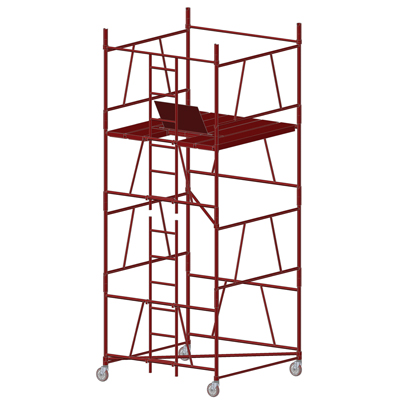
I used a scalifting tower to lift a 800 Kg engine from the ground to the deck of my boat 3 m plus above the ground
using a chain hoist

Self-Lock-Scaffolding-Steel-Tower.jpg
 
Technically, I would have thought that the hole in the ground is what remains when the divot has been removed by a careless drive.
Correct. One would replace a Divot, so therefore it must be the part that is removed.
seriously, the davit will have to be broken down into component parts, however or by whomever it is removed. The lifting wire, motor, drum and control gear will have to be removed. The arm, or boom, will have to supported and unbolted from the base, the base will have to be unbolted from the concrete plinth. Seemples! 😵‍💫
 
Technically, I would have thought that the hole in the ground is what remains when the divot has been removed by a careless drive.
You can tell I have never played golf, and now you have explained it suspect I would be a prolific producer of divots if I did.
 
Just to correct the none golfers a divot is a hole or better described as a scrape and occurs when an iron is struck correctly hitting the ball first on a slightly downward trajectory almost at the bottom of the swing. As the blade of the club follows through the ball it contacts the ground just in front of where the ball was, removing a shallow piece of ground / turf which is also referred to as the divot.
Of course if a player strikes the ground before the ball then a piece of turf is removed and the ball flies off a few meters followed by a few choice words sometimes under ones breath but often out loud and sometimes laden with expletives. This is when an iron is struck badly.
 
Just to correct the none golfers a divot is a hole or better described as a scrape and occurs when an iron is struck correctly hitting the ball first on a slightly downward trajectory almost at the bottom of the swing. As the blade of the club follows through the ball it contacts the ground just in front of where the ball was, removing a shallow piece of ground / turf which is also referred to as the divot.
Of course if a player strikes the ground before the ball then a piece of turf is removed and the ball flies off a few meters followed by a few choice words sometimes under ones breath but often out loud and sometimes laden with expletives. This is when an iron is struck badly.
So I was correct?

No wonder we can't agree here on important subjects like anchors, chains, inmast furling, relevance of electric propulsion for yachts if there is disagreement about whether divot is a lump of turf or the hole left when the lump is removed by a golf club.
 
So I was correct?

No wonder we can't agree here on important subjects like anchors, chains, inmast furling, relevance of electric propulsion for yachts if there is disagreement about whether divot is a lump of turf or the hole left when the lump is removed by a golf club.
Which is not quite what you said, you said it was a hole in the ground when the ball had been struck badly with is only a small part of the explanation, had you simply said it's a hole in the ground left by a golf club in the act of striking the ball their would be nothing to comment on. 😁
 
According to the O.E.D :
A slice of earth with the grass growing upon it, a turf, a sod, such as have been used in northern Britain for roofing cottages, forming the edges of thatched roofs, the tops of dry-stone walls, etc.

In golf, A piece of turf cut out with a club by a player in making a stroke.
 
Which is not quite what you said, you said it was a hole in the ground when the ball had been struck badly with is only a small part of the explanation, had you simply said it's a hole in the ground left by a golf club in the act of striking the ball their would be nothing to comment on. 😁
You are all wrong.

Its the mark in the turf left by one's polo pony.....
 
I thought that's what herring were put in?
A cran is a unit of measure (of fresh herring) - you can put them anywhere, but they would still be a cran, part thereof or multiples of. I have this nagging feeling that there might have been a standard sized basket made to hold a cran of herring.

A divot is produced usually by accident (in golf). In Scotland a divot is a square of turf intentionally cut for roofing or finishing of the top of a dyke (dry stone wall). I have known divots to be used to dam a burn to make a temporary swimming pool. Given that the Scots were said to have invented golf, John Knox would not have approved, one might think that the use of 'divot' derives from the established Scots usage.

The device in the OPs post seems to be located in a rather exotic location, maybe northern Australia :). It appears to be a rather spiffy location and the device is built into the quay side. I'm surprised the bureaucrats are allowing it to be moved without much more investigation - than a recommendation from members here. Before you attack the device in your picture I would have confirmation in writing that the bureaucrats are happy you remove the device - frankly I would have thought it could be quite useful where it is (provided it has some form of certification on what weight it can be used for).

And to the OP - welcome to the Forum. You will find us, occasionally, to be a source of divers and sometimes useful (and serious) information.

Jonathan
 
Well, chaps, where I come from in deepest, darkest Sarf Lundon, a Divot equalls what Del Boy used to call Rodney.

A Plonker. And, not just any Plonker, a Plonker of the First Water.......................................... ;)
 
Top