Refitting job #1

Its the 46 that's the beamy one with 4.46 M
Ops, sorry L, the 46 is indeed the model that I checked out, because that's what I though yours is, by heart.
I should know by now that I can't trust my memory anymore, but heyho....! :D

As I said, I'm afraid that I'll never be able to confirm how accurate the above fuel burn/rpm/speed numbers are, unless I'll decide at some point in the future to install Floscan or similar instruments.
Which might happen, once done with some other priorities... But don't hold your breath.
Anyway, I agree that burning less fuel with a DP 56 compared to an Itama 42 at the same speed sounds hard to believe, in principle.
Otoh, as you already know, deeper V hulls are great in many respects, but sheer efficiency is not one of them... :rolleyes:

Regardless, I'm 100% sure that DP engines are the LE403, i.e. the 800hp version.
And just in case you'd be curious about other numbers (the official ones from the builder - not necessarily 100% correct, but MUCH better than any brokers' cut and paste exercise!), they are as follows:
LOA: 17.71
BOA: 4.96
LH: 17.26
LWL: sorry, not declared and no idea, but fwiw the hull extends under most of the swim platform.
There's just the last foot of the swim platform which overhangs the hull length - if that.
Unloaded displacement: 25.7T
Full load displacement: 31.2T

Oh, and while I was checking the official brochure, I thought that I could as well scan and post one of its nicest pics.
No OB in sight I'm afraid, but it gives a good idea of the cruising attitude...
...which is obviously much more interesting than any topless OBs, for us old farts! :D :cool:

Cruising.jpg
 
Thanks Bouba, I did see some videos, but not yet this one.
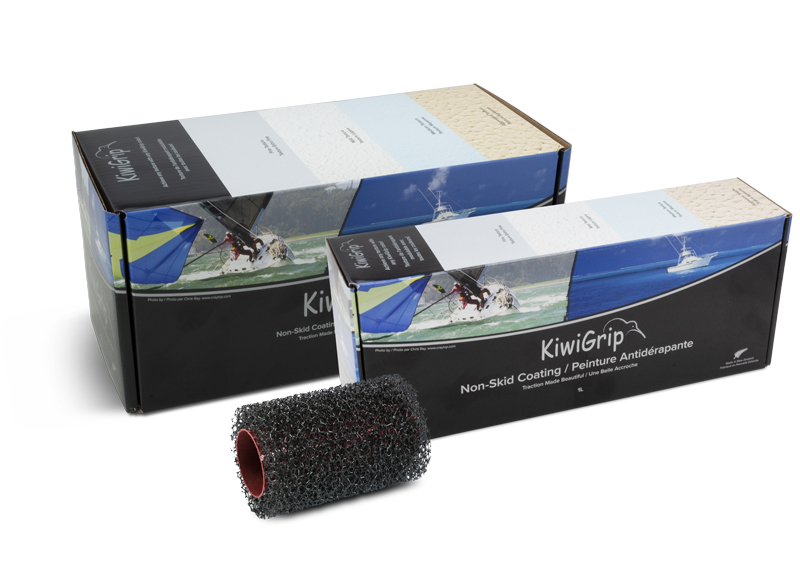
Regardless, KiwiGrip is already one of the options in my (very) short list... :encouragement:
 
Thanks Bouba, I did see some videos, but not yet this one.
Regardless, KiwiGrip is already one of the options in my (very) short list... :encouragement:
Mapism, what did you think of kiwigrip after watching bouba's link? I gotta say, I didn't like it. It was just too rough and it might be ok in grey on a workboat but in white on a med boat it is just going to look dirty all the time imho. I much preferred the diamond sheet gel coat method in the how to videos linked above.
 
Hi J, I see what you mean in principle, but as it happens, a few days ago I had the opportunity to see and try (I mean, walk on it barefoot) a boat that my usual yard (well known also to Deleted User) refitted completely, using that stuff for all the antiskid parts.
And you know what? The final result is outstanding - to the point that if I had a chance to choose between it and a deck originally made with the gelcoat diamonds pattern when moulding the deck, I would be in doubt!
I'm now in the airport waiting to fly back home, but I took some pics and will post them asap - though I'm sure that also after my pics you will still have the same impression you had from the video Bouba linked.
It's only after seeing a real boat refitted with that material, and walk on her, that I was sold. Amazing stuff indeed.
Btw, at the yard they also assured me that it's much less of a dirt trap compared to the gelcoat diamonds pattern - and while obviously I can't (yet) confirm this first hand, I have no reasons to doubt what they told me...
 
Hi J, I see what you mean in principle, but as it happens, a few days ago I had the opportunity to see and try (I mean, walk on it barefoot) a boat that my usual yard (well known also to Deleted User) refitted completely, using that stuff for all the antiskid parts.
And you know what? The final result is outstanding - to the point that if I had a chance to choose between it and a deck originally made with the gelcoat diamonds pattern when moulding the deck, I would be in doubt!
I'm now in the airport waiting to fly back home, but I took some pics and will post them asap - though I'm sure that also after my pics you will still have the same impression you had from the video Bouba linked.
It's only after seeing a real boat refitted with that material, and walk on her, that I was sold. Amazing stuff indeed.
Btw, at the yard they also assured me that it's much less of a dirt trap compared to the gelcoat diamonds pattern - and while obviously I can't (yet) confirm this first hand, I have no reasons to doubt what they told me...
Ah great. I was going just on the video but if you have seen the real deal then great. Good to hear!
 
Soooo.... Here's a couple of pics I took, trying to better show the pattern of this Kiwigrip thing.

Though in hindsight I realize that it's absolutely impossible to give the right impression of how the finishing looks in flesh - not to mention how it feels under bare feet.
If anything, I would expect that these pics will strengthen your impression that it's too rough for a pleasure boat...?
But the boat in the pics is an old-ish fast sportboat, 30' or so, originally built in white gelcoat and completely repainted in metallic grey with the KG stuff (PERFECTLY color matched) on the swim platform, walkaround, etc.
And the overall visual impact was very, very nice, with the boat that now really looks like she came out of the yard that way.

Ref the feeling, my official tester (a very fastidious one, aka swmbo :D) was initially well impressed by the aesthetical appearance, then she reconsidered a bit after touching the surface with the palm of her hand, but eventually found it perfectly comfortable after walking barefoot on the surface. :encouragement:
In fact, I guess this might sound weird, but the roughness feeling is a tad too much on the hand, but absolutely fine on feet.

KG1.jpg


KG2.jpg
 
Looks fine ,the peaks seem a bit taller and more irregular than what we have .
Are there different applicator techniques -roller /brush size etc --dunno ?
Just to dispel any myth,s even though ours is cream /off white. It keeps clean -i would not say it attracts dirt or is diff to clean --very easy to hose off .
But I don,t know exactly what stuff we have ,it's similiar --it's not paint + grit -texture is from the "peaks"

As mentioned it seems to look better a different colour by a shade or two ,to surrounding ,but that changes in direct sun becomes lighter and blends in .
 
Are there different applicator techniques -roller /brush size etc --dunno ?
Application is by roller only, and it has to be a specific one (sold together with the stuff), because its surface has a pattern which is essentially replicated, while spreading the stuff with the roller, on the surface which is being treated.
I understand that they even offer a choice of different rollers, depending on the rough-ness desired, but the yard which did the above job told me that there's one of them which is the best, and by far the more widely used.
 
exactly that type of finish was on BA when we purchased her,
on top of the side deck overhangs and on the rooftop of the lower helmstation.
I really liked that finish, when I occasionally walked on it, and never found the same product (it was redone with something else during the first refit in Rome)

so yes, can absolutely confirm on the use of that stuff.
except up in the corners.
 
Don't know if you've come across this site which features a number of how-to videos?
The following links to an index of various topics covered.
www.boatworkstoday.com/video-page

One, for example, shows the application of Awlgrip soft sand rubber non-skid - pic & video link below.

11001.jpg


Simple quick links to some other topics which might be worth a view if nothing better to do :-
All are www.boatworkstoday.com/archives/ followed by relevant number.
Awlgrip non-skid, as above - 1710
Removing teak deck - 1872 (shows overview + actual removal video etc.)
Applying gelcoat - 1524
Gelcoat matching - 1508
Gelcoat matching part 2 - 1512
Sanding & finishing gelcoat - 1527
Making a non-skid mould - 1811
 
Last edited:
so yes, can absolutely confirm on the use of that stuff.
except up in the corners.
Thanks B, good to have another thumb up from first hand experience! :encouragement:
I'm just not sure to understand what you mean with your exception... :confused:
 
I'm just not sure to understand what you mean with your exception...

I mean the detail that is discussed so much in the earlyer posts in this thread;
what to do with the 10mm vertical border (thickness of the teak) that was covered by the teak, and that might be not smooth after taking away the teak,

imo this vertical border must be smooth,
and there needs to be approx 5cm horizontal border also smooth, and not covered by antislip
how to create that smooth surface ?
 
Aha, got it, thanks.
And yep, that's well understood.
I don't have an answer to your last question (yet), but hopefully I should soon hear about that, too... :encouragement:
 
The die is cast

Here's a couple of pics taken during work in progress, just in case anyone (like myself) is also interested in what is behind the final result of a refitting job.
In the meantime, all teak has been stripped and the deck is ready for the next steps.

Apropos, to answer the previous BartW question, the plan is as follows:
- removal of all the remaining gelcoat;
- filling/smoothing of the deck surface as necessary;
- epoxying of the whole deck;
- painting with urethane topcoat (suggestions on brands/type welcome), colour matching the existing gelcoat;
- KiwiGrip laying.

Walkaround.jpg


Bow_1.jpg
 
Re: The die is cast

- removal of all the remaining gelcoat;

why P.?
remove the gelcoat and go down to the mat??? is it necessary? Wouldn't just an abrasion work as a key to the next coats?

are you going to remove all deck fittings (fairleads, cleats)?
If so, you'll have to fabricate spacers to bring them up the level they should be in order to work properly, right?

out of curiosity, how thick was the teak and on the worn out bits, was the teak to glue area affected?

cheers

V.
 
Re: The die is cast

Hi V, following the order of your questions:

Gelcoat removal wasn't really necessary on paper, but the very high residual Sika adhesion meant that in places the gelcoat came away with the wood removal, no matter how careful they tried.
So, we decided with the builder that it's worth going for the full treatment.

Yep, all hardware still in place in the pics was already removed in the meantime, but no, there's no need to use spacers.
We checked that everything will work equally well if installed about 10mm lower - which in turn answers your second to last question.

Ref your very last one instead, do you mean if the teak was worn out in places enough to reach the Sika underneath?
If so, not really, but in places the seams were beginning to detach, and making just patch repairs would have meant just postponing the problem.

The obvious alternative would have been rebuilding the teak planks, which in terms of deck preparation could have been simpler, not necessarily stripping the gelcoat and epoxying the deck.
But as you know (even if I'm a bit embarassed to tell this to yourself! :o), getting rid of some maintenance burden also for the future was one of the main reasons for downgrading to a plastic boat, to start with... :rolleyes:
 
Re: The die is cast

Here's a couple of pics taken during work in progress, just in case anyone (like myself) is also interested in what is behind the final result of a refitting job.
In the meantime, all teak has been stripped and the deck is ready for the next steps.

Apropos, to answer the previous BartW question, the plan is as follows:
- removal of all the remaining gelcoat;
- filling/smoothing of the deck surface as necessary;
- epoxying of the whole deck;
- painting with urethane topcoat (suggestions on brands/type welcome), colour matching the existing gelcoat;
- KiwiGrip laying.

and suddenly the job seems much simpler and much more straight forward than previously expected / discussed on here,
good that you found someone to do that, and take on this job so quickly
good luck with it !
 
Top