
Recrimping?

P, how were the connections made on your boat?
How would you improve the ones in my pic?
Ref. possible improvements, TBH I'm not sure I'd bother recrimping everything in absence of any problems.
Though the size of your wires makes me think that they are meant to carry some decent current (albeit DC, surely), which makes hard to understand the choice of not fully insulating the connectors.

There are fully enclosed cases designed for that type of connectors, which can be fitted also if they are already crimped (like this, just as the first example I googled for), but I think you should remove those small blue plastic insulations around the crimped part of the spade connectors first, and it might be tricky to do that without damaging also the metal.

Back to your first question, below is how buttons and switches look like, behind my dashboard.
'Scuse the loose cabling, the pic was taken before they were reordered a bit.
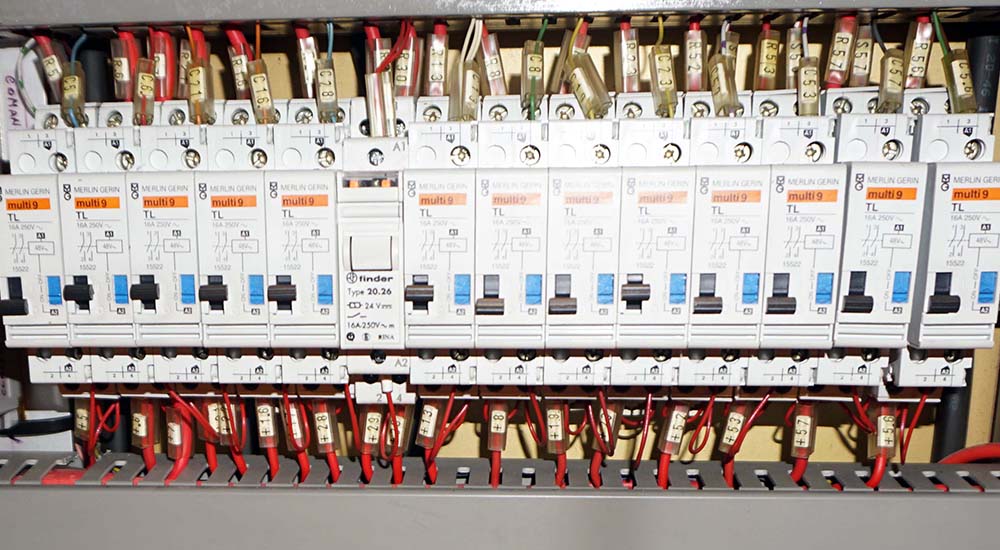
What is relevant is that all of them, bar none, are just contacts controlling a set of remote relais, hidden inside the electrical panel (the second pic shows some of them). So, the current they handle is close to none - milliamps, I would guess. Probably, the led inside them is what demand more current...
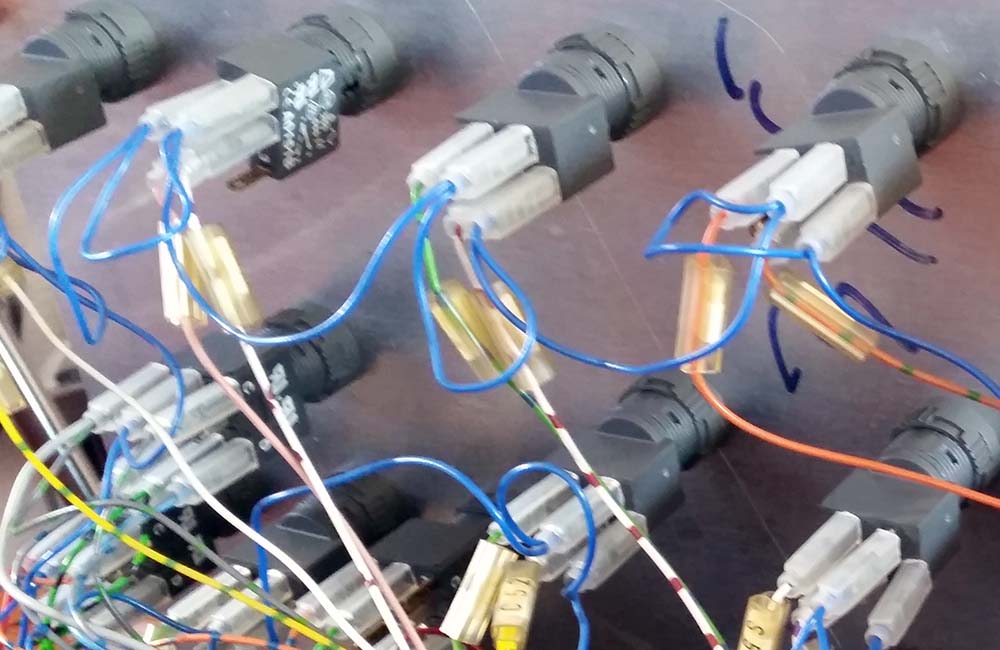
xFsJfmX1_o.jpg


MCDbNdnL_o.jpg
 
Ref. possible improvements, TBH I'm not sure I'd bother recrimping everything in absence of any problems.
Though the size of your wires makes me think that they are meant to carry some decent current (albeit DC, surely), which makes hard to understand the choice of not fully insulating the connectors.

I'm pretty certain that most, if not all of the 12v wiring on the boat has that gauge of cable. A lot of it is colour coded (bilge pumps wiring for example is a particular colour) and Fairline have used the same colour coding for years. I should find out if someone has the key.

There are fully enclosed cases designed for that type of connectors, which can be fitted also if they are already crimped (like this, just as the first example I googled for), but I think you should remove those small blue plastic insulations around the crimped part of the spade connectors first, and it might be tricky to do that without damaging also the metal.

Thanks, I'll take a look at that (I'm quite willing to re-crimp if that would help).

But having read all these replies, I think I'll clean the switch terminals, check all the spade connectors and spray with Waxoyl. Plus get to the bottom of the broken indicator light.
 
Typical Italian engineering echoed throughout the build. Then people question why they are more expensive.

Yet Sealine who used all colour coded looms fitted with multi-pin plug and sockets, get a cheap branding.

Problems of being British.

Brian
 
Incidentally, would a Pershing for example be wired to the same standard?
Do tell P, considering one of them as your next boat? :rolleyes:
Can't answer your question anyway, because I never checked a Pershing electrical panel.
But I did with several Ferrettis, and they are similarly good - in fact, afaik both FG and DP used the same specialized company for most of their electrical systems.
 
Do tell P, considering one of them as your next boat? :rolleyes:
Can't answer your question anyway, because I never checked a Pershing electrical panel.
But I did with several Ferrettis, and they are similarly good - in fact, afaik both FG and DP used the same specialized company for most of their electrical systems.

As much as I like Pershing 37's, I think it would be one step forwards and one back. Whilst the Pershing is on shafts, has more deck space, a better bathing platform and a pasarelle is has less accommodation down below and no doubt much higher fuel burn than our T34.

Whatever is the next Pershing size up would be lovely but sadly for a wage slave like myself is beyond my means.
 
On the subject of crimps, I believe the best ones available these days are the heat shrink ones. Elessar recommended these on another thread - https://www.12voltplanet.co.uk/80-piece-heat-shrink-pre-insulated-crimp-terminal-kit.html. With a decent set of wire strippers and ratchet crimps, I'd suggest that this is as good a way or joining two wires as you can get.

I would still want to add a heatshrink (adhesive) to those exposed female spade connectors. For me I would simply use normal crimp connectors and then add a heatshrink covering the connector and the wire.
 
I would still want to add a heatshrink (adhesive) to those exposed female spade connectors. For me I would simply use normal crimp connectors and then add a heatshrink covering the connector and the wire.

I agree, the 12vplanet ones that I linked to above don't actually solve the bare spades issue that was the subject of my original post. One issue that I do have is that I don't have a heat gun and it's a bit too bulky for occasional use (boat is in Spain). Plus I really don't like using a naked flame either in enclosed spaces. I guess a cheap soldering iron might do the job (but then I need extension cables, etc).
 
Agree, I wouldn't like using a naked flame in enclosed spaces. A heat gun is no larger than a hair dryer without the case, I would simply buy one and put it in the suit case and bring it back with you. I don't keep heat gun on my boat as you say not going to be used often.
 
I agree, the 12vplanet ones that I linked to above don't actually solve the bare spades issue that was the subject of my original post. One issue that I do have is that I don't have a heat gun and it's a bit too bulky for occasional use (boat is in Spain). Plus I really don't like using a naked flame either in enclosed spaces. I guess a cheap soldering iron might do the job (but then I need extension cables, etc).

I use (and keep on the boat) something very like this to shrink the tubing: https://www.12voltplanet.co.uk/portasol-propiezo-75-gas-soldering-iron-kit.html
 
I keep on cooking the tips on my butane soldering iron. I find it very easy to overheat the darn things turning the tip from conductor to insulator. Numpty I know, but it's frustrating.
 
Ref. possible improvements, TBH I'm not sure I'd bother recrimping everything in absence of any problems.
Though the size of your wires makes me think that they are meant to carry some decent current (albeit DC, surely), which makes hard to understand the choice of not fully insulating the connectors.

There are fully enclosed cases designed for that type of connectors, which can be fitted also if they are already crimped (like this, just as the first example I googled for), but I think you should remove those small blue plastic insulations around the crimped part of the spade connectors first, and it might be tricky to do that without damaging also the metal.

Back to your first question, below is how buttons and switches look like, behind my dashboard.
'Scuse the loose cabling, the pic was taken before they were reordered a bit.
What is relevant is that all of them, bar none, are just contacts controlling a set of remote relais, hidden inside the electrical panel (the second pic shows some of them). So, the current they handle is close to none - milliamps, I would guess. Probably, the led inside them is what demand more current...
xFsJfmX1_o.jpg


MCDbNdnL_o.jpg

Italian boat wiring porn. One thing Cranchi did well is wiring... main distribution board is something to awe over. I love flipping down the panel and showing it to people.

Also, on the Smeraldo, they ran 'fish' / 'chase' string to other parts of the boat. A norm on big boats, but very impressive on a 37ft.

Chao!!
 
Nope, sorry. Back then, I only had very little time for boating, and I didn't do much more than turn the keys on and release the lines, whenever I could steal a couple of days to the rat race!
 
Top