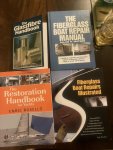
Recommendations for books on GRP repairs?

I have found the west system manuals good. The one I've go I picked up years ago at a boat show. Whist dated a lot hasn't changed.
I only use epoxy for repairs though some use polyester resin.
Which ever resin you decide to use have a go at using it before doing a repair.
 
I’ve got Hugo DuPlessis’ book but I want to read further.

This is a list of little tasks:

a) I need to replace the gas bottle locker lid. The original one was GRP and at some point in the boat’s long life it was replaced with a plywood one which is now rapidly becoming compost. I’ve saved the catches. Making a new GRP one seems like a nice project.

b) I want to get all the grotty deck paint off. As I do so a few hairline cracks in the deck gel coat appear. I assume these are not structurally significant but I want to at least seal them. The decks are balsa core. Fitting a windlass resulted in a sample which was fine for that location.

c) I want to replace some ball valves with Blake’s seacocks, and make sure the backing pads are OK.
 
Don't worry too much, its not rocket science. Working on a wood hull requires far higher levels of skill and knowledge.

Polyester resin is fairly tolerant of hardener rations up to 10% max. in cold conditions. However more hardener gives a weaker finished product. I think I have picked up the knowledge from magazine articles and small jobs over the years.

When my catamaran was slewed in its marina berth in storm conditions it managed to chew a hole through one of the bows against a mooring cleat. Obtained materials from a local fibreglass company, made a mould on the good hull, cut the damage back to sound on the damaged hull with a taper, self tapping screws to hold the mould over the damaged area, treated with release agent, then laid up a new section starting with gel coat and good overlap to existing hull. No problem identified a few years later by a buyer's surveyor.

Previously, I made a set of dorade boxes using a plastic food storage box as the mould, and many years ago three of us borrowed a mould and made three pram dinghies over three evenings. The mould loan came free from the material supplier. Hull was still sound when I gave it away over thirty years later.

You will need to make/find a mould for your new locker lid first.
 
Last edited:
West Systems used to run short courses which received good comments. One of the teaching projects was to make something similar to a gas bottle locker, knock a hole in it and repair it. If they still run them you could do a lot worse than go on one.
 
YouTube is your friend.

Anything worth saying or sharing in a practical sense is now filmed on there rather than being put into print. Admittedly there is more than a fair proportion of wrong or woefully opinionated shite on there, but dig hard enough and there is lots of world class instruction on these topics. Although for epoxy rather than polyester work, these videos might both be of some interest, but also shows the incredibly high standard of some YouTube content. ( https://www.youtube.com/user/easycompositestv ).

Making your gas locker lid is an excellent project and they'll be lots of videos about simple one-off mould making. Curing hairline cracks in gelcoat before painting will also be covered in depth. (Hint - you'll need the patience of Job).

Finally why on earth would you want to fit Blakes through-hulls unless you either own a full set already or you at least own a lot of shares in the company? I went from a life of specifying and fitting nothing but Marelon valves since the 1980s to now in retirement owning a boat full of original Blakes. It's like life has played some cruel joke on me. Thirty five years of trouble free perfection has been replaced by lapping, servicing, dripping, jamming, seizing monstrosities. People who think Blakes are 'the answer' think that 1970s MGB are 'good cars'. They were both 'of their time' and that time has gone. Being nostalgic for an MGB is at least understandable but a sea-cock?
 
In the Nicholson world, is ther another owner who would allow you to make a mould off their hatch? This would be the simplest way to get it right first time.

Amongst the Nic 55s that I know, two are composite built and so have different deck arrangements, our twin sister has also lost hers, has an almost equally grotty ply one and is a customer for a replacement (!) and you have just made me drop a line to the last sister in case she still has hers… Thanks for the idea.
?
 
I’ve got Hugo DuPlessis’ book but I want to read further.

This is a list of little tasks:

c) I want to replace some ball valves with Blake’s seacocks, and make sure the backing pads are OK.
I would use 'plastic' skin fittings and ball valves such as Trudesign from New Zealand. Very nearly fit and forget.
 
Is your boat the prior JSSC Nic 55 'Kukri' ?

Marvellous boats with very very high miles logged giving adventurous trying to many, and for quite a few their first introduction to our marvellous hobby.
 
Is your boat the prior JSSC Nic 55 'Kukri' ?

Marvellous boats with very very high miles logged giving adventurous trying to many, and for quite a few their first introduction to our marvellous hobby.

Yes she is. I’m always interested in her history. Seems to have been twice (?) round the block, commuted across the Atlantic, all around Europe and done most Fastnets in the last forty-odd years.
 
Top