
You are using an out of date browser. It may not display this or other websites correctly.
You should upgrade or use an alternative browser.
You should upgrade or use an alternative browser.
Recommend me a hand held VHF
- Thread starter Buck Turgidson
- Start date
SeasickPete
Active Member
I got a ICOM IC-M94DE with AIS receiver, GPS, DSC etc. I quite like it apart from the fact that you cannot charge it whilst powered on according to the manual. No real issue as I mainly do day sailing on the Dutch inland lakes. I definitely fall in category, buy the best one you can afford. It is probably overkill for my situation but it is the only VHF I have onboard and figured I might as well splurge a bit and get the fanciest one. Now I don't need to buy a separate handheld GPS or AIS receiver which justifies the additional costs for me. Note that I sail a Hunter Formula One and the only semi permanent installed electricals are battery operated cabin lights and the ignition coil on my outboard.

Mark-1
Well-Known Member
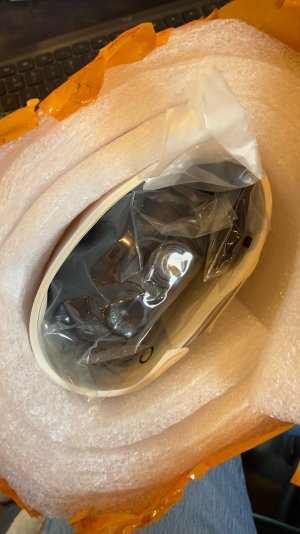
Ali express icom M25 ordered 15th March, arrived today, 25th March.
Not boxed but seems like it might be genuine.
£43 total.
M
"Float'n Flash" felt like a gimmick to me....
,,,,right up until the point I dropped it off a paddleboard.

Biggles Wader
Well-Known Member
I have just ordered the same-----£40 after a £6 discount. Interested to see what turns up!Ali express icom M25 ordered 15th March, arrived today, 25th March.
Not boxed but seems like it might be genuine.
£43 total.
M

Alicatt
Well-Known Member
I have a Hunter too, albeit a Broom Ocean 37 called Hunter that originally came from the Netherlands. With the changes coming to the waterways in Belgium I'm glad to have the AIS and VHF as looking at the new app the Vlaamsewaterweg have leaves a bit to be desired.I got a ICOM IC-M94DE with AIS receiver, GPS, DSC etc. I quite like it apart from the fact that you cannot charge it whilst powered on according to the manual. No real issue as I mainly do day sailing on the Dutch inland lakes. I definitely fall in category, buy the best one you can afford. It is probably overkill for my situation but it is the only VHF I have onboard and figured I might as well splurge a bit and get the fanciest one. Now I don't need to buy a separate handheld GPS or AIS receiver which justifies the additional costs for me. Note that I sail a Hunter Formula One and the only semi permanent installed electricals are battery operated cabin lights and the ignition coil on my outboard.
I have a test and evaluation version of the app on my phone, it was not without problems, but those bugs that I found have now been rectified. Still it only applies to boats registered in Belgium, the way it looks just now is that foreign boats will have to use AIS and VHF to navigate the waterways, and will be compulsory to use the app or the VHF+AIS come July 1st.
Bird_Brain
New Member
Ali express icom M25 ordered 15th March, arrived today, 25th March.
Not boxed but seems like it might be genuine.
I have just ordered the same-----£40 after a £6 discount. Interested to see what turns up!
They are not genuine. Someone did a teardown and writeup on it.
Mark-1
Well-Known Member
They are not genuine. Someone did a teardown and writeup on it.
link?
Bird_Brain
New Member

Dockhead
Well-Known Member
Link?They are not genuine. Someone did a teardown and writeup on it.
Here something: Beware of Counterfeit Icom IC-M25 Euro Marine Radios - Press2Talk
But the main thing -- are the counterfeit ones actually inferior? Or do they work OK?
st599
Well-Known Member
Without a type approval, the counterfeit ones are illegal to transmit on using a marine licence.Link?
Here something: Beware of Counterfeit Icom IC-M25 Euro Marine Radios - Press2Talk
But the main thing -- are the counterfeit ones actually inferior? Or do they work OK?
Mark-1
Well-Known Member
Mark-1
Well-Known Member
But the main thing -- are the counterfeit ones actually inferior? Or do they work OK?
I'm also curious about the differences in components/performance but the fact the one in the vid was actually missing some components for the immersion flash proves there *are* hardware differences which is good enough for me to discount the idea of buying one.
Plus Icom customer service has been amazing for me, they won't be fixing 15yo counterfeits for free without proof of purchase. (Which they did for me.)
Bird_Brain
New Member
The main thing -- are the counterfeit ones actually inferior? Or do they work OK?
Without a type approval, the counterfeit ones are illegal to transmit on using a marine licence.
Correct.
In the grand scheme of owning a boat, the legitimate radios are not expensive. They are also important safety devices. It seems a non-optimal decision to be operating a device that isn't bonafide, for the sake of saving £100.
Dockhead
Well-Known Member
I dunno.Correct.
In the grand scheme of owning a boat, the legitimate radios are not expensive. They are also important safety devices. It seems a non-optimal decision to be operating a device that isn't bonafide, for the sake of saving £100.
That's certainly a strong argument for a device used as a primary radio. But for someone who already has a GPS and DSC equipped primary handheld, and just needs an extra device or two for crew and guests, could be OK.
We spent a summer in Greenland some years ago, in a remote area with no mobile telephone service. Handheld marine VHF's were the main means of comms, practically the only means besides the satphone. For the locals as well, who called them "Greenland telephones".
Bird_Brain
New Member
That's certainly a strong argument for a device used as a primary radio. But for someone who already has a GPS and DSC equipped primary handheld, and just needs an extra device or two for crew and guests, could be OK.
Each boat owner / skipper should make their own decision, based on their circumstances.
For me, I would consider a handheld VHF a safety backup if the primary onboard radio stops working. So I'd want an official device.
FWIW I have just bought an ICOM M25 Evo. I did do a fair amount of research and thought on it, including going down the aliexpress rabbit hole. Some of my thoughts:
* I am a licenced marine radio operator, I should be using licensed equipment.
* I also have a ham licence, so ditto.
* I want to trust my equipment will have the best chance of working correctly.
* unapproved radio equipment can cause interference on other channels or other devices, including navigation equipment, and emergency service communication and opperation.
* counterfeit devices do no one any favors. Trust goes down.
* the newer m25 Evo has usb-c charging.
* I bought my Evo version radio from an established UK business.
* The market is flooded with counterfeit m25 Euro radios. Unscrupulous people are selling the counterfeit Euro versions on, for example, ebay. Buyer beware!
Frank Holden
Well-Known Member
What I have and why.
My fixed VHF is a SH(Yaesu) maybe 25 years old, no DSC.
My handheld is a 10 yo(?) SH with DSC.
It is kept charged but is rarely turned on when sailing in coastal waters.
If things turn to custard I can take the handheld DSC with me in the raft or dinghy.
In that sort of emergency situation VHF DSC is simply the best way of getting attention in the waters in which most of us sail- not to suggest that an EPIRB is redundant. Anything but in the more remote areas.
As stated before by someone else the range is a combination of your ant height and the height of the other fellow's ant.
My fixed VHF is a SH(Yaesu) maybe 25 years old, no DSC.
My handheld is a 10 yo(?) SH with DSC.
It is kept charged but is rarely turned on when sailing in coastal waters.
If things turn to custard I can take the handheld DSC with me in the raft or dinghy.
In that sort of emergency situation VHF DSC is simply the best way of getting attention in the waters in which most of us sail- not to suggest that an EPIRB is redundant. Anything but in the more remote areas.
As stated before by someone else the range is a combination of your ant height and the height of the other fellow's ant.

wonkywinch
Well-Known Member
Not convinced DSC is useful in coastal waters, the alerts, certainly in the Solent, are so common as to generally be ignored.What I have and why.
My fixed VHF is a SH(Yaesu) maybe 25 years old, no DSC.
My handheld is a 10 yo(?) SH with DSC.
It is kept charged but is rarely turned on when sailing in coastal waters.
If things turn to custard I can take the handheld DSC with me in the raft or dinghy.
In that sort of emergency situation VHF DSC is simply the best way of getting attention in the waters in which most of us sail- not to suggest that an EPIRB is redundant. Anything but in the more remote areas.
As stated before by someone else the range is a combination of your ant height and the height of the other fellow's ant.
A pro word (pan or mayday) on CH16 is sure to prick the ears of everyone in radio range. The DSC with position and MMSI would then be useful info for CG. I know this is not the recommended way round but in an emergency I want someone on the way asap, not a hundred fingers pressing the "cancel alert" button and going about their day.
Since it is so busy in the Solent, I end up with the main VHF on tri watch, CH16, CH12 (Soton VTS) and CH68 (Hamble River) and the handheld to hand to speak to the marina on CH80 if I'm short handed and want them to pop down and catch a line.
Listening out on CH16 and CH12 in the Solent brings a lot more situational awareness especially if I intend to tack through the precautionary area.
Last edited:
Dockhead
Well-Known Member
Mostly agree with all of this, but in my particular case I DO have a fully licensed proper certified marine VHF -- a Standard Horizon HX870 with DSC. Definitely, ONE handheld at least, should be proper, top quality, and all that, to serve as backup. Whether the third and fourth VHF radios on board need to be at that standard is a different question. Legally, of course, yes.Each boat owner / skipper should make their own decision, based on their circumstances.
For me, I would consider a handheld VHF a safety backup if the primary onboard radio stops working. So I'd want an official device.
FWIW I have just bought an ICOM M25 Evo. I did do a fair amount of research and thought on it, including going down the aliexpress rabbit hole. Some of my thoughts:
* I am a licenced marine radio operator, I should be using licensed equipment.
* I also have a ham licence, so ditto.
* I want to trust my equipment will have the best chance of working correctly.
* unapproved radio equipment can cause interference on other channels or other devices, including navigation equipment, and emergency service communication and opperation.
* counterfeit devices do no one any favors. Trust goes down.
* the newer m25 Evo has usb-c charging.
* I bought my Evo version radio from an established UK business.
* The market is flooded with counterfeit m25 Euro radios. Unscrupulous people are selling the counterfeit Euro versions on, for example, ebay. Buyer beware!
Very small quibble with your post -- you are a licensed amateur, but that does not indeed mean you have to use "licensed equipment". There is no such equipment, for the amateur bands. As a licensed amateur, I'm sure you know that no license or certification is needed for any equipment used or even exists for the amateur bands. And no station license. Just the operator needs to be licensed. If the operator is licensed, he can operate on a rig ginned up out of baling wire and old vacuum tubes, if he can make it work on the permitted frequencies. Kind of the point of amateur radio.
Dockhead
Well-Known Member
DSC is a fantastic system, and it's only disadvantage is that so few people use it.Not convinced DSC is useful in coastal waters, the alerts, certainly in the Solent, are so common as to generally be ignored.
A pro word (pan or mayday) on CH16 is sure to prick the ears of everyone in radio range. The DSC with position and MMSI would then be useful info for CG. I know this is not the recommended way round but in an emergency I want someone on the way asap, not a hundred fingers pressing the "cancel alert" button and going about their day.
Since it is so busy in the Solent, I end up with the main VHF on tri watch, CH16, CH12 (Soton VTS) and CH68 (Hamble River) and the handheld to hand to speak to the marina on CH80 if I'm short handed and want them to pop down and catch a line.
Listening out on CH16 and CH12 in the Solent brings a lot more situational awareness especially if I intend to tack through the precautionary area.
One of its several great benefits is that it obviates the requirement to hail on 16. The called party is invited directly to the working channel.
Another is that a vessel called by DSC gets an alarm; he doesn't have to be on 16 listening for his vessel name. I've not rarely encountered commercial vessels which don't answer a voice hail on 16 but do answer on DSC.
st599
Well-Known Member
The good thing about DSC alerts is that you can instantly see where they are on the plotter.
I upgraded the VHFs recently as we often sail to the continent and we needed the new split channels and channel 31 plus ATIS.
I upgraded the VHFs recently as we often sail to the continent and we needed the new split channels and channel 31 plus ATIS.