
re-using pencil anode fitting

dutyhog

Well-Known Member
Joined
13 May 2009
Messages
250
Location
Argyll, Scotland
Visit site
I've been re-using pencil anode fittings for some years, by removing the worn zinc pencil stub and pushing in new zinc from a rod of it bought years ago. But several of them don't want to come out. Photo below.

I tried drilling out one, but I don't have a pillar drill and the drill wandered too much. I suppose it can be removed by acid or electrolysis somehow.

The expansion coefficient of zinc - 31 - is greater than that of of bronze - 17 - so heating will just hold it in firmer. But maybe heating it a lot would let it pour out - zinc melts at 420 deg C and bronze at 927 deg C. This sounds dangerous to do on the garage bench - fumes, fire ... Anyone have a good idea? Gordon
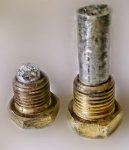
18072013135edited.jpg
 
Last edited:
I've been re-using pencil anode fittings for some years, by removing the worn zinc pencil stub and pushing in new zinc from a rod of it bought years ago. But several of them don't want to come out. Photo below.

I tried drilling out one, but I don't have a pillar drill and the drill wandered too much. I suppose it can be removed by acid or electrolysis somehow.

The expansion coefficient of zinc - 31 - is greater than that of of bronze - 17 - so heating will just hold it in firmer. But maybe heating it a lot would let it pour out - zinc melts at 420 deg C and bronze at 927 deg C. This sounds dangerous to do on the garage bench - fumes, fire ... Anyone have a good idea? Gordon

View attachment 33746

I'd melt it out; a blow-torch would do it. Do it in the open-air and keep upwind of it and you should be fine. A dust mask would help as well. Otherwise, I THINK Hydrochloric acid (available as brick cleaner) would dissolve the zinc before attacking the bronze. After all, that's the standard lab method of generating hydrogen; what I'm not absolutely sure of is that it won't affect the bronze.

Nice that you've got the option of using a plain zinc rod; mine has a threaded hole that the brass carrier screws into, so you have to buy them from Volvo at slightly silly prices!
 
The expansion coefficient of zinc - 31 - is greater than that of of bronze - 17 - so heating will just hold it in firmer. Anyone have a good idea? Gordon

In that case would a night in the freezer loosen the zinc? I have no idea whether it would work.
 
I'd melt it out; a blow-torch would do it. Do it in the open-air and keep upwind of it and you should be fine. A dust mask would help as well. O

Thanks - I'll try that, hoping my blowtorch is powerful enough.

Nice that you've got the option of using a plain zinc rod; mine has a threaded hole that the brass carrier screws into, so you have to buy them from Volvo at slightly silly prices!

Maybe the originals were threaded - I'll see if all the zinc comes out. But even so, a push fit for the new rod (eg squeezed in a vice) could still be good enough.

Gordon
 
Last edited:
In that case would a night in the freezer loosen the zinc? I have no idea whether it would work.

Thanks for the suggestion, and it's easy to try, but it would only differentially shrink by a very small fraction of a mm, so I doubt if that would loosen it enough. I used to work with liquid nitrogen - that would have been worth a try with about 0.5mm relative shrinkage.

Gordon
 
Last edited:
Is that a Beta anode? If so, some seem to be pressed and others threaded. I drill mine out, and have a scrape with a small screwdriver to clean up the thread as much as possible, but would be interested to hear if you find an easier way. It is easier to catch the anode with a bit left on it as a pair of pliers will unscrew it.
 
Where do you buy the zinc rod? My Beta anode lasted 43 hours...that's expensive at £17 a replacement.
 
Thanks - I'll try that, hoping my blowtorch is powerful enough.


Maybe the originals were threaded - I'll see if all the zinc comes out. But even so, a push fit for the new rod (eg squeezed in a vice) could still be good enough.

Gordon


On the Volvo, the anode has a female thread and the carrier a male one. So, the anode really does have to be threaded.
 
Thanks again for all the suggestions.

I tried a left handed drill extractor, but no luck. Heat did the trick - the blowlamp melted the zinc quickly, then I tipped it out holding the bronze with big pliers. I cleaned up remaining traces of zinc by pouring in vinegar and leaving it for about 15 minutes (tried that because I recently restored an old brass clock, and used vinegar/salt/flour paste to get it into a condition where Brasso was useable).

I'd bought zinc rod from Lathom http://www.zincsmart.com/ who are a very helpful supplier. I had it cut and turned down by a local machine shop to give enough anodes to last for many years. You don't need to cut them to the same length as Beta supply if their consumption each year is somewhat less than the whole stub, but too much to keep in for the next year.

The insides of the stubs that I'm recycling are a mixture of plain and threaded. Some of my turned down anodes were a bit too loose a fit, but I just squeezed then a bit oval, then squashed them in with the bench vice. I don't think that it matters if the hole is threaded, the zinc makes plenty of contact.

Gordon
 
Top