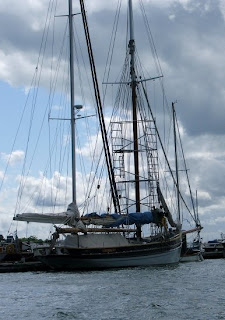
re-reeving halyards, with mast up?

Robert Wilson

Well-Known Member
Joined
23 May 2012
Messages
8,053
Location
Second Coast, Ross-shire, overlooking Gruinard Bay
Visit site
Somehow my main halyard and topping-lift have become entwined within the mast. Also the main enters the mast on port and exits on starboard (topping-lift vice versa)
Apart from increased friction it appears that there is a structural cross-member near the top (10 cm below the top sheeves which is causing damage to the rope).

Any bright sparks know how I can re-reeve the two bits of string? I can climb the mast and remove the top sheeves but how do I get a messenger line down to the entry sheeves (which have restricted access to inside the mast)?
I tried dropping down a fishing weight on a thin feeder line but I couldn't see/ capture the weight at the entry point. I know it reached somewhere near because when I re-threaded the halyard the weight became jammed in the entry sheeve. Much cursing (and tremendous good luck) managed to extricate it.Phew!
I have a long length of "electricians wire threading flexible rod" which I'll try with today, but after that I'm stumped.

As usual, thanks in anticipation.

RW
 
One way to try and capture the mousing line you feed down the mast by gravity is:

Get a suitable cable tie, done up, but with a tag you can hold on to, squash it flat and feed it your "exit" slot. The cable tie should expand in a circle, when the line drops past it, with its weight on, just pull the tie back out.

Works for us, but explaining it in writing is a challenge
 
There is an article in the Haynes Manual on Masts and Rigging by M.Shehan on how to disentangle halyards. Unfortunately I am not able to photocopy until 4th. July. If you are still stuck, PM me then.
 
One way to try and capture the mousing line you feed down the mast by gravity is:

Get a suitable cable tie, done up, but with a tag you can hold on to, squash it flat and feed it your "exit" slot. The cable tie should expand in a circle, when the line drops past it, with its weight on, just pull the tie back out.

Works for us, but explaining it in writing is a challenge
Neat trick :)
 
Judging by the frustrating lack of success and progress from which I am suffering I reckon I shall be needing your kind help! I'll let you know, but thanks for the offer.
Yesterday's efforts failed miserably!

I'm going to try to remove the bottom (entry) sheeve box today, but the screws are locked solid. I'll try heat and then judicious force! If I wreck the screws I'll have to drill-out and/or rivet the box back in.
Desperate measures, but the damage caused to the halyards demands I get it sorted.
Thanks once again.
RW
 
One way to try and capture the mousing line you feed down the mast by gravity is:

Get a suitable cable tie, done up, but with a tag you can hold on to, squash it flat and feed it your "exit" slot. The cable tie should expand in a circle, when the line drops past it, with its weight on, just pull the tie back out.

Works for us, but explaining it in writing is a challenge

Unfortunately the construction of the entry sheeve box means I can't use your idea.
I tried with the flexible wire thingy but I think it started to coil round inside the mast just about where the old boom-roller-reefing assembly goes through the mast at the goose-neck. Also, the wind started to rock the boat and 12 metres above the sea was a very uncomfortable experience and I didn't fancy dropping any of the top sheeve assembly, split pins, cotter-pins etc etc into the briney - so I aborted.
One more attempt today, trying to remove the bottom assembly.
As said above, I can't let this continue, especially as I've just bought a lovely shiny new main halyard and I don't want it ruining!

Thanks for the help.
RW
 
Try again with fishing weights. Try narrower ones or ise multiple fishing shot weights if width is the issue.

I cut down a larger weight and just use the top 8mm plus wire loop.
 
Somebody in the past has suggested using a short length of small chain i.e. bicycle as a weight.
 
Unfortunately the construction of the entry sheeve box means I can't use your idea.
I tried with the flexible wire thingy but I think it started to coil round inside the mast just about where the old boom-roller-reefing assembly goes through the mast at the goose-neck. Also, the wind started to rock the boat and 12 metres above the sea was a very uncomfortable experience and I didn't fancy dropping any of the top sheeve assembly, split pins, cotter-pins etc etc into the briney - so I aborted.
One more attempt today, trying to remove the bottom assembly.
As said above, I can't let this continue, especially as I've just bought a lovely shiny new main halyard and I don't want it ruining!

Thanks for the help.
RW
The mast is deck stepped?
Use weights of magnetic material that can easily pass through the narrow opening (several small steel nuts tied to a string, not as a lump but in a row).
Use a small magnet on a stick (Magnet pickup) to extract the nuts through the opening at the bottom (if mast is deck stepped you can let the string with nuts pile up at the bottom).
If you induce some heel to the side you are working on the weight & reeving line will slid down the mast wall. Enlist some friends to act as movable ballast or use a tackle from the mast to pull the boat over.
 
One way to try and capture the mousing line you feed down the mast by gravity is:

Get a suitable cable tie, done up, but with a tag you can hold on to, squash it flat and feed it your "exit" slot. The cable tie should expand in a circle, when the line drops past it, with its weight on, just pull the tie back out.

Works for us, but explaining it in writing is a challenge

Brilliant, after a couple of hours fiddling with a bent coat hanger, this worked first time.
 
As knuterikt says.
I've used 6mm nuts threaded on a thin messinger and dragged them down the inside of the mast using a powerful seasearcher magnet as I descend the mast, you can then decide which side of the spreader struts the messenger goes. A knot between the nuts helps in articulation.

Plank
 
As knuterikt says.
I've used 6mm nuts threaded on a thin messinger and dragged them down the inside of the mast using a powerful seasearcher magnet as I descend the mast, you can then decide which side of the spreader struts the messenger goes. A knot between the nuts helps in articulation.

Plank
I have read about this method before - but never tried it :)
Might be better than my solution I was thinking about using the magnet to extract the messenger at the bottom.
 
Well guys and gals.
SUCCESS:encouragement:
3 hrs up a girating mast disassembling the top sheeves (having first removed, with great difficulty, the bottom sheeve). Slow, hard work desperately trying not to drop anything, but eventually had all the sheeves, clevis pins, etc removed. The original fishing weight dropped down to the bottom (keel-stepped mast). By now I 'd been bashed and swung about the mast, shrouds, toolbag and jacob's ladder for hours. I descended to deck level but to great fear found no sign of the weight. About to give up I head a quiet "chink" near the goose-neck. With a bit of gentle pulling of the soon to be redundant main halyard and lo-and-behold the darling wee thing slipped into view!!!
Stronger messenger line attached then new halyard pulled through. Yippee.
I reckoned this halyard was now clear of the topping-lift so no danger of entwining.
Then miraculously managed to capture the old (crossed-over) main halyard through the topping-lift exit (part-way up the mast). Pulled this through the top with a strong messenger line.
Now the nervous bit - removed the topping-lift completely. gulp. But no problems as I could now re-reeve it with the un-entwined messenger. BINGO!!!!!
Result: Clear-running halyard and topping-lift, correctly entering/exiting the mast.
This is a job I never want to do again! Especially as I have to do all the work solo as there are no local people/facilities to assist.

Thanks for ALL your help and encouragement - The Fora at their best.

RW

PS Looking in the bathroom mirror this morning it looks like I've been crunched by a tank - cuts, bruises, abrasions all over my body. But they are WORTH IT :)
Time to get sailing now, at last.
 
I have the same problem as the OP except that I don't think there are any cross braces to complicate things. I don't want to have to do it all from the masthead because main halyard and topping lift are the only things I can go up on and see what is going on at the back of the masthead.

My proposed method is to sew a thin mousing line to the topping lift and pull the latter out just leaving the mouse ln place, then see if I can fish for the slackened main halyard though the topping lift exit slot. After that I intend to reverse the process and fish the mousing line out though the halyard slot and replace the poor quality topping lift rope with Marlowbraid to use as a new halyard, using the old one as the new topping lift. The only snag is how do I ensure that I untwist the two, and do not just put another twist in? The only thing I can think of is to complete part one of the process then use the halyard to go up with the spinnaker halyard as safety line, and drop a new line down for the main halyard. Any thoughts?
 
I have the same problem as the OP except that I don't think there are any cross braces to complicate things. I don't want to have to do it all from the masthead because main halyard and topping lift are the only things I can go up on and see what is going on at the back of the masthead.

My proposed method is to sew a thin mousing line to the topping lift and pull the latter out just leaving the mouse ln place, then see if I can fish for the slackened main halyard though the topping lift exit slot. After that I intend to reverse the process and fish the mousing line out though the halyard slot and replace the poor quality topping lift rope with Marlowbraid to use as a new halyard, using the old one as the new topping lift. The only snag is how do I ensure that I untwist the two, and do not just put another twist in? The only thing I can think of is to complete part one of the process then use the halyard to go up with the spinnaker halyard as safety line, and drop a new line down for the main halyard. Any thoughts?

Keep all existing lines, but particularly the the first mousing line, as taught as possible, which may make it impossible for the second mousing line to entwine with the first/any others.
Making sure I'd solved the twist(s) was the big problem. The only way I could be sure was to start afresh with the main halyard (having removed the bottom sheave block) using the dropped weight and leaving a thin mousing line in place top to bottom, then capturing the main halyard and pulling it through the top WITH another mousing line.

You may be lucky by not having cross-braces within the mast - I wasn't! But you may find the top sheave assembly has some form of divider which needs to be dealt with.
Annoyingly, my long-awaited "cheap" borescope arrived the day AFTER I'd done the work. Sometime, when the mast is down, I'm going to thoroughly inspect the inside of my mast with it.

Good luck
 
With all the health and safety you should put up scaffolding ;)

DSCF1812.JPG
 
Top