Rant - Raymarine ST1000 Tiller Pilot

Agree, It only goes to end stop if something has gone wrong!

I have miss-pushed the standby button before, or tack has gone wrong. (Usually when single handed and trying to do too much)

But I want to stop it graunching away and destroying itself whilst I sort it out.

(I've just removed the ground up end stop rubber washers from inside mine - so I do have a problem!)
 
I'm currently in communication with Wuxi HongBa Mechanical Electrical Equipment Co Ltd, who are the original manufacturer of the Pelagic actuator arm. Wuxi is a city about 90 miles from Shanghai, by the way.

Their websites:
The Pelagic is their HB-DJ809 model - it is available in various configurations,[PDF spec sheet] and I assume that Wuxi adjust the gearing to favour either a faster rate-of-travel or higher load capacity. The Pelagic is the HB-DJ809 with a 25cm stroke and a 200N load capacity, full part number HB-DJ809-12-250-453-58 - anyone with an official Pelagic will find this full part number on it, and will see that the logo matches that on Wuxi HongBa's website.

One european chandler is already selling these with a slight discount against Pelagic's price.

As Pelagic ship it, with pin, plug and bracket, their actuator arm is a drop in replacement for the Raymarine QO-47 actuator arm, but Wuxi do not include the articulating mounting bracket, so you will have to source that separately or have something fabricated. A google search for "linear actuator Install bracket" throws up plenty of possibilities, including Gimson Robotics (their GLA1500 actuator is also similar) and HyQuip in the UK. My Pelagic came with a 3-pin plug from the Bulgin Buccaneer standard series, which Raymarine have used on their QO-47 tiller arms in the past, although it doesn't look like this is used on the current version (in the 90's they used 2-pin Bulgin Buccaneer connectors).

Wuxi HongBa are quite open about being OEM for Pelagic, but have a minimum order quantity of 8 pieces. They are quoting about $50 per unit with a 2 week lead time, but FedEx shipping nearly doubles this cost and no doubt VAT / import duty will have to be added. I'm currently in discussion with them with regards to the position-sensor option - this may allow those handy with an Arduino to pipe rudder position information back to the controller.

The Pelagic does seem very rugged - I know there's been lots of discussion of this before, here and on other forums; I crossed Biscay with mine, and it'll quite happily cope with 30+ knots of wind. However I instigated this search because I wanted to get a spare actuator arm "just in case". I will probably order a batch and sell the spare ones at cost, but beware that I am currently located in the EU so you will probably get hit with a second set of VAT and customs charges if you're in the UK.


@pandos and @Daydream believer - in another thread you asked me to appraise you of the outcome of my enquiries. I do so now, and apologise for the delay.
Thanks for the reply KompetentKrew.
Minimum order quantity of 8 hmmm...
Wonder if there are 8 Aussies who are keen to go for this.
 
Within days of buying a Raymarine I handed it back for a Simrad.

This was 8 years ago.

Raymarine look the most up to date and offer displays and attractive buttons etc. - but are more from the marketing dept. than the technical lab !
 
Thanks for the reply KompetentKrew.
Minimum order quantity of 8 hmmm...
Wonder if there are 8 Aussies who are keen to go for this.
The price for 8 of them is still less than buying a single Raymarine RQ47 tiller arm, so you can afford to stick them in your shed (wrap them in plastic first obviously) and take your time finding buyers. Just do a round of posting on boating forum and Facebook buy-sell groups every few weeks.
 
I'm currently in communication with Wuxi HongBa Mechanical Electrical Equipment Co Ltd, who are the original manufacturer of the Pelagic actuator arm. Wuxi is a city about 90 miles from Shanghai, by the way.

Their websites:
The Pelagic is their HB-DJ809 model - it is available in various configurations,[PDF spec sheet] and I assume that Wuxi adjust the gearing to favour either a faster rate-of-travel or higher load capacity. The Pelagic is the HB-DJ809 with a 25cm stroke and a 200N load capacity, full part number HB-DJ809-12-250-453-58 - anyone with an official Pelagic will find this full part number on it, and will see that the logo matches that on Wuxi HongBa's website.

One european chandler is already selling these with a slight discount against Pelagic's price.

As Pelagic ship it, with pin, plug and bracket, their actuator arm is a drop in replacement for the Raymarine QO-47 actuator arm, but Wuxi do not include the articulating mounting bracket, so you will have to source that separately or have something fabricated. A google search for "linear actuator Install bracket" throws up plenty of possibilities, including Gimson Robotics (their GLA1500 actuator is also similar) and HyQuip in the UK. My Pelagic came with a 3-pin plug from the Bulgin Buccaneer standard series, which Raymarine have used on their QO-47 tiller arms in the past, although it doesn't look like this is used on the current version (in the 90's they used 2-pin Bulgin Buccaneer connectors).

Wuxi HongBa are quite open about being OEM for Pelagic, but have a minimum order quantity of 8 pieces. They are quoting about $50 per unit with a 2 week lead time, but FedEx shipping nearly doubles this cost and no doubt VAT / import duty will have to be added. I'm currently in discussion with them with regards to the position-sensor option - this may allow those handy with an Arduino to pipe rudder position information back to the controller.

The Pelagic does seem very rugged - I know there's been lots of discussion of this before, here and on other forums; I crossed Biscay with mine, and it'll quite happily cope with 30+ knots of wind. However I instigated this search because I wanted to get a spare actuator arm "just in case". I will probably order a batch and sell the spare ones at cost, but beware that I am currently located in the EU so you will probably get hit with a second set of VAT and customs charges if you're in the UK.


@pandos and @Daydream believer - in another thread you asked me to appraise you of the outcome of my enquiries. I do so now, and apologise for the delay.

Kompetent Krew,

Did you ever get any of these actuators?
I burned up a motor and am trying to find a actuator with the same motor.
 
Kompetent Krew,

Did you ever get any of these actuators?
I burned up a motor and am trying to find a actuator with the same motor.
Yes, but not relevant if you have an ST1000.

I would imagine that any 12v motor that fits the dimensions / current draw will work for fixing the ST1000. I believe these motors are in a bunch of standard sizes, and that people have in the past fixed tiller pilots with motors sourced on eBay.
 
Yes, but not relevant if you have an ST1000.

I would imagine that any 12v motor that fits the dimensions / current draw will work for fixing the ST1000. I believe these motors are in a bunch of standard sizes, and that people have in the past fixed tiller pilots with motors sourced on eBay.

Correct.

They are bog standard brushed motors.
 
It’s the PC. that is causing me problems, agreed the general construction does not correspond well with the price (I would be ashamed to admit it was my product) but the cost of a replacement PC is ludicrous (over £170) compared to the cost of buying a new unit.
The motor is a standard £15 item from RS components, but of course without the toothed pulley.
With no end stop system ( current limiter or micro switch the end travel can’t be set.
Poor design and poor construction, Will probaly go for a Simrad when replacement is due.
 
I thought the ST1000 had similar to the old AH800 / 1000 it replaced ......... if the arm stalls or hits ends ... after a short interval the unit defaults to stby ...

That’s the theory, it doesn’t always, I have a unit which was full of ‘ground rubber dust’ from where it consistently failed to stop, eventually wrecking the various bits at the end of the travel.
 
I thought the ST1000 had similar to the old AH800 / 1000 it replaced ......... if the arm stalls or hits ends ... after a short interval the unit defaults to stby ...
I've had this idea for some time, but have been too idle to buy/fit one. Given that my TP10 is specced at using only a max of 0.5A, this current limiter could be useful preventing any mishap with the arm at its limit.
 
I've had this idea for some time, but have been too idle to buy/fit one. Given that my TP10 is specced at using only a max of 0.5A, this current limiter could be useful preventing any mishap with the arm at its limit.
The problem with using a current limiter is you are likely to draw maximum motor current when either first turning on or when you want to initiate a turn or in rough weather or overcoming an unbalanced rig.

These limiters can be set with a time delay so if the current doesn't drop back to an operating level within that time then it will trip.

They can also be set up for auto or manual reset.

It seems an added complication to me. I used to be a regular user of an ST1000. It served me well as long as I remembered to always put it in standby if there was any risk the tiller pilot could not achieve the desired set course.

The single biggest improvement I made to mine was fitting an eBay 4 channel remote control.

I was able to steer or glide into the wind or current to a controlled stop from outside the cockpit.

I could remotely put the autopilot in standby.

I would then happily lower the anchor and allow the boat to settle back knowing the autopilot wouldn't knock itself to pieces on its end stops and with the rudder held amidships.

Your current limiter might do the same but I think you will get far more nuisance trips in normal operation especially if your boat is not easy on the helm.
 
I think that having the limits and timings pre-programmable would be of great benefit in eliminating any of your concerns.
I've not ordered one (yet) and will later today check the current draw at start-up and end of travel.
It being a 2 wire in/out and under £8.00 is quite attractive also!
 
I think that having the limits and timings pre-programmable would be of great benefit in eliminating any of your concerns.
I've not ordered one (yet) and will later today check the current draw at start-up and end of travel.
It being a 2 wire in/out and under £8.00 is quite attractive also!
If you are thinking of buying one, then suggest you get an ST 2000 - currently on offer here marinesuperstore.com/autopilots/cockpit-autopilots/raymarine-st2000-tiller-pilot at a price below that of an ST1000! They have sold 3 (including one to me) since Thursday, but still have over 20 in stock.

Maybe Raymarine are off loading surplus stock.
 
I've got a TP10, which is fine for my wee Folkboat. There have been a couple of times, through personal misjudgement, where the unit's gone to its limits, and been stalled there for a time; maybe 10 seconds, where I've hated myself for allowing it to happen, so fitting this current limiter would absolve me (a bit) from the guilt/worry of having it occur, not that I'm planning on it reoccurring!
 
I've just taken my 2 year old Raymarine ST1000 Tiller Pilot apart to give it a clean and service as I noticed a spot of condensation inside the window. What a crappy piece of design it is! It had already let me down once last year off Start Point in fairly heavy weather singlehanded at night. The two screws that hold on the electric motor had worked loose as there was no thread lock on them. When I got to Plymouth I quickly got it working again without inspecting anything else as I needed to get sailing.

This time I had a good look over the rest of it and was unimpressed with the design and the quality control. It was clearly on the point of failing again and it's just a case of which bit would break first.

The roll pin which fixes the toothed-belt pulley to the main threaded rod had worked part way out and was in the process of destroying the toothed belt.

There's far too much end float of the threaded rod so the belt alignment is all over the place.

The outer end plate of the ram guide was bent and the plastic guide bush was broken. This happens because the unit has no way sensing when the ram has reached the end of it's travel so it keeps on applying full force, presumably until some time limit has been reached when it shuts off the motor and displays a message. The construction isn't strong enough to resist this force. The rapid clicking noise it makes at the end of it's travel must be one of the toothed belts slipping which can't be good for the belt or the pulleys.

The circuit board isn't given any sort of sealing after the components have been soldered on so there are bare metal terminals all over it which can corrode and short out if any salt water does get in, which is pretty much envitable over time.

There's no thread lock on any of the screws holding the mechanism together so it's just a matter of luck whether they work loose or not.

If you buy cheap things then it's likely that they're not going to be very well made and won't last long, but the recommended retail for this is £525. That's not cheap for a fairly simple and shoddily made mechanical device, and the electronics involved don't cost a lot these days.

It would be relatively straightforward to eliminate most of these problems at the design stage, in fact the existing design would need only minor modifications, a few extra components and a few lines of code in the firmware to add the ram position sensing. The unit must have paid for it's original development and tooling costs long ago so the company could easily afford to sort it out and still make a decent profit.

The impression I get is that it's designed to fail soon after the warranty runs out. It's not just the rip-off aspect that annoys me, it's the waste and environmental impact this sort of attitude results in. The management arseholes who make these decisions know perfectly well that a lot of these units are going to end up in landfill soon after the warranty runs out, but they don't give a toss because they're making a little more money than if they did it properly.

End of rant.

-----

Fortunately I caught it early enough that it's worth saving. I'll build in a couple of microswitches and diodes to shut off the motor when the ram reaches the ends of it's travel, remake the broken/bent bits, lacquer the circuit board and assemble everything properly with loctite. Liberal use of silicon grease should keep the worst of the salt water at bay. I use a plastic cover when it's likely to get wet but inevitably some moisture does get in.

Keeping the water out is tricky as hermetically sealing something like this would be very expensive to design in and I do have some sympathy for the designers on this point. As the ram moves out the volume of the internal space increases so the air pressure drops and damp air will be drawn into the unit. The motor generates heat and if the unit's been sitting in the sun the air inside can get quite hot. If it then gets a glob of cold spray over it the air inside will cool rapidly and that will also cause low pressure inside.

I've got a couple of ideas for solving this but I'm not sure how practical they are. A flexible tube could be connected between the tiller pilot and the inside of the boat so that relatively dry air is sucked in. It'd be a bit of extra faff when plugging the unit in but with a suitable connection arrangement for the tube it could work.

The other idea is to have a flexible bladder inside the unit which is connected to the outside air. As the inside air pressure drops the bladder will expand to equalise it. A small polythene bag would probably work but I'm not sure whether there's enough room inside for it to expand sufficiently.
I am very unhappy with Raymarine products. I have just posted a video about some of them
 
Success at last! Just in case anybody's interested in the extended saga...

I was going to demagnetise the original ram but couldn't find a suitable scrap transformer to make a demagnetiser out of. Also, if the ram had become magnetised once then it could happen again so I decided to make a new one out of 316 stainless. I found some suitable tubing on eBay but then found that the internal thread in each end was 19tpi, an unusual pitch which my standard set of lathe change gears couldn't manage. So the first job was making a 38 tooth change gear so that I could cut 19tpi threads. I ended up making a new plastic drive nut as well as the thread inside the original was quite short. Making the drive thread the full length of the nut seemed sensible as it would reduce the rate of wear. Of course this meant that I could have used whatever thread I wanted in the ram as a matching new fitting for the outer end would have been easier to make than a gear, but by the then I'd already cut the thread in the ram.

Put it all back together and it was a definite improvement but the compass heading was still changing as the unit operated causing it to hunt in and out. After a spot of testing it turned out that the threaded drive rod had also become magnetised and as it rotated it affected the compass. I ordered some 316 stainless studding but when it arrived it too was slightly magnetic. Turns out they'd sent me 304 by mistake, but my researches revealed that even 316 can become magnetic if it is heavily cold worked. Studding is usually produced by rolling the thread which certainly counts as heavy cold working, so I decided to go for brass instead just to be on the safe side.

Made the new brass drive rod and also fitted a new toothed-belt pulley as the original was a bit cheap and nasty and it was getting chewed up with the constant dismantling. Put everything back together yet again and it worked! Nice steady compass reading as the ram moved in and out, although it does change by about 5 degrees when it nears full extension. I think it's the steel circlip which holds the slider onto the nut getting close to the compass, but that doesn't matter when the tiller is hard to starboard anyway.

But now I had a new problem - excessive vibration! The brass drive rod had a very slight bend in it which I thought wouldn't matter as the rod is only constrained in 2 places, but turns out it does matter. So took it all apart yet again to get the rod as straight as I could, reassembled it and this time everything worked perfectly.

So, it's been a ridiculous amount of work and I must have dismantled and reassembled it at least 20 times. I've ended up remaking more than half the internals as well as adding the microswitch mechanism, but it hasn't cost much and it's been an interesting project. I'm (reasonably) confident that it will now carry on working. Time will tell.
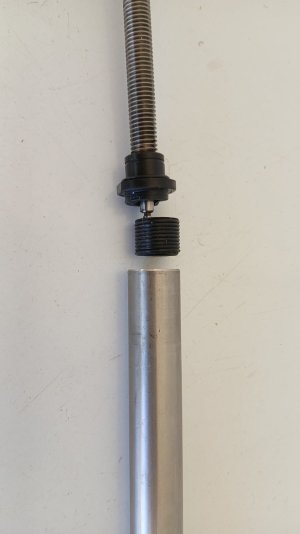
Hello Elbows, I hope you read this. I'm all excited to read that you have made a drive nut for the ST1000+. That is what is broken on mine and Raymarine will not provide this part, so I would have to buy a new unit because of one plastic part. Those 2 plastic pieces in the photo should be one. Manfred
Would you be able to help me out there?
 

Attachments

  • WhatsApp Image 2025-02-06 at 12.14.31.jpeg
    WhatsApp Image 2025-02-06 at 12.14.31.jpeg
    57.1 KB · Views: 10
Top