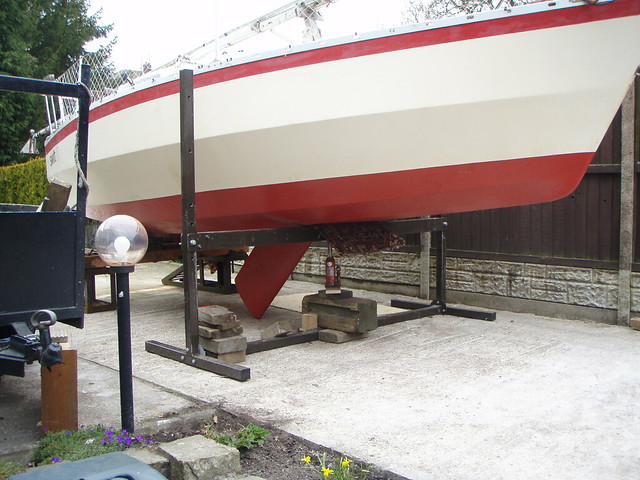
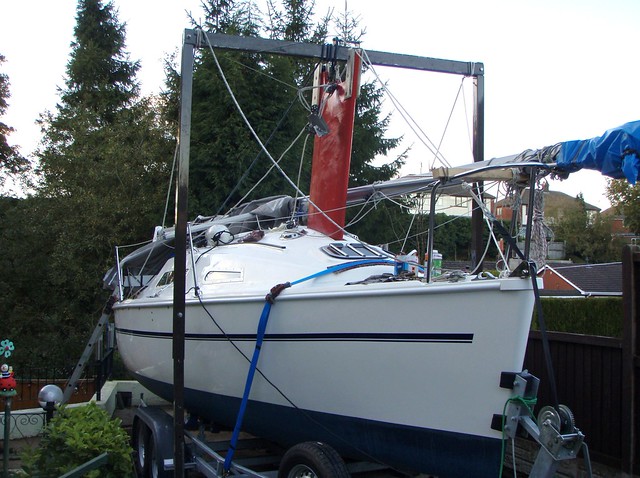
Raising Yacht to work on swing keel.

ferrispeterchris

Well-Known Member
Joined
13 Aug 2005
Messages
850
Location
Bangor, County Down
Visit site
Interested in a swing keel yacht (Newbridge Navigator) which is sitting on a trailer. Apart from using a crane has anyone found a way to raise one to inspect and work on the keel? Many thanks, Peter.

 
I have heard of someone using a couple of railway sleepers, breize blocks and a couple of car jacks to do it but you take your life in your hands and depends how she sits on the trailer. You use two columns of blocks each end of each sleeper so you jack up on one each side and then insert a block on the other. YOu need the jack to be able to let you do 2 blocks so you can then lower the jack to put another on the jacking column.

I use a couple of Gantries at home. You would probably find it cheaper to hire a HAIB if you are not at a marina. If you are at a marina you will probably find they will only allow you to do certain things on their property due to H&S and insurance/liability.
 
Most keels can't drop when on the trailer, so a pit may not help. The problem initially is getting the boat off the trailer which will require some beefy kit, whether a crane (incl. HIAB type) or sheerlegs. Those gantries are great, but where do you store them?!

Sometimes it helps to think laterally. First requirement is enough space around the boat to open up any options, then look at local businesses who may have a mobile crane. I've had the local scrap yard truck call round and use his HIAB arm to drop and raise my mast - a half hour "homer" for the driver on his way home. Actually the driver is very good at setting the mast up in coloumn with even tension on the rigging - practice makes perfect. He obviously insists that everything is ready to lift or his tea will get cold.

Rob.
 
Dont use breeze blocks or any other building blocks. Use big chunks of wood eg sections of railway sleeper. Small galvanised water tanks are also useful

Dont use an ordinary car jack . Us a hydraulic bottle jack.

Support the stern on a couple of 45 gallon oil drums and some sturdy pieces of timber and wedges

Build a bridge forward of the keel using a watertank, blocks of timber and hydraulic jack to lift the boat so that the trailer can be withdrawn.

Follow the lifting with timber blocks so that if anything goes wrong the bridge will still be supported and to replace the jack eventually,

support the hull well with blocks on the bridge and wedges to spread the load.

You may want to put some additional supports either side once the trailer is withdrawn.

If necessary dig a hole when the trailer is out of the way to drop the keel into

The above is in outline how my 19ft boat has been jacked up every autumn and every spring to get it off or onto the yard launching trolley for the past 34
years

Things have however moved on and "Hercules" is employed to do the lifting.
'swhat you want. Something like Hercules

DSCF1135.jpg


Seen at the launching and naming ceremony earlier this year


Hercules%25202.JPG


Annabel%2521.JPG
 
This topic comes up regularly.

The devil is in the detail. Make some modifications to your trailer.

Here's mine
trailer_3.jpg


I removed some of the rollers that were in between the two spine members, and replaced them with two pairs of rollers either side of the spine. This supports the hull either side of the keel slot.

The fore / aft position of the boat has been set carefully so that the swing keel just clears the rear axle cross member as it swings down in between the two spine members.

The photo was taken before the final modification. I've now cut the bar joining the two front roller pairs above the front axle cross member. Prior to that this bar severely limited how much the keel could be lowered.

As mine's a swink keel, pivoting from the front, it now lowers most of the way before the keel hits the front axle cross member.

I'll live with that. Enough of the keel is exposed to anti foul most of it, and inspect the mechanism. Though if I was a purist I would cut the front axle cross member and find another way to strengthen it instead
 
Classic innit.

Even the most simple and supposedly economical way of getting on the water - trailer sailing - can be larded with complications.

Why do we do it!! :)
 
I know someone who is just having a new trailer built with modifications to allow dropping his Anderson 22 keel.

An important thing to bear in mind is to support the hull ( at the right places, ie under bulkheads ) when doing this, tiny standard trailer pads are not enough.
 
I know someone who is just having a new trailer built with modifications to allow dropping his Anderson 22 keel.

An important thing to bear in mind is to support the hull ( at the right places, ie under bulkheads ) when doing this, tiny standard trailer pads are not enough.

If he gets it right, he will have a superb and very useful trailer.

When I first got my boat, I thought the trailer was pretty ****. Mainly because it was in a poor state, two bearings were on their last legs, 2 tyres were perished and it was set up really badly.

Now it's been repaired and modified, it's much more useful and it now tows nicely. And with a fresh lick of paint (not shown in the photo) it looks quite reasonable.
 
If he gets it right, he will have a superb and very useful trailer.

When I first got my boat, I thought the trailer was pretty ****. Mainly because it was in a poor state, two bearings were on their last legs, 2 tyres were perished and it was set up really badly.

Now it's been repaired and modified, it's much more useful and it now tows nicely. And with a fresh lick of paint (not shown in the photo) it looks quite reasonable.

ProDave,

well he's very experienced with trailing inc trailer sailing a smaller boat and has taken a lot of trouble with measurements, so it bodes well; I'll mention this forum to him, will see if he can take photo's and post his findings after some use.
 
Things have however moved on and "Hercules" is employed to do the lifting.
'swhat you want. Something like Hercules

Seen at the launching and naming ceremony earlier this year

Hercules%25202.JPG


That's a great way to name & launch a trailer - Now, what will you do for the boat? ;-)
 
Droping a swing keel

My keel is a vertically dropping keel and I have made a gap in the keel rollers so that by rolling the boat back I can drop the keel about half way before it hits the ground. If I jack the trailer up it does expose more of the keel but ultimately the top of the keel is painted from inside the boat.
If i had the swing keel problem I would be looking to find a gap in the keel rollers that would allow the keel to drop. Presumably well aft of the axle or cross member.
If the trailer has good rollers then the boat can be rolled back using a jack at the bow support post. (or at least mine can) ( a bit of tilt of the trailer helps).
When the boat is slid aft of course it is past balance point and it needs jacks under the back of the trailer body. It may be that Op will decide it is too much trouble to make a gap in the keel rollers so the boat must come off the back of the trailer. (gets a bit dangerous).
You will need to support the stern of the boat while either pulling trailer forward or boat back. The trailer can be used as the front support provided it is jacked up at the back of the trailer body. Either way the trailer or the stern of the boat must be supported as it moves. That is the tricky part. A tall gantry with sling under the stern might be allowed to swing if coupled with under stern keel jacks and blocks. Or you might be able to use the car attached to the trailer to hold down the draw bar as trailer moves forward. You would still need to jack the boat and trailer apart as the car pulls other wise you would pull the boat off the stern support.
All this waffle might just convince you that it is going to be difficult (dangerous) without good structural support. 2 over head gantries would be best option or 2 under keel bridges may do. If you can store them they would be worth the cost over years especially in making the a/f painting easier. (mine is a pain painting through and under the trailer structure.
Think about it a lot and good luck olewill
 
Hopefully, the picture shows what I did to drop my centreplate assembly out. You can just see the centreplate leaning against the trailer.
Boat and trailer were about 2 tons.

I managed it in a day, including putting the trailer back together though I didn't half ache the next morning!

Key items were solid level ground, 2 good trolley jacks and 4 good prop stands.
 
If your boat is sitting on its keel stub on the hard all of the trailer solutions are great once its been lifted on.

The Newbridge needs at least half a metre below the keel stub just to lower the keel. I suspect it may need more to enable complete removal.

If you dont have a trailer and dont want to dig a hole the only route is to lift the hull up using gantries and 4 chain hoists as illustrated earlier.

I am currently building gantries out of unistrut...
http://www.unistrut.co.uk/Unistrut-GEC-UK/#?page=0
Chain hoists can be hired or bought from Machine mart(or borrowed from work!)
Unistrut can be easily transported and assembled on site as all the joints are bolted using m12 spring channel nuts and Bolts. No welding required. It is like a grown ups version of Mechano except it is galvanised steel so doesnt rust.
Once lifted I have a boat cradle that supports the hull allowing the 800 kg keel to be lowered, unbolted and removed for fettling.

I am going down the DIY lifting route as Crane hire works out very expensive £275 for a simple lift off our trailer onto the cradle last time.
 
Things have however moved on and "Hercules" is employed to do the lifting.
'swhat you want. Something like Hercules


That's a great way to name & launch a trailer - Now, what will you do for the boat? ;-)

The boat is Tony Curphey's Galenaia . Built 1958 but had been lying in Paynes Boatyard for many years before Tony took her on for his global voyaging.

http://www.cruisingclub.org/awards/awards_stephens_2008.htm

https://lh4.googleusercontent.com/-...X9hHo/s860/Tony%20Curphey%20summer%202011.jpg

.
 
We used this to lift a Swift 18 to get at the keel.
..
5315827059_d57853d138_z.jpg


and adapted it to get at the Parker 235 keel...handy that the keel comes out of the top.

5104681490_ffd81bc6fa_z.jpg


Some form of hydraulic lift arrangement would be better pushing up off the trailer, still thinking about that option.
 
I have heard of someone using a couple of railway sleepers, breize blocks and a couple of car jacks to do it but you take your life in your hands and depends how she sits on the trailer. You use two columns of blocks each end of each sleeper so you jack up on one each side and then insert a block on the other. YOu need the jack to be able to let you do 2 blocks so you can then lower the jack to put another on the jacking column.

I use a couple of Gantries at home. You would probably find it cheaper to hire a HAIB if you are not at a marina. If you are at a marina you will probably find they will only allow you to do certain things on their property due to H&S and insurance/liability.

Those gantries look the biz! Just get those plant pots shifted out of the way missus and the job will be a good un:D
 
Interested in a swing keel yacht (Newbridge Navigator) which is sitting on a trailer. Apart from using a crane has anyone found a way to raise one to inspect and work on the keel? Many thanks, Peter.

I've done it.
Raise the boat & trailer using a bottle jack. (Several small lifts, blocking the trailer up as you go.)
Place wooden beams under the boat, supported at either end on concrete blocks.
Lower trailer, leaving the boat on the beams.
Pull trailer away.

It needs a bit of thinking through but the boat stayed on the beams for months. Cost was around £100 for the timber. I borrowed the concrete blocks.

Once I got everything ready it took about 2 hours to lift the boat. Surprisingly (and annoyingly!) I found lowering back on to the trailer took longer.

I'm not sure what the objection is to concrete blocks is, but I found them to be no problem. I did make sure that they were on firm, solid ground and I made sure there was no point loading by using wooden pads to spread the load evenly.
 
Last edited:
Top