Raising the anchor in waves

Supertramp

Well-Known Member
Joined
18 Jul 2020
Messages
1,371
Location
Halifax
Visit site
What tips does everyone have for raising the well dug in anchor in a bouncy swell and singlehanded?

I have had several situations where the chain comes in but instead of breaking the anchor out I remain firmly attached to the bottom. A vertical chain and some brutal snatching until I can let some chain back out. Then my last resort is to motor over the anchor to try and reverse the pull on the shank.

It's the combination of singlehanded, wind waves or swell which cause pitching and a very grippy substrate that causes the problem.

Any tips?
 
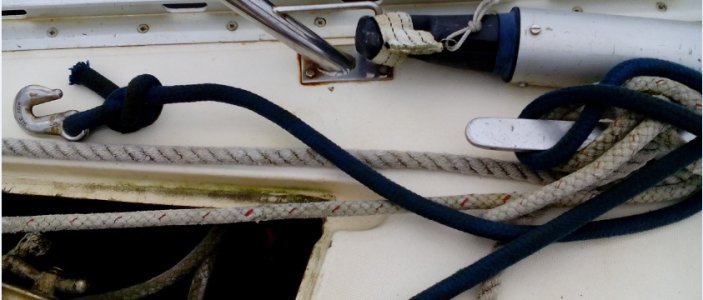
As an ex single hander... In choppy conditions when the anchor was well dug in, I used to use a short length of heavy nylon rope..22/24 mm with a chain hook on it. Use the windlass to haul in all the slack then put the chain hook on the anchor chain and make the nylon fast. Usually the pitching of the boat would would break the anchor out. That method uses the weight and movement of the boat, not man power on the windlass.
 
You need to get one of these "old generation" anchors that all the experts tell us don't work. 😀
Quite agree, and it can be a problem. Maybe shortening up to 2:1, and sitting at that until the anchor comes free might work. You certainly don't want a vertical chain with the boat pitching. Something will break.
There's a thread somewhere on here about the problems of getting aboard a yacht, anchored off Pitcairn Island. I wouldn't like to have been involved in getting that anchor up.
 
I use this hook, slowly retrieve the chain then attach the hook, free the gypsy and let the boat movement slowly do the job. Little by little, retrieve a little more chain but always have the hook taking any load and try and avoid -just- that final sudden snatch; as the bow can move up/down by half a meter or so it's important to proceed slowly, the anchor eventually comes up with half a cubic meter of mud so one understands why :) .
I also use it when anchoring with wind/current: as soon as I let out the required length of chain I immediately attach the hook and release the gypsy, by the time the chain is laid on the bottom the boat has taken up backward speed, the chain is fully stretched as the boat comes to a sudden stop, the hook takes all the load and the shrieking sound of the rope tells a long story.
FWIW before using the hook I had a bent bow roller axe and permanently deformed chain.

add. of course this is just for temporary handling chain under load, the final anchor snubber is a different thing.
As it has to be easily hooked/unhooked it's better if the rope is made fast on the cleat OXO or whatever, I d definitely avoid any eye splice, once the rope is tight one is stuck.


hook.jpg
 
Last edited:
What tips does everyone have for raising the well dug in anchor in a bouncy swell and singlehanded?

I have had several situations where the chain comes in but instead of breaking the anchor out I remain firmly attached to the bottom. A vertical chain and some brutal snatching until I can let some chain back out. Then my last resort is to motor over the anchor to try and reverse the pull on the shank.

It's the combination of singlehanded, wind waves or swell which cause pitching and a very grippy substrate that causes the problem.

Any tips?
Very carefully for a start. Before windlass I made myself secure (clipped on too) sitting down. When slack took a turn of chain around sampson post (2 turns) waited and repeated. Stem head going up and down took the weight and broke anchor out. I have always built up the stemheads of any boat I owned to proportions that people thought were well over the top (with epoxying and woven mat) Even taught myself to weld stainless to create monster stemhead fittings fit for boats 3x my size. Lucky not to break chain as someone said. Also tried (after securing as much chain as possible) reversing to port and starboard repeatedly - it eventually broke free and did not bend - don’t ask what type of anchor it was. I think others have posted better advice but I super fast skim read - snubbers and hooks sounded good idea
 
It is a serious issue that is rarely talked about. Modern anchors bury themselves very deep and even at 1:1 grip seem to have no give despite the high shock loads that can result from wave action.

There are a couple of strategies to minimise this problem. The first is to have plenty of patience. From the bow it appears that the anchor is stuck and immovable. No chain can be retrieved and it is easy to conclude nothing is happening to the anchor. In reality the shank will be slowly rising. This takes considerable time but if you keep steady pressure on the anchor it will be slowly breaking out.

The second tip is to attach a long snubber while breaking the anchor out in large swell. This adds some elasticity to the system preventing shock loads causing damage. It works best if you have a snubber attached near the stern of the boat, this means you can deploy the full snubber with close to a 1:1 scope. Unfortunately this is not practical on all vessels.

If you have the more common snubber attachment near the bow it is still worth a try, but often the resulting scope is too long to break out modern large anchors.

It is important to protect the windlass in these conditions. A chain stopper is helpful, if you do not have one a short snubber can be used, unfortunately these do not add any elasticity. Keeping the windlass clutch relatively loose if there is a danger of shock loads is good practice.

Don’t forget the patience part, especially if you have recently upgraded the anchor design or size and are accustomed to anchors breaking out easily.
 
What tips does everyone have for raising the well dug in anchor in a bouncy swell and singlehanded?

I have had several situations where the chain comes in but instead of breaking the anchor out I remain firmly attached to the bottom. A vertical chain and some brutal snatching until I can let some chain back out. Then my last resort is to motor over the anchor to try and reverse the pull on the shank.

It's the combination of singlehanded, wind waves or swell which cause pitching and a very grippy substrate that causes the problem.

Any tips?
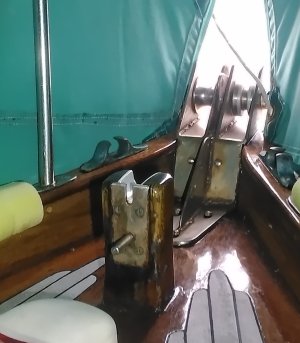
I use this handy notched plate on the aft of my Sampson post. When the chain goes slack I just drop the chain into the notch so that as the boat raises with the next wave it hauls hard on the chain. The boat does most of the work. I find it works well.
 

Attachments

  • Sampson Post.jpg
    Sampson Post.jpg
    157.4 KB · Views: 71
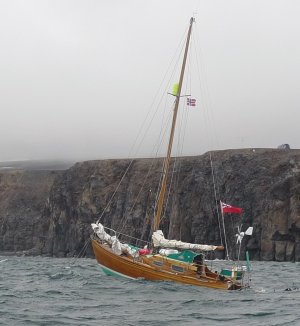
  • Rough anchorage.jpg
    Rough anchorage.jpg
    169.8 KB · Views: 71
I use this handy notched plate on the aft of my Sampson post. When the chain goes slack I just drop the chain into the notch so that as the boat raises with the next wave it hauls hard on the chain. The boat does most of the work. I find it works well.
Nice set up. Nice stem head fitting. Nice boat. Don’t envy the maintenance of the wood but it looks great. Did a friend take the second photo?
 
As an ex single hander... In choppy conditions when the anchor was well dug in, I used to use a short length of heavy nylon rope..22/24 mm with a chain hook on it. Use the windlass to haul in all the slack then put the chain hook on the anchor chain and make the nylon fast. Usually the pitching of the boat would would break the anchor out. That method uses the weight and movement of the boat, not man power on the windlass.
That makes sense, and I will either make one up or use my long V bridle off the midships cleats.
 
I use this handy notched plate on the aft of my Sampson post. When the chain goes slack I just drop the chain into the notch so that as the boat raises with the next wave it hauls hard on the chain. The boat does most of the work. I find it works well.
Now that's exactly the sort of thing.....

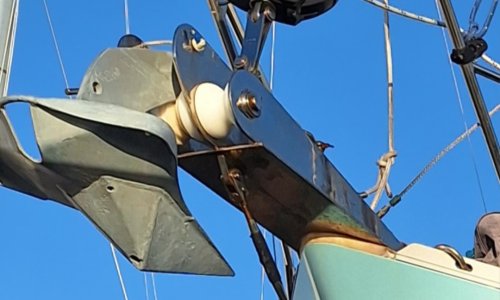
I envy you that roller fitting - mine is a mini sprit which is robust but not the best for snatch loads in any direction. You can see why I'm wary of snatch loads. Screenshot_20250404_124422_Gallery.jpgI use a V bridle to take the load off at anchor.
 
You need to get one of these "old generation" anchors that all the experts tell us don't work. 😀
Quite agree, and it can be a problem. Maybe shortening up to 2:1, and sitting at that until the anchor comes free might work. You certainly don't want a vertical chain with the boat pitching. Something will break.
There's a thread somewhere on here about the problems of getting aboard a yacht, anchored off Pitcairn Island. I wouldn't like to have been involved in getting that anchor up.
I didn't want to get the debate onto anchors (!) but I never had this trouble with the CQR. The Epsilon shank is at least 40cm shorter and the shape doesn't encourage lifting out from above. It does stick like glue when it's in.
 
I use this hook, slowly retrieve the chain then attach the hook, free the gypsy and let the boat movement slowly do the job. Little by little, retrieve a little more chain but always have the hook taking any load and try and avoid -just- that final sudden snatch; as the bow can move up/down by half a meter or so it's important to proceed slowly, the anchor eventually comes up with half a cubic meter of mud so one understands why :) .
I also use it when anchoring with wind/current: as soon as I let out the required length of chain I immediately attach the hook and release the gypsy, by the time the chain is laid on the bottom the boat has taken up backward speed, the chain is fully stretched as the boat comes to a sudden stop, the hook takes all the load and the shrieking sound of the rope tells a long story.
FWIW before using the hook I had a bent bow roller axe and permanently deformed chain.

add. of course this is just for temporary handling chain under load, the final anchor snubber is a different thing.
As it has to be easily hooked/unhooked it's better if the rope is made fast on the cleat OXO or whatever, I d definitely avoid any eye splice, once the rope is tight one is stuck.


View attachment 191622
I use those on V bridles as snubbers. With 3 strand or octoplait I would have spliced the rope to the hook but left the other end free.
 
I use those on V bridles as snubbers. With 3 strand or octoplait I would have spliced the rope to the hook but left the other end free.
Yes sure one can use a different rope and eye splice the hook, the one in the picture was the first short length of rope I had on hand at that time.
Bear in mind one has first to bring the boat nearly to 1:1 scope then attach the strop and remain at the bow to slowly gain 10cm by 10cm while quickly hooking/unhooking, can't see how a long snubber could be used but each to his own, I am happy with my system.
 
I use this hook, slowly retrieve the chain then attach the hook, free the gypsy and let the boat movement slowly do the job. Little by little, retrieve a little more chain but always have the hook taking any load and try and avoid -just- that final sudden snatch; as the bow can move up/down by half a meter or so it's important to proceed slowly, the anchor eventually comes up with half a cubic meter of mud so one understands why :) .
I also use it when anchoring with wind/current: as soon as I let out the required length of chain I immediately attach the hook and release the gypsy, by the time the chain is laid on the bottom the boat has taken up backward speed, the chain is fully stretched as the boat comes to a sudden stop, the hook takes all the load and the shrieking sound of the rope tells a long story.
FWIW before using the hook I had a bent bow roller axe and permanently deformed chain.

add. of course this is just for temporary handling chain under load, the final anchor snubber is a different thing.
As it has to be easily hooked/unhooked it's better if the rope is made fast on the cleat OXO or whatever, I d definitely avoid any eye splice, once the rope is tight one is stuck.


View attachment 191622
That design of hook seems to be strong enough for most jobs. I originally used one made from bent wire: it opened under surging in a Greek harbour and our stern hit the wall. We replaced it with one like yours years ago and it has survived well.
 
That design of hook seems to be strong enough for most jobs. I originally used one made from bent wire: it opened under surging in a Greek harbour and our stern hit the wall. We replaced it with one like yours years ago and it has survived well.
A word or six of caution

Most chain hooks sold to the leisure marine market are at best crude. If you want a hook to a modern design source one from the lifting industry. Most leisure marine chain hooks will preferentially point load the chain within the hook and do not spread the load, or the tensions applied, over the whole link - the WLL of your chain is based on even tension on the chain link - NOT point loading. Based on measuring snatch loads at anchor my estimate is that in moderate chop with a near vertical rode and well set anchor then the snatch loads are at or near WLL.

Testing the Effects of Chain Hooks - Practical Sailor

Snubber Chain Hooks Revisited - Practical Sailor


In one of the photos in this article, below, the author of the article is looking at his bent hook.

Safety at Sea: Surviving a Powerful Storm in the Med | Cruising World


This chain hook, below, has sharp 'working' edges - the G30 6mm chain (the size (1/4") for which the hook was intended) has failed below the chain WLL. The hook also failed, it deformed. The hook was quietly with drawn from sale.

IMG_5322.jpeg


I tested an Oscalutti 'bent wire' chain hook - it deformed and the chain fell out. It might have been the same design as that reported by Vyv Post 16.

Jonathan
 
A word or six of caution

Most chain hooks sold to the leisure marine market are at best crude. If you want a hook to a modern design source one from the lifting industry. Most leisure marine chain hooks will preferentially point load the chain within the hook and do not spread the load, or the tensions applied, over the whole link - the WLL of your chain is based on even tension on the chain link - NOT point loading. Based on measuring snatch loads at anchor my estimate is that in moderate chop with a near vertical rode and well set anchor then the snatch loads are at or near WLL.

Testing the Effects of Chain Hooks - Practical Sailor

Snubber Chain Hooks Revisited - Practical Sailor


In one of the photos in this article, below, the author of the article is looking at his bent hook.

Safety at Sea: Surviving a Powerful Storm in the Med | Cruising World


This chain hook, below, has sharp 'working' edges - the G30 6mm chain (the size (1/4") for which the hook was intended) has failed below the chain WLL. The hook also failed, it deformed. The hook was quietly with drawn from sale.

IMG_5322.jpeg


I tested an Oscalutti 'bent wire' chain hook - it deformed and the chain fell out. It might have been the same design as that reported by Vyv Post 16.

Jonathan
I understand your argument but the hook shown, which looks the same as mine, has quite gentle entry and exit points that seem to contact the chain over a short distance rather than a point.
 
Let the boat do the work ... as it pitches DOWN - get that chain in and hook it .... boat moves towards anchor ... pitches down again - chain in and hook it .... moves - pitches down - chain in - hook it ...

Once boat is over anchor .... boat movement should with pitching up and down break it out ... patience is the trick ... not brute force and hurting yourself !
 
Top