
Gary Fox
N/A
Nah!
"Close enuff for government work...."


Nah!
"Close enuff for government work...."

What's wrong with using bolts with nylocs instead of clevis pins?
BlueWave Smart Pins are a very good replacement for split pins. Previous time to my last mast raising event the rigging company fitted these instead of split pins but last time a different contractor fitted split pins because he could not find them sitting on the chart table to be reused!
Blue Wave Smart Pin - 4 Pack | Force 4 Chandlery
What's wrong with using bolts with nylocs instead of clevis pins?
Probably an infinitesimal difference. But, compared with wrestling with a fiddly split pin on a wet and heaving deck, worth every penny.Cost?
Probably an infinitesimal difference. But, compared with wrestling with a fiddly split pin on a wet and heaving deck, worth every penny.
If you do go that route consider using a bronze nut if the gear is SS to prevent galling.Is their anything wrong with my locknut idea? Just I may be using it....
Why on earth would you be wrestling with split pins on wet heaving decks?Probably an infinitesimal difference. But, compared with wrestling with a fiddly split pin on a wet and heaving deck, worth every penny.
An alternative you ask?Yes, I have bent the split pin ends around the turnbuckle and taped them. This would seem to be a good way (best method) of doing it. Unless someone has a good alternative?
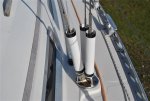
Seizing wire is much thinner than split pins & a correctly sized split pin should fill the hole it is designed for. Seizing wire would have to pass several times through the hole & the amount of material would almost certainly be less than the equivalent split pin. One often sees just a single strand though the hole & this may be insufficient. The seizing wire needs to be fastened to something else so there is a length of unsupported wire that is subject to damage. It may be incorrectly twisted at the terminal end, leading to failure.I thought seizing wire would be better in every application - but apparently lots of split pin lovers in this thread!
What do people like about split pins, over seizing wire?
Dumping the mast?Why on earth would you be wrestling with split pins on wet heaving decks?
You would if the mast was punching a hole through the side of the boat. Getting the split pin out is one thing; but you still have to get the loaded pin out as well & it will be loaded with a mast pulling on it at an odd angle. It is not just a few shrouds to worry about. There are all sorts of other ropes threaded through the deck to get rid of. You do not have time to faff with anything.Dumping the mast?
(No- I would not consider cutting the lines even though I have shears (not bolt cutters).
I have just shortened a couple of my stays. Even with my RN shears, it took a lot of effort. Bolt cutters seem to be worse. Undoing a bolt, albeit in less than benign conditions, is straightforward. I use Copperslip on all SS to SS mating surfaces. Once the nut is off a bolt, there is sufficient length left protruding for a hammer blow to shoot it out. The same is not true of a clevis pin.You would if the mast was punching a hole through the side of the boat. Getting the split pin out is one thing; but you still have to get the loaded pin out as well & it will be loaded with a mast pulling on it at an odd angle. It is not just a few shrouds to worry about. There are all sorts of other ropes threaded through the deck to get rid of. You do not have time to faff with anything.
I do know, I have had a mast go over the side. There is rigging, ropes& wiring that you never though existed . One just has to chop the lot & get rid of it pronto.
I cut some 8mm with an old rusty hacksaw and was surprised how easy it was... certainly I think it might be an easier approach than a bolt cutters once you had a good saw and a good blade.I've often thought that, with my bolt cutters, I'd have a better chance of cutting the bottle screws or the threaded ends of the wires than the wires themselves if I had to dump the rig. Something I hope fervently never to have to put to the test.
Rig cutting has been an emotive subject on the forum for yearsI cut some 8mm with an old rusty hacksaw and was surprised how easy it was... certainly I think it might be an easier approach than a bolt cutters once you had a good saw and a good blade.
I know a bolt cutters on your knees in the dark would not be fun.
I also think many of the clevis pins could be bashed out with a hammer and cold chisel.
I cut some 8mm with an old rusty hacksaw and was surprised how easy it was... certainly I think it might be an easier approach than a bolt cutters once you had a good saw and a good blade.
I know a bolt cutters on your knees in the dark would not be fun.
I also think many of the clevis pins could be bashed out with a hammer and cold chisel.