Pushpit mounted ais antenna - tx only

chris-s

Well-Known Member
Joined
24 Apr 2019
Messages
816
Visit site
Eagerly, I went to the boat last evening to fit my new ais transponder, the plan being to use an existing, unused ais splitter to share the main vhf antenna. My plans were thwarted when I realised I was missing a bnc/pl259 cable.

As I dinghy’d back to shore a thinking about the splitter, I questioned whether it might not be suitable for a transponder, lo and behold, a quick check online midway between boat and shore showed it wasn’t, so I placed an order for a dedicated ais antenna and missing cable before stepping ashore.

I’m quite happy with my existing ais receiving setup using the b&g vhf, so this is really only for transmit purposes.

However, I now wonder if I have overlooked something with positioning the ais tx antenna on the push pit…carrying our aluminium hulled tender on its side across the stern and it blocking the signal?

I guess i either need to mount the antenna on a pole (ugly pita option) or splash out for a more suitable splitter. Bugger.
 
The ais antenna is used for Tx and Rx so its mounted height will govern its range.
If you've been used to a long range on your old receiver mounting the new antenna on the rail might lead to disappointment, not to mention its vulnerability to damage. Putting it on a pole will help, but a pole is still another thing to clutter the deck / rail.
 
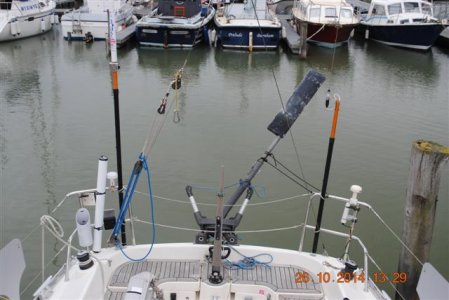
Mounted directly on the pushpit could make the aerial liable to snagging from ropes tossed to the boat. ie from a lock wall etc. Or from somebody passing an electric cable ashore when rafted alongside. mine is on an extendedin mast made from half a sailboard boom. It is held in place with 2 "U" bolts % the curve at the end is trimmed to length such that it leads the wire straight to the deck gland with no exposed wire. It gives me 10 mile range . The aluminium in the boom is good quality anodised to last,
Having the aerial 6-8 ft higher has meant, for me ast least, that it has never been damaged. My echomax radar transponder is on the other half of the boom on the other side of the stern.
DSC_2416 (Small).JPG
 
Last edited:
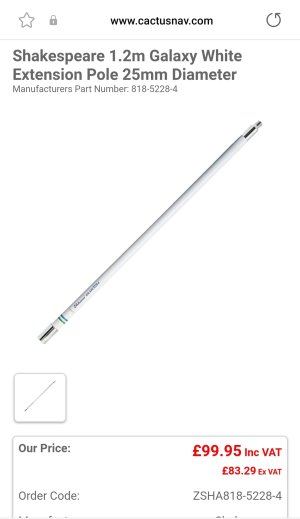
I have a spare antenna mounted on a Shakespeare pole on the pushpit. I think they look rather good and at least they take the antenna tip above eye height so less risky in case of sbdy falling on it.

1.2m shakespeare extension..

Screenshot_20250621-121123_Samsung Internet.jpg

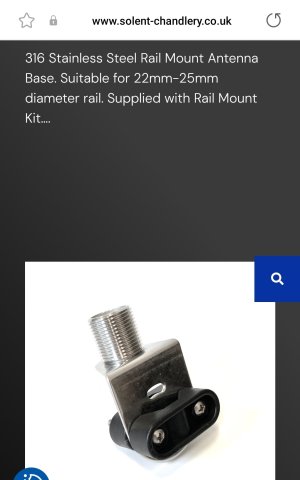
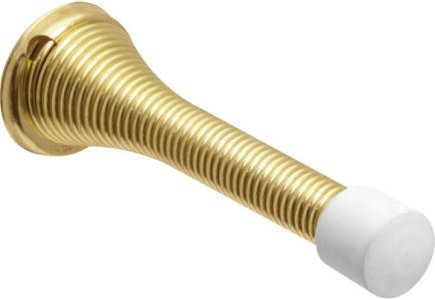
At the bottom, I have mounted it to the lower pushpit rail with something like this...

Screenshot_20250621-120859_Samsung Internet.jpg

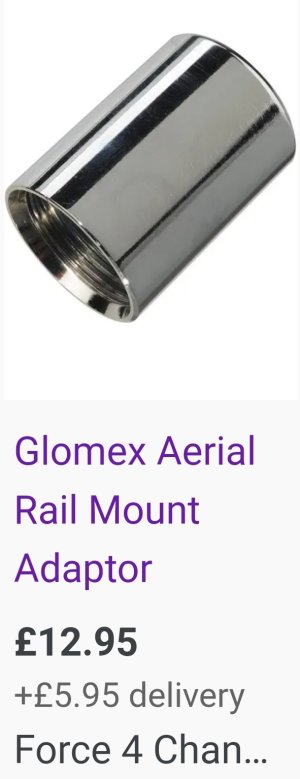
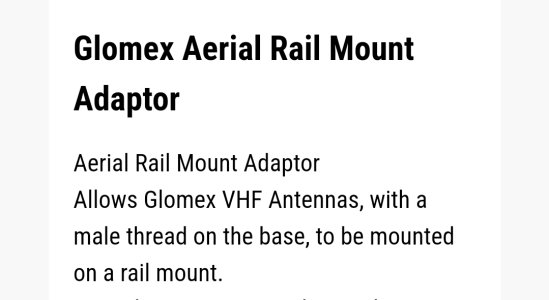
And at the top, this (next) convertor was useful to allow a Glomex antenna to screw directly into the top, with the co-axial feed cable kept totally within the pole..

Just used a lashing to hold it to the top pushpit rail and it's been like that for 12 years so far!!

Screenshot_20250621-120956_Samsung Internet.jpg
Screenshot_20250621-121923_Samsung Internet.jpg
 
Last edited:
I have ais receive via my vhf using a mast head antenna and the transponder transmits from the pushpit. Works fine. Do need to filter my own boat as the system gets muddled and thinks I am on a close approach with myself -but that was OK to sort. I could use the transponder for receive as well, but why bother when it won't see as far as the mast head antenna can and I now have an in built back up?
 
My comar says it needs to be 3m up in the air so you don't radiate yourself.
.What does your safe working distance calculation say? (it's been a requirement for all marine VHF licence holders to calculate the safe working distance and provide mitigations for all antennas since 2021)

Not sure even a 25W VHF antenna operating 50% of the time would get up to 3m.
 
Not sure even a 25W VHF antenna operating 50% of the time would get up to 3m.
Something faulty if your AIS is transmitting with a 50% duty cycle. IIRC the typical transmission is about 30ms long and on class B responder at yacht speeds would be every 30s. So 0.1% transmission time. I seem to recall you were more like handheld power on class B.
 
Something faulty if your AIS is transmitting with a 50% duty cycle. IIRC the typical transmission is about 30ms long and on class B responder at yacht speeds would be every 30s. So 0.1% transmission time. I seem to recall you were more like handheld power on class B.
Never said an AIS would. My calc for a main VHF is less than 3m (my calc for an AIS is 0m)
 
I get nearly 20 nm range from my combined vhs and ais masthead aerial at least when looking out for those big tall things. Quite useful in planning crossing traffic separation zones and the big things hurtle through at 17kt.

I personally would want to retain distance capability of reception and am alert to the fact that my emergency push pit aerial would give less capability.

If we ever can afford an ais sender I will get its aerial up high
 
I get nearly 20 nm range from my combined vhs and ais masthead aerial at least when looking out for those big tall things. Quite useful in planning crossing traffic separation zones and the big things hurtle through at 17kt.

I personally would want to retain distance capability of reception and am alert to the fact that my emergency push pit aerial would give less capability.

If we ever can afford an ais sender I will get its aerial up high
It’s a bit like binoculars in that even the cheapest are a hundred times better than nothing. AIS on the pushpit may not be ideal but it should be serviceable providing its limitations are taken into account.
 
Top