Propagation distance of AIS.

Puzzles me that so many want to be tracked.

Its funny you say : "Puzzles me that so many want to be tracked." .....

I would suggest that most people are not thinking so much about being tracked - as being SEEN .. and TO SEE others ....

I also think that many choose AIS as its much easier to install than a radar set. Even though the radar set in good hands is far better and does not rely on other vessel Tx's.

I often have conversations with other yotties over here and most are convinced they really need AIS to be able to see others. More than half in fact refer to it as 'radar' !! The fact is I reckon - the advent of the combined Plotter and AIS transponder has a lot to do with it ... the cost difference between a straight plotter and one with AIS is not so great now and makes sense. But I wish manufacturers would stop using the term Radar in their manuals when describing modes !
 
The power shouldnt matter much. Ham radio enthusiasts do 2m links with foreign countires using 1 watt.

Puzzles me that so many want to be tracked.
I sail SH & it is useful for my wife to know where I have gone, when I left & when I arrived. It is better if I do not have to tell her because if I forget it would cause her concern. Plus sometimes I wake up & decide on a whim to leave at 04-00, or I might arrive at bradwell ( or wherever) after midnight& she would not appreciate a phone call at those times of the day.
 
Its funny you say : "Puzzles me that so many want to be tracked." .....

I would suggest that most people are not thinking so much about being tracked - as being SEEN .. and TO SEE others ....

I also think that many choose AIS as its much easier to install than a radar set. Even though the radar set in good hands is far better and does not rely on other vessel Tx's.

I often have conversations with other yotties over here and most are convinced they really need AIS to be able to see others. More than half in fact refer to it as 'radar' !! The fact is I reckon - the advent of the combined Plotter and AIS transponder has a lot to do with it ... the cost difference between a straight plotter and one with AIS is not so great now and makes sense. But I wish manufacturers would stop using the term Radar in their manuals when describing modes !
Radar would be difficult for many SH sailors to use . The unit could be in the cockpit overlaid on the plotter on a larger boat but then that becomes harder for the sailor to sail & more electronics to handle in a busy area like, say, the Dover strait. It would defeat its own object.
We are not all Alex Thompsons. If the unit is down below, I know that on my boat, I could never get to use it as I could not be in 2 places at once. Plus, it would cause sea sickness in minutes, There is not exactly a lot of room on a 31 ft yacht below & no room in the cockpit. My chart plotter takes up all the spare room I have & operating the AIS overlaid on the CP is hard enough in a rolling sea.
 
Don't forget that AIS data set is dependent on GPS positional data ..... if the GPS you are using is an old set feeding the AIS unit - the AIS Tx does not correct it - it takes the info as 'gospel'. Old sets can wander a lot ... OK - it shouldn't be as much as you quote in your post ... but not impossible.
AIS messages are transmitted in "slots" - there are 2250 AIS transmission slots in a minute, and each slot is 25 milliseconds long.

Each ship transmits in its own slot to ensure that it doesn't transmit at the same time as another ship - both class A and class B do this, except class A and class B+ reserve their slots, whereas class B transmits when it figures out a slot to be empty and unused.

The only coordination of these slots is by their time - slots start on the minute, at 25 milliseconds past the minute, at 50 milliseconds past the minute and so on.

These slots are coordinated by the atomic clocks of GPS satellites - I doubt there's any other practical way to do it, but the AIS specification requires all units to have a built-in GPS. GPS provides a clock accurate to about 3 nanoseconds.

I doubt many AIS units are using external sources for their position when they are obliged to have a built-in GPS.
 
There was no option to reduce clutter and it was having to display everything within the Solent as well as multiple ships across the shipping lanes. The cursor point is at 60 miles distance.

View attachment 136118

This looks like a B&G which has options to reduce clutter by only showing vessels within a certain distance it only showing "dangerous" vessels.
Also considerable configuration of what you want "dangerous" to include.
 
AIS messages are transmitted in "slots" - there are 2250 AIS transmission slots in a minute, and each slot is 25 milliseconds long.

Each ship transmits in its own slot to ensure that it doesn't transmit at the same time as another ship - both class A and class B do this, except class A and class B+ reserve their slots, whereas class B transmits when it figures out a slot to be empty and unused.

The only coordination of these slots is by their time - slots start on the minute, at 25 milliseconds past the minute, at 50 milliseconds past the minute and so on.

These slots are coordinated by the atomic clocks of GPS satellites - I doubt there's any other practical way to do it, but the AIS specification requires all units to have a built-in GPS. GPS provides a clock accurate to about 3 nanoseconds.

I doubt many AIS units are using external sources for their position when they are obliged to have a built-in GPS.

Simple response :

Class A transmits more often than Class B and actually Class B+ as well.

I accept that having been with Transit - then GPS with all sorts of additions such as first generation gear - the incorporation of GPS receiver into AIS units has removed the old crap from the market. I stand corrected on GPS data.
BUT it does not remove the fact of positional wander / scatter that GPS can and does have at times ......... especially when Military exercises near your location .....
 
Today I picked up a ship 285nm away. Masthead antenna, Onwa class B+ AIS plotter.
It's only the really big ships that I can get at that sort of range. I'm not sure what my transmit range is but friends said they could track us most of the way across Biscay last year, which was from S Ireland to Galicia.
 
Today I picked up a ship 285nm away. Masthead antenna, Onwa class B+ AIS plotter.
It's only the really big ships that I can get at that sort of range. I'm not sure what my transmit range is but friends said they could track us most of the way across Biscay last year, which was from S Ireland to Galicia.
It's more important to know how shipping near you receives your transmissions. Those are the things that are going to hit you ?
 
Today I picked up a ship 285nm away. Masthead antenna, Onwa class B+ AIS plotter.
Sounds like atmospheric ducting, a refraction effect that may develop in high pressure systems where temperature and density differences cause a waveguide over the sea surface. Not to be relied on and I don't think its in the VHF radio course syllabus.
 
I have just posted this in the other AIS thread but it may also be relevant here:

On the STCW radar simulator training courses I ran up to ten years ago for MN deck officers candidates were expected to have recognised potential close quarters situations at five miles and to make course corrections no later than three miles from the target. Obviously the very large vessels could need even more lead time if a significant course change is required. Collision avoidance is normally taken by change of course as speed changes require large fractions of an hour to have any effect, assuming that the engine room is on maneuvering standby.

The message for us is that big ships need to reliably detect us (by visual, AIS, RADAR) at ranges in excess of five miles. Once they are inside four to five miles range, with the best will in the world, they are unlikely to be able to avoid us by their actions alone.
 
I have just posted this in the other AIS thread but it may also be relevant here:

On the STCW radar simulator training courses I ran up to ten years ago for MN deck officers candidates were expected to have recognised potential close quarters situations at five miles and to make course corrections no later than three miles from the target. Obviously the very large vessels could need even more lead time if a significant course change is required. Collision avoidance is normally taken by change of course as speed changes require large fractions of an hour to have any effect, assuming that the engine room is on maneuvering standby.

The message for us is that big ships need to reliably detect us (by visual, AIS, RADAR) at ranges in excess of five miles. Once they are inside four to five miles range, with the best will in the world, they are unlikely to be able to avoid us by their actions alone.
Good to know. Anybody with a poor AIS transmission strength needs to know this. Those with 2nm transmission range need to check their systems
 
Last edited:
Sounds like atmospheric ducting, a refraction effect that may develop in high pressure systems where temperature and density differences cause a waveguide over the sea surface. Not to be relied on and I don't think its in the VHF radio course syllabus.
Interesting. This isn't unusual, we generally receive larger vessels within 100nm and often the monsters out at 150nm+. But today's was a new record.
 
Sounds like atmospheric ducting, a refraction effect that may develop in high pressure systems where temperature and density differences cause a waveguide over the sea surface. Not to be relied on and I don't think its in the VHF radio course syllabus.
I had similar distances when testing my new AIS recently - all the distant ships were in the same direction, in a cone of about 30° around due south (to seaward) of me. There is surely an equal amount of shipping to the west, north-west and south-east of me, but those were not showing up.
 
Technically VHF based Frequency is 'visible' horizon. Visible Horizon - that is the direct line from antenna to horizon ... not you the 'eyeball on deck' !
But with low power - that distance reduces significantly not only as a result of the power radiated - but the conditions and other RF prevailing.

Its not a simple calculation such as Height of Eye ........ too many other factors.

I regard it as : If I can see the other vessel, and my AIS antenna has clear line to it - then I expect my AIS to be rec'd by them. (I have a 2W system). My antenna is pushpit mounted - but soon to be sorted at masthead. My visible horizon at present is technically about 5nm

Ship to Ship on A class - its generally regarded as 20nm plus - based on Horizon distance ... with up to reception at 100nm where a shore station may be seriously elevated.

Class B at 2W is generally not expected to exceed 10nm for even a high elevation antenna - its all about horizon distance vs Tx power. Class B+ at 5W should give a reasonable increase in Tx range - possibly out to that 20nm depending on horizon distance again

Of course there will be exceptions and pick up at greater distances. VHF radio has been "bounced" and heard over 1000's of miles - but its not the norm.

If you want to calculate the Visible Horizon .... lots of online pages do it ... such as :

Distance to the Horizon Calculator

I am sure someone is now going to come along and give all sorts of stuff ... but basically - if you can see on a clear day the other vessel - its most likely if he receives AIS - he has your transmission.
That was really helpful - thanks.
 
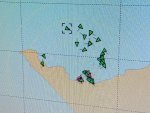
I am currently sitting below a sea wall, second pic shows the view to the north from my cockpit, the AIS ant can be seen in front of the kedge.
First picture is the AMEC AIS display, furthest targets displayed are 4.5 miles away, the ones to the west are not only behind my seawall but also behind a headland covered with high rise.
Nothing showing beyond 4.5 miles as there are no ships currently in siight beyond 4.5 miles.
Offshore I expect to she ships at about 15~20 miles. Don't forget that line of sight involves not only the height above sea level of your antenna but also the height of the other stations antenna. If you can see the top of a ship's funnel you can see his AIS ant.
Re 60 mile reception. That typically involves ducting and as with radar and VHF radio you will probably receive it for a bit and then it will vanish just to re-appear at about 15/20 miles.
Back in the days of the Raj - OK maybe not quite that long ago - I recall the record being a ship in the middle of the Arabian Sea in the north east monsoon being able to work both a ship near Bombay and another near Socotra on VHF at the same time.
 

Attachments

  • IMG_2672.jpeg
    IMG_2672.jpeg
    641.3 KB · Views: 6
  • IMG_2671 (1).jpeg
    IMG_2671 (1).jpeg
    568.7 KB · Views: 6
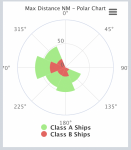
For real world examples, the charts on Marine Traffic are handy. Select 'station', then 'details and statistics' and in particular a chart of ranges for class A and B can be seen.

For example, here's the chart for Portpatrick station, with an antenna height of 20m.

1654432972022.png

I run an AIS base station feeding Marine Traffic and have noticed that vessels and beacons are commonly received which are not line-of-sight, which I assume arise from diffraction of signals over hilltops and reflection of signals from local hills. I've noticed this on the boat too, and it's actually remarkably common, although I'd not rely on this for anything.

There are clearly exotic propagation modes for AIS signals as for other communications. I have received reports from several hundred miles, and commonly receive reports the direction and range of which makes me assume that these are aircraft scatter.

I endorse a previous comment about receiver quality; I tried one which could not even receive vessels I could see from the window!
 
I run an AIS base station feeding Marine Traffic and have noticed that vessels and beacons are commonly received which are not line-of-sight, which I assume arise from diffraction of signals over hilltops and reflection of signals from local hills. I've noticed this on the boat too, and it's actually remarkably common, although I'd not rely on this for anything.

There are clearly exotic propagation modes for AIS signals as for other communications. I have received reports from several hundred miles, and commonly receive reports the direction and range of which makes me assume that these are aircraft scatter.

VHF propogation is not limited to the visual line of sight - it refracts beyond the horizon. To get an approximation, RF engineers multiply the Earth radius by 4/3rds, then it becomes line of sight (and this is an average as it changes with weather).

You then get knife edge diffraction over hills and the like, ducting etc.

https://www.itu.int/dms_pubrec/itu-r/rec/p/R-REC-P.834-2-199708-S!!PDF-E.pdf
 
I have my AIS antenna on the top of the mast - next to the VHF antenna, which is not ideal, I know, but that's how the vessel came...

I can sometimes, but not often, see larger commercial vessels in 600 nm distance, so it is not line of sight at all, but requires multiple bouncing off some layers in the air and the water surface. Leisure crafts with AIS-B I can see very occasionally in 60 nm, but more often only in 10+ nm.

I once saw an AIS buoy off the French coast whilst sailing in the Caribbean. That buoy was over 2500 nm away.

It really seems to have a lot to do with antenna height and quality of the installation of the AIS antenna cables. A few months back I fixed the AIS installation of a friend of mine, who I could only see in a few miles. Now his installation is as good as mine and I can often see him in 30+ nm.

Cheers, Mathias
 
I have used my AIS connected to both the mast-head (~12m) and pushpit (~4m) antennas. Normal range in good conditions is about 20-ish and 13-ish Nm respectively. That is for ships, but is much less for smaller craft due to to their lower antenna height. Any moisture (fog or rain) in the atmosphere or lots of wave movement will greatly reduce this.

I did once receive signals from ships over 100Nm away for a couple of hours. A person much smarter than me (that's most of the world) explained how an approaching low-pressure system allowed some form of channeling of the signal, hence the extreme range.

Cheers, Graeme
 
Top