Prop moths

Hacker

Well-Known Member
Joined
4 Nov 2015
Messages
1,211
Location
Falmouth
Visit site
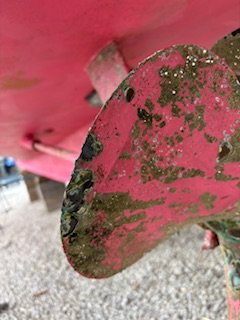
Had Perla, our Channel Island 32, lifted out on Friday foe 2 weeks to antifoul, varnish the spray rail and change the anodes. Had a nasty shock when I went to clean the port prop, it had been attacked! All 3 blades have pitting on the surface and damage to the edges. No such damage apparent on the stb prop, both rudders, both P brackets and both shafts (although still to grind the crap off them. Pictures from her survey last August show the prop is fine.
Current view is either that I have a ground fault on my charger or a neighbouring boat has an issue. If the former then I would have expected the damage to be spread across the other bits. The neighbouring boat is moored on my port side and appears to be built from steel.
Does anyone have any further thoughts? I’m trying to get a local marine electrician to have an initial look.
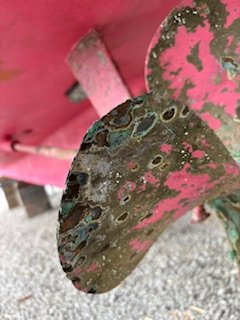
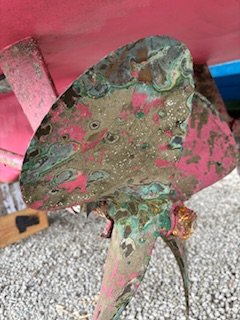
IMG_3156.jpeg
IMG_3154.jpeg
 

Attachments

  • IMG_3155.jpeg
    IMG_3155.jpeg
    69.5 KB · Views: 34
First thing is to clean it to determine the extent of the pitting. "Ring" the blades with small hammer. Dull sound suggests dezincification. Check continuity between the anode and the propeller. Because it is only one propeller suggests maybe the anode is not working.

If the propeller is basically sound it may be repairable.
 
As per life my multimeter packed up so had to order a new one, which arrived today. Plan to check continuity tomorrow. Channel Islands have a fully bonded internal system that is attached to the 2 main anodes, so unlikely to be the problem but will check to eliminate. Will probably be ringing Clements tomorrow!
 
"fully bonded internal systems" often give me the heebie jeebies. There really is no need for such things. Just identify the bits that need protection and connect to an anode directly with the shortest possible route. both electrically and visually, In your case you have 2 propellers and possibly 2 rudders. First line of defence for your propellers is a shaft anode in front of the P bracket. The P bracket does not need protection other than painting as it is not in contact with any other metal. If you have a bow thruster that will have its own anode. No anodes required for skin fittings. No need to connect any external anodes to the engine unless using it as a path to the prop shafts and no need to connect to the DC systems. Your 240v system should have a galvanic isolator and would benefit from being grounded, perhaps through a convenient anode.

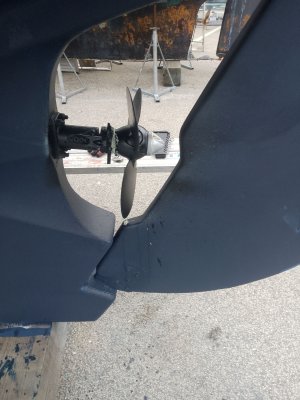
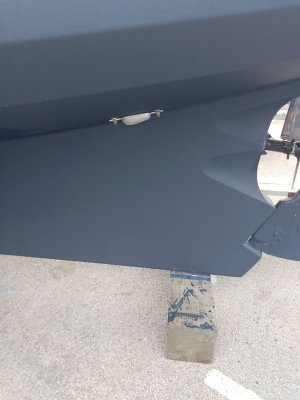
Photos show my boat - not a MOBO but same principles. Anode bolted to the hub of the propeller as first line and then through the prop shaft to a hull anode located as close as practical to the propeller (fuel tank stop it from being closer)
 

Attachments

  • IMG_20231023_134639 (1).jpg
    IMG_20231023_134639 (1).jpg
    444.4 KB · Views: 28
  • IMG_20231023_135230.jpg
    IMG_20231023_135230.jpg
    356.1 KB · Views: 27
  • IMG_20231016_165203.jpg
    IMG_20231016_165203.jpg
    277.9 KB · Views: 28
"fully bonded internal systems" often give me the heebie jeebies. There really is no need for such things. Just identify the bits that need protection and connect to an anode directly with the shortest possible route. both electrically and visually, In your case you have 2 propellers and possibly 2 rudders. First line of defence for your propellers is a shaft anode in front of the P bracket. The P bracket does not need protection other than painting as it is not in contact with any other metal. If you have a bow thruster that will have its own anode. No anodes required for skin fittings. No need to connect any external anodes to the engine unless using it as a path to the prop shafts and no need to connect to the DC systems.
If a hull anode is electrically connected to the shaft there is no need for a shaft anode.
Your 240v system should have a galvanic isolator and would benefit from being grounded, perhaps through a convenient anode.
The OPs boat would not have had the Earth electrically connected to the sea when built and would not have had a GI, it didn't need one. If there is still no connection to the water it still doesn't need a GI.
 
If a hull anode is electrically connected to the shaft there is no need for a shaft anode.

The OPs boat would not have had the Earth electrically connected to the sea when built and would not have had a GI, it didn't need one. If there is still no connection to the water it still doesn't need a GI.
It is a big "if" as there is no indication as to where the anode is positioned. It may well be too far away. If it is close and well connected then fine, but there is value in having a shaft anode as that does not rely on the "bonding system". There is clearly something amiss as there are signs of dezincification on the propeller.
 
It is a big "if" as there is no indication as to where the anode is positioned. It may well be too far away. If it is close and well connected then fine, but there is value in having a shaft anode as that does not rely on the "bonding system". There is clearly something amiss as there are signs of dezincification on the propeller.
forgive me if I am wrong, everyone seems to be focusing on the OP's boat. The fact that the PORT side seems to have some relevance seems to have been ignored. I would be very suspicious of the boat moored on that side. :unsure: ;)
 
It is a big "if" as there is no indication as to where the anode is positioned. It may well be too far away. If it is close and well connected then fine, but there is value in having a shaft anode as that does not rely on the "bonding system". There is clearly something amiss as there are signs of dezincification on the propeller.
It's just an "if", no big about it. I wasn't specifically talking about the OP, just a general comment.

My current boat only has hull 2 anodes. Electrically connected to shafts by bridging wires across the shaft couplings. They last 2 years.

My previous boat only had a hull anode. Electrically connected to the shaft be being connected through a gearbox bolt, sold coupling so no bridge wire.

One before that had a hull anode, a shaft anode and a prop anode. Prop anode didn't last a year, shaft anode barely a year and the small hull anode half depleted. I discarded the prop and shaft anodes, fitted a bigger hull anode, which easily lasted a year, no issues.

If i was the OP i would disconnect anything that doesn't need to be protected (as you say in post #5). I would then fit a good sized hull anode to each side to protect each shaft, prop and maybe rudder.
 
One before that had a hull anode, a shaft anode and a prop anode. Prop anode didn't last a year, shaft anode barely a year and the small hull anode half depleted. I discarded the prop and shaft anodes, fitted a bigger hull anode, which easily lasted a year, no issues.
That is not surprising. The prop anode goes first because it is in direct contact with the prop. Shaft anode next as it is further away and hull anode last as it is even further away
 
forgive me if I am wrong, everyone seems to be focusing on the OP's boat. The fact that the PORT side seems to have some relevance seems to have been ignored. I would be very suspicious of the boat moored on that side. :unsure: ;)
Not ignored - a suggestion it could be related to the steel boat next door, but could just as easily be a failure of the bonding to the hull anode. That is the first thing to check which the OP is doing.
 
That is not surprising. The prop anode goes first because it is in direct contact with the prop. Shaft anode next as it is further away and hull anode last as it is even further away
Of course it does, i'm not an idiot. You totally miss the point. Point being, as i said before, if a suitable hull anode is fitted and correctly connected there is no need for piddly little prop and shaft anodes.
 
Ok bit of an update. Had to replace my multimeter as it decided to pack, new one arrived yesterday. Current setup are 2 x 12” bar anodes towards the stern of the boat (trim tabs have separate disc anodes and bathing platform bars have “shaft” anodes, currently no shaft anodes fitted). The bar anodes have a stud in the lazarette to which appear to be attached multiple cables which (I assume) lead to the various items they protect.
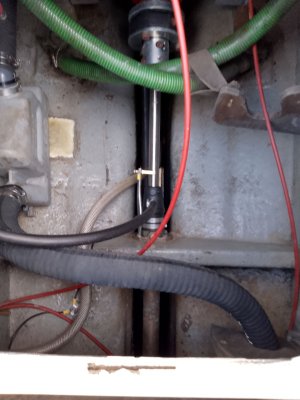
This morning I measured the resistance between the external anode and the shaft, prop, p bracket and rudder. The stb side were all around 0.1 to 5 ohm. The port side were 0.1 ohm on the rudder and p bracket, but 501 ohm on the shaft and rudder. After antifouling I was too knackered to try and crawl around the engine space but my current thinking is that the bonding wire to the shaft has either broken or is more likely corroded.
Will investigate further, but will have to wait until Friday.

Next issue is the prop. It seems to ding when tapped so I’m taking that as a goodish sign. Now need to contact someone to find out if it can be repaired. Clements seem to have a good rep, any other suggestions?
 
Ok bit of an update. Had to replace my multimeter as it decided to pack, new one arrived yesterday. Current setup are 2 x 12” bar anodes towards the stern of the boat (trim tabs have separate disc anodes and bathing platform bars have “shaft” anodes, currently no shaft anodes fitted). The bar anodes have a stud in the lazarette to which appear to be attached multiple cables which (I assume) lead to the various items they protect.
This morning I measured the resistance between the external anode and the shaft, prop, p bracket and rudder. The stb side were all around 0.1 to 5 ohm. The port side were 0.1 ohm on the rudder and p bracket, but 501 ohm on the shaft and rudder. After antifouling I was too knackered to try and crawl around the engine space but my current thinking is that the bonding wire to the shaft has either broken or is more likely corroded.
Will investigate further, but will have to wait until Friday.

Next issue is the prop. It seems to ding when tapped so I’m taking that as a goodish sign. Now need to contact someone to find out if it can be repaired. Clements seem to have a good rep, any other suggestions?
🤞You may have cracked it. Sounds like at the very least a bad connection. A break would show an open circuit i.e. no reading. Good to get a result.
 
I am totally ignorant of anodes on hulls and shafts (never had inboard engines) but understand the point of anode on outboard (stops electrolysis and aluminium disappearing)

But would anyone explain to me why having a metal boat moored nearby is a bad thing, please?
 
I am totally ignorant of anodes on hulls and shafts (never had inboard engines) but understand the point of anode on outboard (stops electrolysis and aluminium disappearing)

But would anyone explain to me why having a metal boat moored nearby is a bad thing, please?
It is all a little complex if you haven't looked into it. Basically it is to do with the dissimilar metals and a big lump of steel near to a metal such as props and some through hulls are made from will eat them, if they are not protected by suitable anodes. :unsure: Also, if the steel hulled boat has any current leakage (especially , but not necessarily, DC) to the Hull (Earth) this will also cause problems. There are two problems that can occur, Cathodic (Dissimilar metals) and electrolysis which is caused by the current leakage in association with dissimilar metals.
The above is a very basic and simple explanation. No doubt the experts will come along and rip all the above to pieces. If you do a search for Cathodic protection and Electrolysis you will find lots of info. Have a couple of paracetamol handy as well as a good hour or four free.:oops::ROFLMAO:
 
I am totally ignorant of anodes on hulls and shafts (never had inboard engines) but understand the point of anode on outboard (stops electrolysis and aluminium disappearing)

But would anyone explain to me why having a metal boat moored nearby is a bad thing, please?
There are many myths and untruths about the subject. Here are some facts.
Galvanic corrosion requires two (or more) dissimilar metals to be connected together and immersed in a conducting liquid. If these requirements are met, galvanic corrosion can occur. So if a steel boat sits next to you in the sea nothing untoward will happen. If the steel boat and yours are in a marina and both plugged into the mains, the earth wires in your cable can connect your boats together, in which case the requirements for corrosion are met.

However, and this is where the myth falls down, steel is anodic to copper alloys, so it is the steel boat that will corrode, albeit very slowly as there is a size factor involved. Your anodes, being more anodic than steel, may be wasted more quickly but your prop and shaft will not.

A galvanic isolator installed will disconnect the earth wire if a galvanic current is detected.
 
There are many myths and untruths about the subject. Here are some facts.
Galvanic corrosion requires two (or more) dissimilar metals to be connected together and immersed in a conducting liquid. If these requirements are met, galvanic corrosion can occur. So if a steel boat sits next to you in the sea nothing untoward will happen. If the steel boat and yours are in a marina and both plugged into the mains, the earth wires in your cable can connect your boats together, in which case the requirements for corrosion are met.

However, and this is where the myth falls down, steel is anodic to copper alloys, so it is the steel boat that will corrode, albeit very slowly as there is a size factor involved. Your anodes, being more anodic than steel, may be wasted more quickly but your prop and shaft will not.

A galvanic isolator installed will disconnect the earth wire if a galvanic current is detected.
Can i just add, that the mains/galvanic isolator issues are only relevant if the boats shore power Earth is connected to the anode.
 
Can i just add, that the mains/galvanic isolator issues are only relevant if the boats shore power Earth is connected to the anode.
I have read that there are various scenarios concerning mains and 12 volt grounding. I have no anodes other than prop and shaft. My mains ground is to the engine, I think, (it is a very long time since I did it) which is connected via various bearings to the shaft and prop. It could well be that mains ground is connected elsewhere.
 
There are many myths and untruths about the subject. Here are some facts.
Galvanic corrosion requires two (or more) dissimilar metals to be connected together and immersed in a conducting liquid. If these requirements are met, galvanic corrosion can occur. So if a steel boat sits next to you in the sea nothing untoward will happen. If the steel boat and yours are in a marina and both plugged into the mains, the earth wires in your cable can connect your boats together, in which case the requirements for corrosion are met.

However, and this is where the myth falls down, steel is anodic to copper alloys, so it is the steel boat that will corrode, albeit very slowly as there is a size factor involved. Your anodes, being more anodic than steel, may be wasted more quickly but your prop and shaft will not.

A galvanic isolator installed will disconnect the earth wire if a galvanic current is detected.
Thank you.
 
Top