Princess P45 Anodes

Soul_dancee

Well-Known Member
Joined
11 Dec 2020
Messages
100
Visit site
Hi everyone

I have completed a service for the shafts and the propeller few months back and installed new anods on the shafts+rudders+Propellers +trim tabs.

I currently have 2 anods installed in each shaft (total is 4)
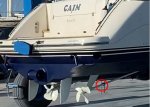
I dove under the boat few days back and noticed that the front shaft anods have moved from it's original place.

I was told by the diver who is going to replaced the damaged anods that the location of the shaft anods has to be carefully measured to avoid unnecessary shaft vibration and damage.


For that reason i have contacted the local princess dealer and i was shock to know that princess don't require any shaft anods. But he says that i can keep them if i want to.
(anodes were installed by the previous boat owner)

I am currently suffering from mild vibration that increase with the hire RPM.


do you guys recommend me to keep or remove the shaft anodes? Giving that i live in Dubai where it gets really hot during summer and my rudder anods get eaten up really fast.


Best regards.
 

Attachments

  • Screenshot_20220226-132027_WhatsApp.jpg
    Screenshot_20220226-132027_WhatsApp.jpg
    555.2 KB · Views: 22
  • Screenshot_20220226-131938_WhatsApp.jpg
    Screenshot_20220226-131938_WhatsApp.jpg
    576.9 KB · Views: 22
Last edited:
I have an Atlantic 42 with no shaft anodes fitted, ever (since 2002). The shafts are in perfect condition and protected (according to the surveyor) through linkage to the anodes on the transom and trim tabs, which are all wired together. I was thinking of adding them but was cautioned about over protection (not sure what that entails TBH.
 
Duff electro eliminators work well. I have both electro eliminators and a shaft anode on each shaft on a 48ft boat.

Firstly know the diameter of your shafts probably 2 inch ( if so don't fit 50mm anodes) there is a knack to fitting them using two hammers before you tighten the bolts, they need to be snug.

You don't need two shaft anodes.

Fit a stainless jubilee clip above and below the shaft anode to stop the anode moving up or down the shaft .

Do P 45's have rudder anodes?

Does your boat have Electro eliminators, if not fit them. Some boats were connected through couplings, gearbox and engine not always effective.

I would say the previous owner was a bit of a bodger, get back to first principles, when the boat is out of the water check the continuity as Andy says above for all met skin fittings, shafts, rudders, P brackets and work out which anodes they are connected to (or not) check all wiring to anodes and fittings, check joints are clean and not corroded, if you replace any corroded wiring use tinned cable.
 
Shaft anodes.
I have never understood the logic of shaft anodes.
That is -as long as you have a good electrical contact between the shafts and the boats earth bonding system,
Think about it.
What do the anodes do?
They create an electrical flow between the anodes and the cathodes (in this case, the cathodes are the props)
The main hull anodes are connected to the boats earth.
The cathodes (props) are on the end of the shafts.
So the electrical flow will be between the hull anodes and the props.
This assumes that you have good electrical brushes inside the boat that electrically connect the boats earth to the shafts.

So, my point is why on earth (excuse the pun) would you want to upset that flow by fitting shaft anodes in the middle of the electrical circuit?
IMO you would get current flowing in all sorts of directions.
I believe that shaft anode are great if you haven't got a good electrical connection between the shafts and the boat's earth system.

But we are talking about a Princess here and Princess do it properly.
So, I'm in agreement with the local Princess dealer that you don't need them.

I haven't got shaft anodes on my Princess 67.

However, I noticed the other day that @John100156 does have them on his Princess 45.
 
..
Shaft anodes.
I have never understood the logic of shaft anodes.
That is -as long as you have a good electrical contact between the shafts and the boats earth bonding system,
Think about it.
What do the anodes do?
They create an electrical flow between the anodes and the cathodes (in this case, the cathodes are the props)
The main hull anodes are connected to the boats earth.
The cathodes (props) are on the end of the shafts.
So the electrical flow will be between the hull anodes and the props.
This assumes that you have good electrical brushes inside the boat that electrically connect the boats earth to the shafts.

So, my point is why on earth (excuse the pun) would you want to upset that flow by fitting shaft anodes in the middle of the electrical circuit?
IMO you would get current flowing in all sorts of directions.
I believe that shaft anode are great if you haven't got a good electrical connection between the shafts and the boat's earth system.

But we are talking about a Princess here and Princess do it properly.
So, I'm in agreement with the local Princess dealer that you don't need them.

I haven't got shaft anodes on my Princess 67.

However, I noticed the other day that @John100156 does have them on his Princess 45.


I totally agree with you. But i guess there is no harm of having shaft anods.

But my only concern would be where exactly shold i place the anods so that it won't create unnecessary vibration.


I guess we have to wait to see what @John100156 can recommend


Best Regards.
 
Hi. No need for them to be honest. These were originally set up with hull anodes with conjoined wiring to all external gear. Our family have a 33 year old Princess 385 that’s had a set up like this since new. As long as there is continuity between them all…nothing to worry about.
 
I too was always concerned about a changing weight/mass rotating on a shaft, but as it was between two bearing points (whether that makes any significant difference I don't know), I just re-fitted them anyway, as they were on the boat when I bought her. Never noticed any vibration issues even though one shaft anode was eroded when lifted. I will check voltages and continuity when next lifted, just in case, but they seem to be doing something....! Located as follows: Doc1.jpg
 
If you are going to fit prop anodes - and it is a moot point whether they are necessary if the hull anode is sited correctly and properly bonded to the shaft - then the accepted best location is about 25-30mm forward of the P bracket. This puts them closest to the thing they are protecting (the prop) and cause the least interference with water flow. You may well find they deplete first simply because they are closer to the prop, and therefore the hull anode less. They do no harm, but if the hull anodes don't disappear quickly then maybe not worth fitting.
 
If you are going to fit prop anodes - and it is a moot point whether they are necessary if the hull anode is sited correctly and properly bonded to the shaft - then the accepted best location is about 25-30mm forward of the P bracket. This puts them closest to the thing they are protecting (the prop) and cause the least interference with water flow. You may well find they deplete first simply because they are closer to the prop, and therefore the hull anode less. They do no harm, but if the hull anodes don't disappear quickly then maybe not worth fitting.

I don't think that there is enough space in front of the bracket
 
I don't mean between the P bracket and the prop - that is definitely a no-no. but like the photo above but moved aft on the shaft to within approx 30mm of the P bracket - you need that space for water flow through the cutless
 
I have seen shaft anodes without jubilee clips move up the shaft and damage the hull and down the shaft to block water flow to the 'P' bracket cutless bearing and overheat that.
 
I have seen shaft anodes without jubilee clips move up the shaft and damage the hull and down the shaft to block water flow to the 'P' bracket cutless bearing and overheat that.
If they are the type that has a liner of the right size and are properly installed then they should not move on the shaft.
 
I have just been having a very similar conversation with a boat owning friend. I have just bought an Aquador 32 and need to replace all the anodes - partly wear and partly as they are magnesium from the boat living in fresh water. Do I just replace like for like and hope that they were done right in the first place or do I tinker and potentially get it wrong?
Currently, another bad pun, one on each of the trim tabs, one on the shaft and one on each of the twin rudders. haven't found a hull anode yet and none on the prop nut.
 
If you are going to fit prop anodes - and it is a moot point whether they are necessary if the hull anode is sited correctly and properly bonded to the shaft - then the accepted best location is about 25-30mm forward of the P bracket. This puts them closest to the thing they are protecting (the prop) and cause the least interference with water flow. You may well find they deplete first simply because they are closer to the prop, and therefore the hull anode less. They do no harm, but if the hull anodes don't disappear quickly then maybe not worth fitting.

Interesting and informative many thanks. I am still not 100% convinced so may leave them off next time, after thoroughly checking all bonding systems, to see what impact it may have on main hull anodes - we shall see! Mind you, rather loose some zinc than the props!
 
I saw one badly corroded twin engine mobo, props and "P" brackets very badly corroded, the anodes were in excellent condition?

The problem was the boat owner had used plain stainless washers on the anodes and not serrated washers and there was no good electrical connectivity.
 
I have just been having a very similar conversation with a boat owning friend. I have just bought an Aquador 32 and need to replace all the anodes - partly wear and partly as they are magnesium from the boat living in fresh water. Do I just replace like for like and hope that they were done right in the first place or do I tinker and potentially get it wrong?
Currently, another bad pun, one on each of the trim tabs, one on the shaft and one on each of the twin rudders. haven't found a hull anode yet and none on the prop nut.
Only reason for having a hull anode is to protect the prop through bonding it to the shaft via the gearbox or brushes direct to the shaft inside. Expect the shaft anode is doing that job so hull anode not necessary.
 
So, why not have anodes on the rudders?
I know that some boats do - but a Princess?
I'm sorry, I don't agree that shaft anodes are necessary if the bonging system is good.
There are usually anodes on the thrusters though for different reasons.
 
The rudder anodes are probably there because they are made of mixed metals such as stainless stock and bronze blades.

There is not one best system for protecting mixed metal assemblies in sea water. Just because one builder uses one method does not mean another cannot be equally effective and shaft anodes can be very effective and avoid the need for a hull anode and all the potential difficulties of bonding to the shaft. Equally many boats use anodes on the prop itself - for example many Beneteaus.

On a boat like the Princess that has a good system using hull anodes there may still be a case for adding a shaft anode if the depletion rate is high as the shaft anode will deplete first so extending the life of the hull anode.
 
So, why not have anodes on the rudders?
I know that some boats do - but a Princess?
I'm sorry, I don't agree that shaft anodes are necessary if the bonging system is good.
There are usually anodes on the thrusters though for different reasons.
Totally agree with you. They aren’t. I’m almost certain that originally, a hull anode with bonding would be what was installed. Any boat I’ve known similar is set up as such.
 
Top