Princess 45 Refit

Great idea using the tablets. I’m going to replace my old Furuno radar with a Raymarine Quantum that will connect to my Axiom 9. I will have a gap left so I think I’ll get a tablet to run Navionics, Savvy Navvy, etc. The Doogee U11 looks decent and some packages have a mouse which could be handy.
You can use the Raymarine app too, should mirror the Axiom.
 
Did you have to change the engine sensors to suit the new gauges. Lovely wiring job.
I am still discovering/unravelling 40 years of DIY wiring. Not sure what some of it ever did.
 
Well that was the easy part of the lower helm job. Removing the walnut effect panel reveals this mess. I don’t think carpentry was a previous owner speciality, neither was wiring.

View attachment 203035

Then this, Oh dear!

Stop laughing at the back.

View attachment 203036

A new ply panel fitted for the replacement gauges. New gauges slightly bigger, so the holes have been enlarged accordingly. The new gauges secure the walnut effect panel. The switches are next to impossible to see as they are lying flat and they do not illuminate, so I cut a slot beneath the gauges for them. All of the switches were replaced by new ones that illuminate.

View attachment 203037

Gauges and switches fitted. Finding a full set of matching switch tops in the UK proved difficult, but I found a company in the US that had everything I needed. The warning buzzers, which were previously just hanging on the wires behind the gauges, are now fitted to where the key switches were, the key switches are being replaced by stop/start switches

View attachment 203038

What a mess! The thick cables are the engine harnesses, one from each engine to the three way adapter, one from each adapter to the flybridge helm and the final one, chopped very short, going to the lower helm instruments. It’s a miracle anything worked.

View attachment 203039

Removed the wiring and gauges, fitted a new ply panel and installed the new gauges. Also fitted the new switches and wired them up.

View attachment 203040

Made a new wiring harness for the gauges and connected it to the DIN rail mounted Wago connectors.

View attachment 203041


The connectors needed 2, 3 or 4 wires so for neatness I used 4 way connecters throughout. I divided them into three groups, port engine, starboard engine and everything else. The engine harnesses had been cut stupidly short, so they were extended using the original cable colours, soldered and heat shrunk. Bootlace ferules are crimped onto the ends of the wires, which are then inserted into the Wago connectors. A small screwdriver inserted into the square hole next to the wire releases it.

Top right in the picture is an Actisense EMU1, which is connected to the analogue engine sensors, converting the data to NMEA2000 and putting this onto the NMEA2000 network.

View attachment 203042

The panel next to the engine controls has the non-operational Cetrek autopilot controller and a redundant hailer/intercom fitted, both of which were removed.

View attachment 203043

In their place, an engine stop/start panel to replace the key switches removed earlier. The power switch operates a latching relay so the power can be turned on/off from either helm. Drat, mistyped "Papa", will correct that later as i have some EGT alarms to add to that panel.

View attachment 203044


All finished!

View attachment 203045

View attachment 203046
Wiring looks almost professional…..

😀

Seriously, great thread. Inspirational.

BTW I had an iPad for my lower helm nav two boats ago. That had the first gen of raymarine that had the mirroring in a tablet. Makes loads of sense.
 
Did you have to change the engine sensors to suit the new gauges.
No, i used KUS gauges , EU resistance and they work spot on.
Lovely wiring job.
Thanks.
I am still discovering/unravelling 40 years of DIY wiring. Not sure what some of it ever did.
This was advertised as being "professionally rewired" 🤣

Stripped miles of redundant wiring out, something that's a common thing with my day job.
 
Top right in the picture is an Actisense EMU1, which is connected to the analogue engine sensors, converting the data to NMEA2000 and putting this onto the NMEA2000 network.

View attachment 203042

Notice you have one of the Chinese engine converters there as well. How do you find the Actisense EMU1?

I bought an AlbaCombi but tbh I think it’s a bit crap and wish I bought the EMU1.
 
Notice you have one of the Chinese engine converters there as well. How do you find the Actisense EMU1?

I bought an AlbaCombi but tbh I think it’s a bit crap and wish I bought the EMU1.
The Chinese one wasn't very successful, i suspect because it was in parallel with the analogue gauges at the lower helm. At the time i took that pic it was connected to the water tank sender and worked fine with that, as it wasn't connected to a gauge. Shortly after the pic was taken i fitted the Cerbo, connected the tank sender to that and removed the Chinese converter. The Actisesne is very good, once set up i forgot about it. Needs a NGT-1 to program it, but i left that in place so i can see N2K data on the ships computer, OpenCPN can make use of that.
 
Well that was the easy part of the lower helm job. Removing the walnut effect panel reveals this mess. I don’t think carpentry was a previous owner speciality, neither was wiring.

View attachment 203035

Then this, Oh dear!

Stop laughing at the back.

View attachment 203036

A new ply panel fitted for the replacement gauges. New gauges slightly bigger, so the holes have been enlarged accordingly. The new gauges secure the walnut effect panel. The switches are next to impossible to see as they are lying flat and they do not illuminate, so I cut a slot beneath the gauges for them. All of the switches were replaced by new ones that illuminate.

View attachment 203037

Gauges and switches fitted. Finding a full set of matching switch tops in the UK proved difficult, but I found a company in the US that had everything I needed. The warning buzzers, which were previously just hanging on the wires behind the gauges, are now fitted to where the key switches were, the key switches are being replaced by stop/start switches

View attachment 203038

What a mess! The thick cables are the engine harnesses, one from each engine to the three way adapter, one from each adapter to the flybridge helm and the final one, chopped very short, going to the lower helm instruments. It’s a miracle anything worked.

View attachment 203039

Removed the wiring and gauges, fitted a new ply panel and installed the new gauges. Also fitted the new switches and wired them up.

View attachment 203040

Made a new wiring harness for the gauges and connected it to the DIN rail mounted Wago connectors.

View attachment 203041


The connectors needed 2, 3 or 4 wires so for neatness I used 4 way connecters throughout. I divided them into three groups, port engine, starboard engine and everything else. The engine harnesses had been cut stupidly short, so they were extended using the original cable colours, soldered and heat shrunk. Bootlace ferules are crimped onto the ends of the wires, which are then inserted into the Wago connectors. A small screwdriver inserted into the square hole next to the wire releases it.

Top right in the picture is an Actisense EMU1, which is connected to the analogue engine sensors, converting the data to NMEA2000 and putting this onto the NMEA2000 network.

View attachment 203042

The panel next to the engine controls has the non-operational Cetrek autopilot controller and a redundant hailer/intercom fitted, both of which were removed.

View attachment 203043

In their place, an engine stop/start panel to replace the key switches removed earlier. The power switch operates a latching relay so the power can be turned on/off from either helm. Drat, mistyped "Papa", will correct that later as i have some EGT alarms to add to that panel.

View attachment 203044


All finished!

View attachment 203045

View attachment 203046
Well - All normal mess and chaos in older boats: I have made similar experiences in my Azi 46 from 2001 ... the two former owners and some (unknown wizzards) have done some installations out of any good electrical rules ...

Paul - you will have a great, refit boat with professional (and stable) installations.
 
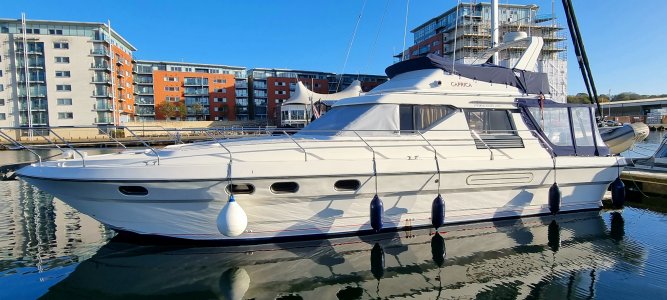
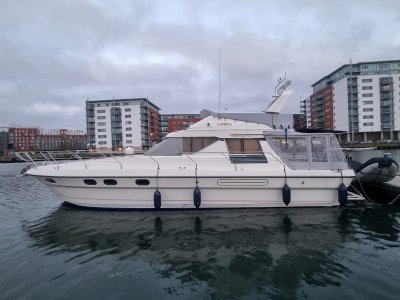
The cockpit enclosure was getting rather tired, time for a new one. We decided the navy looked a bit dreary, so we decided to go with a more modern grey. Only problem being, the flybridge cover will have to be changed too.

Here's the before ;

Caprica-Aurora.jpg

Was a nice day today for fitting, here's the result, will repaint the grey vent in the lighter grey that's just above the waterline.

Caprica-Aurora 2.jpg
 
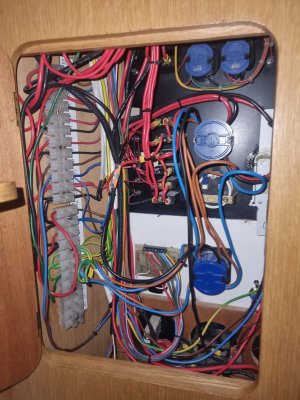
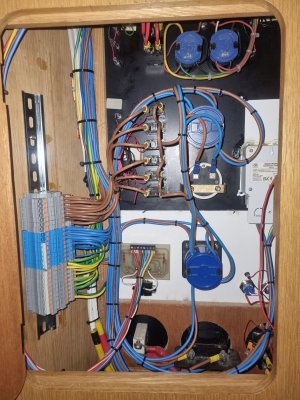
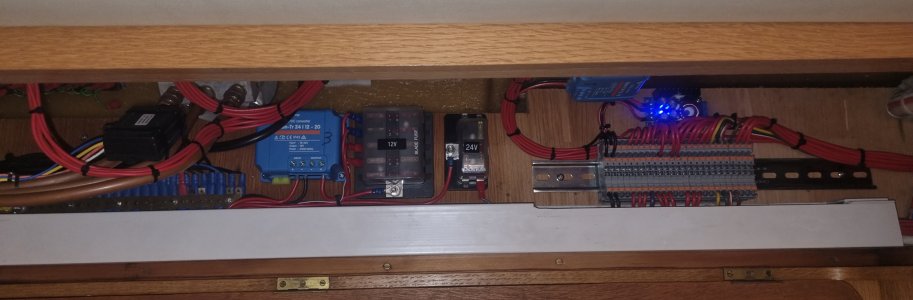
There is a little cupboard in the guest cabin that accesses the back of the switch panel. It's a mix of 24VDC and 240VAC, being built in 1988 the AC wiring was red and black, rather than the current brown and blue. It was also rather untidy and featured a big strip of chocolate block connectors, one of my pet hates.

20251024_141003.jpg

Changed the AC wiring to brown and blue (the red ones right at the top are DC). Replaced the circuit breakers for one with spade connections, rather than the screw on ones, less chance of touching live AC, will make a cover for the back of the volt meter. Gone are the chocolate block connectors, replaced with DIN rail mounted Wago connectors.


20251028_142211.jpg

Another small cupboard above the bunks (back of the helm) also had a large strip of chocolate block connectors in it, these were also removed and replaced with DIN rail mounted Wago connectors.

20251023_171350.jpg


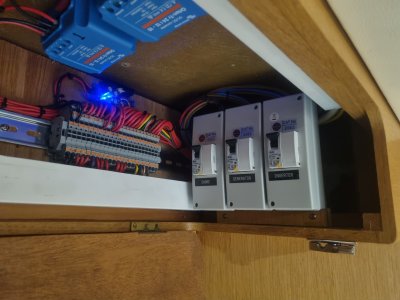
When the boat was built it was not fitted with an RCD, one was fitted subsequently to the incoming shore power, but no-one thought to fit one for the generator. I have fitted a 3Kw inverter, which also needs an RCD on it's output. I removed the old RCD on the shore power inlet and fitted 3 new RCBOs, one for shore power in, one for the generator and another for the inverter output.

20260127_125319.jpg
 
Top