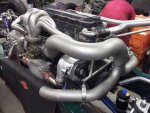
Princess 43 with bigger engines

volvopaul

Well-Known Member
Joined
1 Apr 2007
Messages
9,065
Location
midlands
hotmail.co.uk
At last the 43 is offered with the motors it deserves.
I did think at its launch twin 435 D6 motors would not be enough, sure after talking to the men in overalls it was true, some boats only achieving less than the brochure stated speeds empty on stores and fuel.

The boats now offered with Cummins 6.7 litres engines which will make it feel effortless to drive I'm sure, I don't think I've seen a Cummins engine in a Princess flybridge boat since the 35 way back in the late 80s which was a humble 250 hp 6BT unit, which have the same feel I'm sure as this new model.

I did wonder if Princess might have squeezed the D9 500 or 575 as I'd bet it would fit the new design hull quite easy.

You can bet the Cummins unit was a lot cheaper, only downfall will be the lack of dealers compared to the green engine outlets which are a bit mcDonalds, one on every stretch of the South Coast here in the UK! Let's hope it had proper sea trials and engineers on board to test loads and tweak the prop sizes to ultimate fuel economy, balance and vibration and of course speed.

Looking forward to the results and test, I was only nosing around two boats here yesterday that are for sale new or nearly new, both which I'd guess have D6 motors in.
You all know I'm a VP man but have serviced many of Cummins QSB lumps and I will openly admit there a lot smoother and quieter .

Anyone out there looking for a new 43?
 
Any idea why they didn't use the d9's?

My guess is weight (and cost as already noted). The added weight cancels out much of the extra power.
Here is a short list of possible power alternatives. Maybe you can see D9 stands out quite a bit. All weights are bobtail, so add transmissions

2X Volvo D6: max 870hp, 1190kg
2X FPT N60: max 960hp, 1190kg
2X Cummins QSB 5.9: max 960hp, 1230kg
2X Cummins QSB 6.7: max 1100hp, 1320kg
2X FPT N67: max 1140hp, 1300kg
2X Volvo D9: max 1150hp, 2150kg

Why not FPT N67-500 (former Iveco). They would be more than powerful enough and probably even a good deal cheaper than Cummins. Deliver rated power at lower rpm than Cummns too (3000rm vs. 3300rpm)
 
Last edited:
The p42 goes better with the older tamd75 480 hp engines though it's heavier than the D6 model, the p43 is a stunning boat, another 1000kg with D9 would sort it but the expense would probably kill the deal.
I'm keen to see the rest report.
 
If prop curves are similar the power of D6-435 at 3000rpm is 287hp vs Cummins engine at same prop power circa 2600rpm. The MBM review showed D6 pushing boat along at 20 knots at 3000rpm, does that mean cummins powered boat will cruise at 20 knots at 2600rpm? Soon find out.

Seems a lot more torque for slight increase in capacity / stroke, are they running higher boost?
 
Why not FPT N67-500 (former Iveco). They would be more than powerful enough and probably even a good deal cheaper than Cummins. Deliver rated power at lower rpm than Cummns too (3000rm vs. 3300rpm)

Hugin, curious to know why 3,000 rpm is a better rated speed than 3,300??
 
Hugin, curious to know why 3,000 rpm is a better rated speed than 3,300??

Minor point really.... only that all things else in this universe being equal slower revving engines should in theory last longer. I suppose there could also be a difference in perceived noise.
 
Minor point really.... only that all things else in this universe being equal slower revving engines should in theory last longer. I suppose there could also be a difference in perceived noise.

When you drill deeper things not quite what they seem.

Iveco NEF got to 6.7 litres by offset grinding crank pin reducing rod bearing diameter in the process bore and stroke 104 X 132mm giving piston speed at 3,000 rpm rated speed 11.4 meters/sec.

Cummins got to 6.7 litres by reversing the con rod and designing a brand new crank keeping original bearing area so bore and stroke is 107 X 124mm , different bore/stroke ratio keeps piston speed down to 13.6 meters/sec. Producing higher output as lower speed dramatically increases cylinder pressure potentially effecting head gasket integrity and potential reliability. Iveco use 3,300 rpm for race versions of their NEf 6.7 however having 132mm stroke takes piston speed into uncharted 14.5 metres/sec territory.

Iveco use Bosch ECU and software, Cummins use their own engine control software, there is an effective and patented noise algorithm and despite have 300 rpm greater rated speed QSB is quieter than the NEF.
Volvo D6 is 103 X`110mm, despite a rated speed of 3,500 rpm however piston speed of 12.9 meters/sec.

CAT set the record for leisure rated engines with the C18, 145 X 183mm stroke which gives piston speed of 14.03 meters/sec. Nobody has ever questioned C18 durability.

As to VP's comparison between VP 6o and 70 series I have always found transient response of the 70's far better than 60's, in this case suspect situation is possibly reversed, QSB 6.7 transient response is incredible, and despite difference in cubes suspect it is in fact better than D9.

As to pricing Cummins charge $$ per hp and as power density has value suspect price difference is pretty small.

Full report will be interesting.
 
Last edited:
I may be wrong but I thought Volvo had stopped the D9 - I think they are still supplying it as a commercial only motor but not for pleasure craft. I was told they where going to crank the D6 upto 500bhp. This may be completely wrong but it was something I was told at the boatshow by one of the manufacturers.
 
When you drill deeper things not quite what they seem.

I am not even going to try refuting any of your obviously quite specific technical knowledge.... as I wrote, it's was a minor point.

Regarding pricing, then I have read about it on a US-centric boat forum maybe a year ago, where Cummins vs FPT was discussed. 3-4 boat owners had apparently received very favorable quotes for FPT engines, making them significantly cheaper than comparable Cummins engines. Considering Cummins is probably a brand held in generally higher esteem than the relatively unknown FPT (few have a clue until you say Iveco) it is hardly surprising FPT tries to gain market share with very attractive prices.
 
Last edited:
D9 still on VPs global website, so we can assume still in production and marketed

500hp from a D6 seems a bit steep, but who knows.... after all there are quite many leisure diesels getting close to 100hp/liter now... a few (smaller engines) even slightly above 100hp/liter.
 
Surely the better solution is reducing the overall weight of the boat.

Better use of light weight materials such as carbon fibre seems like the obvious answer where possible.

I know there is a cost to this technology but economy's of scale could mitigate some of the cost.

Just a thought
 
Surely the better solution is reducing the overall weight of the boat.

Better use of light weight materials such as carbon fibre seems like the obvious answer where possible.

I know there is a cost to this technology but economy's of scale could mitigate some of the cost.

Just a thought

You would have to be carefull taking too much weight away as you will then affect the handling and comfort in a less than flat sea state.
 
You would have to be carefull taking too much weight away as you will then affect the handling and comfort in a less than flat sea state.

Sure but marine design and materials must have developed by now to make stronger/lighter boats thus allowing smaller engines to produce 25knt plus planning speeds.
The weight of a Deisel engine is what it is until someone invents a lighter weight alternative material for the block, therefore the materials that the boat is made of is one of the few factors that can be looked at.
I accept that making the Hull from Carbon Fibre is going to be expensive but could it not be used in strength critical areas or internally for bulkheads etc?
 
............I accept that making the Hull from Carbon Fibre is going to be expensive but could it not be used in strength critical areas or internally for bulkheads etc?
Remember that a lot of weight is carried above waterline, so just looking at hull will affect COG (Centre of Gravity) ... so whole design needs to be looked at, not just hull structure...
 
Top