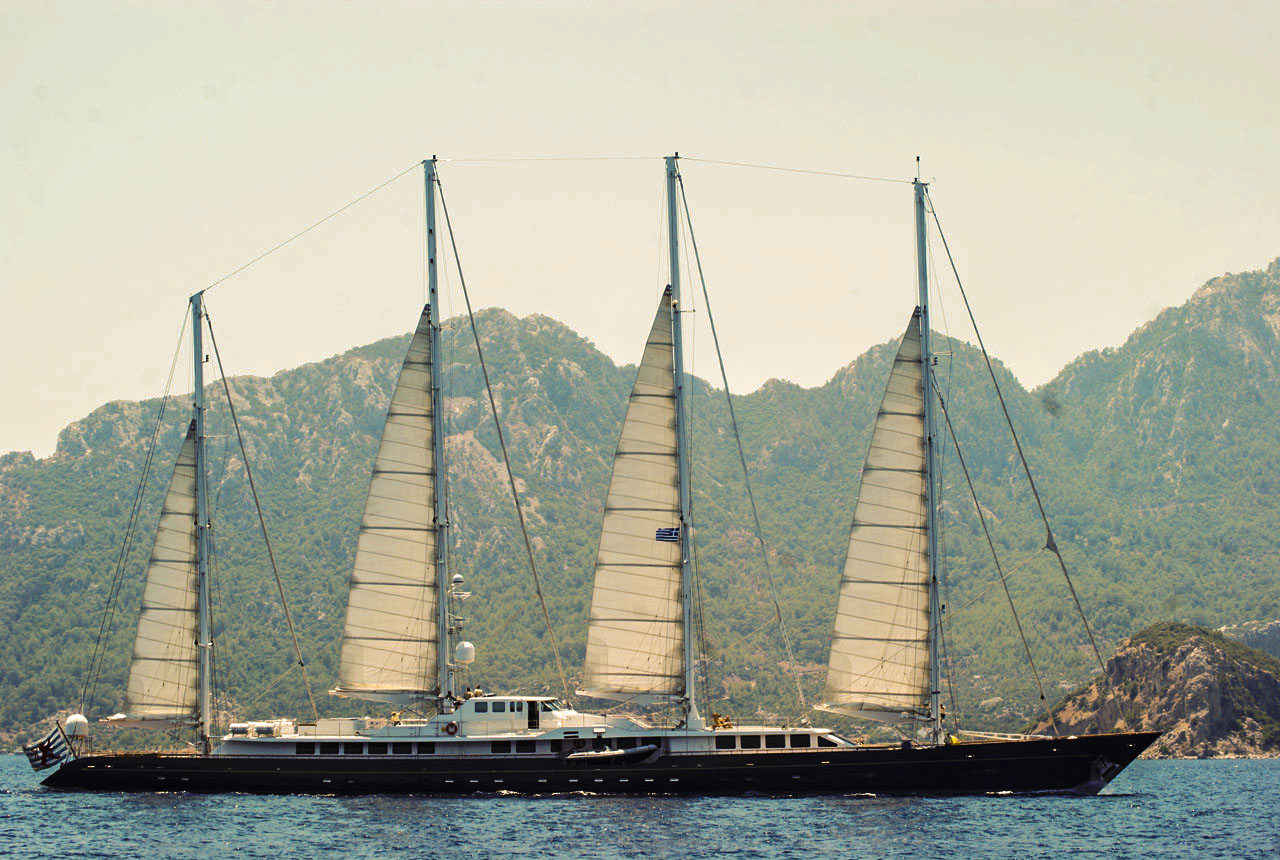
Portrait of the ideal boat.

Have a look at the Ovni range. Very similar and some older ones as small as 34', current smallest 36'. However, they don't have the hard shelter. It is really difficult both functionally and aesthetically to have that feature under about 45ft without it looking like a shed stuck on top. A good collapsible sprayhood is a compromise but is still effective.

Once you get to the larger sizes there are many custom and semi custom designs available that meet the brief - just that like this one they require deep pockets to buy so only only made in very small numbers.

I spoke to the OVNI people at the show last year and they said that if I wanted a hard shelter they could do it.
 
I did not read all this thread but....

Amel ticks all boxes for their older boats.

Apparently, the newest ones have mast and quality problems..

Guess who is thinking Super Maramu in near future.... GF wants to sail to Galapagos and Tahiti via Caribbean etc. We have to agree don't we??:D:D
 
It is really difficult both functionally and aesthetically to have that feature under about 45ft without it looking like a shed stuck on top.
This worried me inordinately before I made the decision to buy my boat because aesthetically the dog-house does look like afterthought garden greenhouse plonked onto the stern of a somewhat tubby sailing boat. How important is form over function? How important is the so-called 'row-away' factor?

Then I thought of how fashion in all things changes. To this ancient the modern AWB looks awful with the fat stern, flat sheer and plumb bow but to most younger sailors they certainly look great. Fashion in clothes show us that yesterday's models look distinctly weird to our eyes. Our standard perception of what is acceptable - even of beauty - is transitory and subjective, it changes with familiarity; what becomes the norm becomes the standard with which to judge all.

In my working life I once became part-responsible for a new self-service banking product planned to be introduced internationally and the final cabinet shape was to be decided. I studied similar products world-wide and discovered how the shape of them had evolved and how geographic dispersion once dictated their form. Japan followed the US in preferring flat, rectangular forms while Europe favoured curves. Eventually modern travel, communications and manufacturing globalisation have evolved a standard product that for most consumers looks best. For now - tomorrow it will look ugly and dated. Nowhere was this psychological quirk more exploited than in the automotive industry of Detroit during its heyday when each year the identical chassis and engine was wheeled out under a different body shape. Suddenly, last year's model looked passé.

So as for buying my boat I eventually decided that function was more important than form. And you know what? Time and familiarity have mellowed my perception of my boat; no longer do I see an unsightly blister on the back, I see a functional and proportional whole. Perhaps what I am beginning to see is what the two eminent naval architects, Olle Enderlein and Christoph Rassy, influenced by the legendary designs of Colin Archer, saw when they first drew her lines back in 1980.

Beauty is indeed in the eye of the beholder.
 
Last edited:
This worried me inordinately before I made the decision to buy my boat because aesthetically the dog-house does look like afterthought garden greenhouse plonked onto the stern of a somewhat tubby sailing boat. How important is form over function? How important is the so-called 'row-away' factor?

Then I thought of how fashion in all things changes. To this ancient the modern AWB looks awful with the fat stern, flat sheer and plumb bow but to most younger sailors they certainly look great. Fashion in clothes show us that yesterday's models look distinctly weird to our eyes. Our standard perception of what is acceptable - even of beauty - is transitory and subjective, it changes with familiarity; what becomes the norm becomes the standard with which to judge all.

In my working life I once became part-responsible for a new self-service banking product planned to be introduced internationally and the final cabinet shape was to be decided. I studied similar products world-wide and discovered how the shape of them had evolved and how geographic dispersion once dictated their form. Japan followed the US in preferring flat forms while Europe favoured curves. Eventually modern travel, communications and manufacturing globalisation have evolved a standard product that for most consumers looks best. For now - tomorrow it will look ugly and dated.

So as for buying my boat I eventually decided that function was more important than form. And you know what? Time and familiarity have mellowed my perception of my boat; no longer do I see an unsightly blister on the back, I see a functional and proportional whole. Beauty is indeed in the eye of the beholder.

I subscribe pretty much to your philosophy. Even if the boat isn't all that attractive but is very comfortable - well you are inside looking out.

I have a few books of yacht plans which date from the 70's and 80's. In them I see some designs which really make my mouth water, notably those of Michel Bigoin, the architect of Club Méditerranée.
 
This worried me inordinately before I made the decision to buy my boat because aesthetically the dog-house does look like afterthought garden greenhouse plonked onto the stern of a somewhat tubby sailing boat. How important is form over function? How important is the so-called 'row-away' factor?

Then I thought of how fashion in all things changes. To this ancient the modern AWB looks awful with the fat stern, flat sheer and plumb bow but to most younger sailors they certainly look great. Fashion in clothes show us that yesterday's models look distinctly weird to our eyes. Our standard perception of what is acceptable - even of beauty - is transitory and subjective, it changes with familiarity; what becomes the norm becomes the standard with which to judge all.

In my working life I once became part-responsible for a new self-service banking product planned to be introduced internationally and the final cabinet shape was to be decided. I studied similar products world-wide and discovered how the shape of them had evolved and how geographic dispersion once dictated their form. Japan followed the US in preferring flat forms while Europe favoured curves. Eventually modern travel, communications and manufacturing globalisation have evolved a standard product that for most consumers looks best. For now - tomorrow it will look ugly and dated.

So as for buying my boat I eventually decided that function was more important than form. And you know what? Time and familiarity have mellowed my perception of my boat; no longer do I see an unsightly blister on the back, I see a functional and proportional whole. Beauty is indeed in the eye of the beholder.

You are right about fashion. Many of the wheel shelter more sailor than motor type boats come from a different era. Where I am there are quite a lot - Halberdiers, Nabs, Barbarys, Atlantics etc. Would have been bought new by people driving around in Aunty Rovers and with G Plan furniture in their houses. You see what you want to see, so if your mind is set on practicality, ruggedness etc then such boats are highly desirable.

Last year there was a Halberdier sold in Poole that had been through the ultimate makeover and was essentially a new boat. It sold for under £70k - less than the cost of the refit. A newly built boat to a similar standard would be at least £200k. Gives some idea of how things are valued and why attempts to build "practical" boats new are usually failures.

There was a glimmer of hope when the new style deckhouse cruisers came in (Bavaria Vision, Jeanneau DS etc) that practicality would be possible, but all they really do is offer more headroom so you seem to be getting "more" for your money - and of course the swoopy styling.
 
I subscribe pretty much to your philosophy. Even if the boat isn't all that attractive but is very comfortable - well you are inside looking out.

I have a few books of yacht plans which date from the 70's and 80's. In them I see some designs which really make my mouth water, notably those of Michel Bigoin, the architect of Club Méditerranée.

Hmm...not completely sure I follow the philosophy there. Granted, acknowledgement of attractive/appealing hulls/superstructures/rigs varies over time, but already today, we can look at rigs of 20/40/80 or more years ago and form strong likes and dislikes...

...so, no reason to assume that what is seen as ugly or awkward today, will necessarily wear well. On the other hand, I reckon sheer unpretentious practicality has a powerful honest appeal - I don't really dislike the way Catalacs look, however inorganic their proportions.

I think Club Med is one of those vessels I'd prefer to be inside, looking out of, than have to behold from the near distance...

Phoc%C3%A9a_-_Luxembourg.jpg


Reminds me of the Red Jet, passing a fleet of racers. :)

Anyway, personally, I reckon beauty, as an elemental marketing mother-lode, has been abandoned long since.

When designers gave up overhangs, short waterlines, curvy sheerlines and flush decks, they were collectively bending over to be kicked and bossed by the great god Efficiency, for whom any and every possible performance-improving sacrifice must apparently be made. :mad:

All we can do with the industry as it is, is suggest that a definite (if diminutive) portion of the market, would greatly value the designer's best plan for making just two people comfortable aboard a 30-footer, two couples comfortable on a 40-footer, three aboard 50-ft...

...and urge the designers to see they might break new ground by applying their brains to a collapsible bolt-on cockpit hard-top, stowable in the forepeak in fine weather, thereby restoring whatever beauty there was in the yacht's brochure-pictures, captured in hot, dreamy weather, so rare in the UK.
 
Last edited:
Sorry, I'm still drifting on about "lost beauty".

I s'pose not only performance-efficiency has shaped the modern cruising yacht, inside and out, but also space-efficiency (and thus cost-efficiency); greater space within a given LOA being greeted only ever as a good thing (I begin to suspect less is more). :rolleyes:

I find it a dismal irony, that in an age when we can construct rugged, light, spacious hulls to any form we choose, our 1st choice is graceless as a shoebox. Modern ownership isn't a fraction as frustrating and exhausting and maintenance-intensive, as fifty years ago...

...yet the pleasure of ownership must be likewise lessened, relatively, by the popular AWB's artlessly efficient caravanesque form.

Hence so many old (and not-so-old) persons, cheering the sight of restored 'classics' and feeling downcast at boatshows. :(
 
I s'pose not only performance-efficiency has shaped the modern cruising yacht, inside and out, but also space-efficiency (and thus cost-efficiency); greater space within a given LOA being greeted only ever as a good thing (I begin to suspect less is more). :rolleyes:

I find it a dismal irony, that in an age when we can construct rugged, light, spacious hulls to any form we choose, our 1st choice is graceless as a shoebox. Modern ownership isn't a fraction as frustrating and exhausting and maintenance-intensive, as fifty years ago...

...yet the pleasure of ownership must be likewise lessened, relatively, by the popular AWB's artlessly efficient caravanesque form.

Hence so many old (and not-so-old) persons, cheering the sight of restored 'classics' and feeling downcast at boatshows. :(

Some years ago my old girl was on a hammerhead at Woolverstone and on the other hammerhead was a very big Oyster. As I was paying my bill in the office, the duty boatman came in and remarked that he had asked everyone he had taken on or off that day "which boat they would most like to own" and without exception they had pointed at mine, not the expensive new one.

(I agree with the list in the OP, by the way)
 
So, nobody suggesting that a big rigid cockpit enclosure has any actual downsides other than aesthetic? e.g. increased windage, or decreasing the helm's wind awareness? Maybe these 'problems' are blown out of all proportion by the few that cite them.

On another point- I find I spend very little time actually helming, unless it is one of those days where the wind is just right and you actually want to do it. If just putting miles under the keel it is autopilot or windvane all the way. In which case all you need is slightly improved cabin visibility, not a full blown inside steering position.
 
I did not read all this thread but....

Amel ticks all boxes for their older boats.

Apparently, the newest ones have mast and quality problems..

Guess who is thinking Super Maramu in near future.... GF wants to sail to Galapagos and Tahiti via Caribbean etc. We have to agree don't we??:D:D

Good choice even the Santorin at 45' which would be my choice as it will get into harbours where the Super Maramu 53' might not.
 
Yes, one of the advantages of aluminium construction. Wonder whether they have actually done it, though.

That I don't know but I saw an aluminium boat that looked from a distance like an OVNI which had an enclosed bridge a little like the Boreal.
 
You are right about fashion. Many of the wheel shelter more sailor than motor type boats come from a different era. Where I am there are quite a lot - Halberdiers, Nabs, Barbarys, Atlantics etc. Would have been bought new by people driving around in Aunty Rovers and with G Plan furniture in their houses. You see what you want to see, so if your mind is set on practicality, ruggedness etc then such boats are highly desirable.

Last year there was a Halberdier sold in Poole that had been through the ultimate makeover and was essentially a new boat. It sold for under £70k - less than the cost of the refit. A newly built boat to a similar standard would be at least £200k. Gives some idea of how things are valued and why attempts to build "practical" boats new are usually failures.

I have the photos in my scrap book!

There was a glimmer of hope when the new style deckhouse cruisers came in (Bavaria Vision, Jeanneau DS etc) that practicality would be possible, but all they really do is offer more headroom so you seem to be getting "more" for your money - and of course the swoopy styling.

That's what I thought until I actually tried one: a Jeanneau DS. I found it very disappointing and was much more comfortable in their same-sized normal boat. I am no a fan of the tear-drop swoopy design which everybody seems to have copied. First it's a question of looks; I prefer the traditional but then it's the fact that the helm'sman is still exposed to the elements. It's all very well putting an a/p joystick inside but when seas get to the limit the a/p's no longer can cope and so you are back outside again.
 
• 95% of sailing is done as a couple.
• 95% use the engine in the absence of or in light wind or contrary winds.
• 99% leave the cockpit canopy in place all the time.
• 95% are between 55 and 65 years old and are retired.
• They anchor as often as they use marinas.

Therefore :

• Comfort and ease of use are more important than performance.
• A large engine and adequate diesel tanks are essential.
• A moderate sail area and a rolling foresail lead to efficiency, comfort and security.
• The canvas cockpit canopy is out.
• A hard dog-house is better : better visibility, better protection, total waterproofness and no wear and tear. It should cover the main hatch and the forward third of the cockpit.
• A short roof aids interior clarity and allows a panoramic vision as well as leaving a clear foredeck.

As far as the interior is concerned :

• It should be conceived with a smaller crew in mind.
• Rather than an over-sized saloon and 6 berths which are not required, we would prefer :
o A real fridge
o A real garbage bin
o A real bread bin
o A real oilskin locker
o A sufficient number of drawers
o A boot locker
o A large chart table with a lot of storage space
o Plenty of lockers with separations
o A separate shower in the heads.

Good list, very close to what ours was except for age, family of 4 and really not being bothered about a hard wheelhouse (a proper sprayhood and bimini can be as good ioho).

Which is why we went for an Island Packet :D

And if we were to do it again we'd buy a bigger Island Packet :D:D
 
Interestingly, most French alu builders are in some difficulty.

They pooled their resources last year with each of the manufacturers assuming a production responsibility. These manus are Garcia, Ovni, Cigale and Allures.

I was quite interested in the Allures 45 I saw at Southampton; I was told they went into receivership yesterday. Sad really coz its one hell of a boat with the long distance cruiser in mind.
 
Interestingly, most French alu builders are in some difficulty.

They pooled their resources last year with each of the manufacturers assuming a production responsibility. These manus are Garcia, Ovni, Cigale and Allures.

I was quite interested in the Allures 45 I saw at Southampton; I was told they went into receivership yesterday. Sad really coz its one hell of a boat with the long distance cruiser in mind.

Times are tough everywhere.

Probably Garcia has the highest quality; they are certainly the most expensive but beautifully built - bit like French lifeboats ;)

They are built in the middle of Normandy, far from the sea.
 
So, nobody suggesting that a big rigid cockpit enclosure has any actual downsides other than aesthetic? e.g. increased windage, or decreasing the helm's wind awareness? Maybe these 'problems' are blown out of all proportion by the few that cite them.

On another point- I find I spend very little time actually helming, unless it is one of those days where the wind is just right and you actually want to do it. If just putting miles under the keel it is autopilot or windvane all the way. In which case all you need is slightly improved cabin visibility, not a full blown inside steering position.

Here is what Salar 40 Condesa's owner says :

Condesa’s most distinctive, and in my opinion her best feature is her prominent wheelhouse. While perhaps not the most pleasing to the eye, the wheelhouse accomplishes three major functions:
1.It protects the crew from wind, waves, sun, sleet, hail, spray, and the general beating of the elements.
2.It provides relatively dry and convenient place for all of the instruments.
3.It provides a perfect exposed surface for mounting an array of solar panels.

I cannot imagine cruising without it. I guess I would be much more at one with the elements, meaning cold, wet, and having skin cancer. In a recent passage down the coasts of Patagonia and Tierra del Fuego we had rain, sleet, and hail being driven by fifty knot winds. From behind the protection of the wheelhouse it was nothing more than a curiosity; step outside and we were being gunned down by an icy firing squad. Consider strictly the ravages of the sun in the tropics: By having a roof over my head all these years I have saved my skin untold damage.

I have all of the instruments—GPS, depthsounder, radar, and VHF radio—all mounted on the ceiling, hanging down in easy view just in front of the helm. These instruments are all water-resistant, but even the worst of weather can’t get any spray up there. I can also connect a computer for electronic chart navigation, but I usually keep it below. This arrangement allows me to fly by instruments in zero visibility, as everything is right there in easy view of the helm. Boats that have a navigation station down below are putting all the instruments where they are useless to the person who needs them most, the helmsman. I realize this is usually a necessity of the design, but it’s cumbersome in practice. Having someone yell up the companionway what they see on the radar is inferior to seeing the radar oneself.

Many boats have solar panels in precarious places on adjustable mounts. Condesa’s are securely bolted down on top of the wheelhouse where they are always in the sun. I made rounded teak guards for the sharp corners of the panels to protect crewmembers from injury and rigging from getting snagged.

Another of Condesa’s attractions when I bought her was her center cockpit and split accommodations. There is no belowdecks passageway between the forward and aft cabins. Most aft cockpit sailboats are one big room inside, more or less. Since most of my cruising is done with single people, it is nice to have some privacy. I can be literally having a party in the forward cabin while someone is sleeping peacefully in the aft.

Condesa has two heads, which I thought was ridiculous when I bought her. In practice, it’s great. It’s one of those things I can’t quite explain: If you total the amount of time spent in the head each day for all the crewmembers it probably adds up to less than twenty minutes, yet somehow one head would create a bottleneck and the two heads open things up and give some extra privacy. I have the same kind of toilet, a Raritan PH-2, in both heads, so they are redundant and parts are interchangeable.
 
I was lucky enough to sail with the 'keen' owner of a HR49 which we thrashed very hard-hard enough to windward to have the deck hatches leak, all the drawers in the cabin fly out until roped up, the hull banged and slammed and flexed, bust a spectra line, autopilot wouldn't cope, staysail and part furled ( mast furler)main did the business and we kept powering to windward...but the wonder of wonders was the protection given by the fixed dodger, the spray really hurt when you exposed your head ( real wet day motorbike open-face helmet stuff) and the wind was very tiring..

When I bought my current R36 I had been strongly advised to think Salar40 for long legged comfortable 4season cruising but I just don't like steering from an enclosed bulkhead wheel when I want to steer for fun, just a personal preference.
Anyway, i always assumed I would be designing and building an elegant-but detachable-hardtop with glass windows n all but in 4 years I have not once put on oilskin trousers despite several upwind passages with two reefs and staysail. ( and windvane or a/p)
Not to say I won't one day, but I am sure it will look just fine if and when.( And I am a complete design snob, I cut off the back of my last AWB cos it was just short, fat high and a bit well fugly, drew the lines out, moved the rudder, blah blah, better looking better behaved and lots of 'elegant' praises..
My point? With grp boats you can do anything you like to them. Or leave them completely standard to assist resale, the trick is good design should look as though it was always there, and the execution of same should reflect that.
 
I was quite interested in the Allures 45 I saw at Southampton; I was told they went into receivership yesterday. Sad really coz its one hell of a boat with the long distance cruiser in mind.
EEEK that is sad.

Times are hard.
 
allures?

Monique,

Do you have a source for that news? Is it Allures that went into receivership? Or are you refering to the reason garcia was taken over by Allures? Also, I think Alubat has new owners since a year or so.

I also visited the 45 in Southampton and was very impressed (had a long look at the adhesive/connection between the alu hull and grp deck). The owner had looked at both Boreal and the Allures and decided on the Allures as it was slightly bigger and the contruction time slot was 9 months versus something like 2 years....sounded very happy...
 
Top