Portable generators - electrical safety question

Poignard

Well-Known Member
Joined
23 Jul 2005
Messages
55,656
Location
South London
Visit site
I have bought an old Honda E300 portable generator to use on the boat occasionally for powering small electrical tools.

Question:-

I planned to fit a Residual Current Device [RCD] in the AC cable but, being portable, the generator will not be earthed. Will an RCD provide protection under those circumstances?
 
An RCD works by detecting imbalance in the positive and neutral flow, so yes it would provide additional safety. It would for example pick up leakage to another supply or to your DC supply. You might want to see if you can get with with overload protection if your genset does not have that built in. There's quite a good article on RCDs in Wikipedia which you might want to refer to for a full description.
 
In general, I am reluctant to give opinions on electrical safety, but I must disagree with the previous comment. Because the generator is isolated from earth (the voltage is "floating"), a (fault) connection to earth would NOT complete a circuit, so would not draw a current. You should not expect the RCD (ie Earth Leakage Trip) to provide any protection.
 
I agree with gjeffery. The RCD does work as previously stated by detecting a imbalance or difference between the current flowing in live and neutral but that difference is the current flowing from live to earth. If the "neutral" output of the generator is not earthed then there can be no return path so an imbalance will not exist. (technically if it is not earthed then it is not a neutral)

That does mean that it is not just the casing of the generator that has to be earthed, the "neutral" must be earthed as well. If the generator has a fully floating output then an RCD is not going to give the protection it should.
 
Yes Fit a RCD And fit it at the socket outlet. It will work if it detects any (current above its protective rating) leak from LINE or NEUTRAL to any other sorce, ie earth.

Fit a 30ma Rcd
 
Oh dear! Two for using an RCD, two against!

I notice the machine has an earth terminal on its frame. If I connected a wire to this and dangled it in the water, would that make any difference to your answers?
 
There are may reasons to justify that you should fit one .

There is only one reason not to fit one and that is because one is already fitted.

as for the "earth " connection on the genny ..Yes you can if you wish drop a wire into the water from the genny case ,but DO NOT connect it to any other 12v_ve and if you are in a yard drive a ground stake and "earth" the genny case to that.

IF you fit a RCD at the socket outlet all the generated electricity after the RCD is "protected" (for want of a better word) against leakage via any other circuit ie a circuit thro you to "earth" or anything that will create a circuit allow current to flow.

The only thing that wont be protected is the genny case itself and that only becomes a problem if the genny has an internal fault which will cause the case to be at a different potential than "earth"

Generators are normally on rubber "feet" therefor isolating them from "Ground"/ "Earth"
so an "earth" connection is made available for it to be connected to ground should a fault occur within its self.

FIT A RCD.
 
Those who believe that the generator which is not earthed is unable to supply a voltage and a current which will pass through them would also presumably be willing to grasp the live supply from the generator with complete confidence that they would suffer no ill effect.

As the effect would in actuality be deleterious to the health of anyone acting in that way fit an RCD of 30mA rating or lower and give yourself some protection from the tools which you are using.

In order to protect yourself from the ill effects of an internal fault developing which could cause the casing of the generator to become live particularly as it will possibly be standing on rubber feet earth the generator also either with an earth spike or by grounding it to a similar earth.

From Jack's Small Engines website:-
'How about grounding? Don't worry you say? Oh, you bought an expensive generator that is equipped with a GFI (Ground Fault Interrupter). Well did you know that a GFI might not function at all if the generator is not properly grounded? Recently we had a customer bring in a new generator for service. He should have bought a lotto ticket that day. His generator had an internal short circuit that made the handles on the unit electrically charged (hot as we say). Had he touch the wrong two things, at the same time, it could have killed him.'

If you remain unconvinced try a meter between the generator live and an earth. If there isn't a voltage reading it isn't very likely that it will run your power tools.
 
Surely there are two issues here. One how an RCD works and two what it is good for.

As previously stated an RCD works by detecting an imbalance in the pos and neg. So if any current leaks to 'earth' it will trip. The genset itself does not have to be earthed, but might provide a source of earth if it were, as might various other things, as has been suggested, if the boat was in the water or on the hard.

On the other hand an RCD does not protect against shorts. As the Wiki entry says "An RCD will help to protect against electric shock where current flows through a person from a phase (live / line / hot) to earth. It cannot protect against electric shock where current flows through a person from phase to neutral or phase to phase, for example where a finger touches both live and neutral contacts in a light fitting. It is virtually impossible to provide electrical protection against such shocks as there is no way for a device to differentiate between current flow causing an electrical shock to a person and normal current flow through an appliance. Protection against electrical shock of this nature must be through mechanical means (guards or covers to protect against accidental contact) and procedure (e.g. switching off power before undertaking maintenance)." This is true whether or not there is a local earth.

So an RCD will provide some protection, but it is never total.
 
[ QUOTE ]
So an RCD will provide some protection, but it is never total

[/ QUOTE ] Very true . My experience of them has been that they do not fail safe either. They just fail to trip!
 
Quote
___________________

So an RCD will provide some protection, but it is never total

__________________________-

Of course it isn't total, the only way to be totally safe is not to use electricity!

Quote
_________________________

My experience of them has been that they do not fail safe either. They just fail to trip!

_________________________________________--

Your experience VicS comes as supprise to me as generally I (and I am sure many others) have not heard unreliable reports of these devices, altho it is always possible that there will be faulty ones, Also poor quality cheap ones that come into the market


An RCD DOES NOT prevent you getting a shock!

You have to get an initial shock to activate the device into safe mode ie trip out and cut the supply.

If the current flowing thro you, giving you the shock is less than the rated trip current you will continue to get a shock, but if it exceeds the current rating of the device it will trip.

RCCB's RCD's are designed with different current protection ratings.

The normal rating is 30ma which means that any current giving you a shock has to exceed 30ma before it will trip, they also have to conform to a specified maximum time delay in microseconds to operate.

As you know there is also a test button which should be used to ensure the device is working.

I advise always use an RCD
 
Just one thought! Why dose a bird sitting on a high voltage over head cable not get electrocuted, because he is only connected to the high voltage and is not earthed.
 
Basically yes, because it is not "earthed" or touching another conductor of different potential at the same time, in order to to create a circuit.
 
[ QUOTE ]
Your experience VicS comes as supprise to me as generally I (and I am sure many others) have not heard unreliable reports of these devices, altho it is always possible that there will be faulty ones, Also poor quality cheap ones that come into the market

[/ QUOTE ] I am using what is I think my third one in the workshop and garden. Both of the previous ones eventually failed to trip (One of them after it was subjected to a full neutral to earth fault, although that may be a red herring) They are electronic devices so the electronics can fail! I must admit that the newest one does seem to operate in a different way, maybe if it fails it will fail safe.

I don't regard them as unreliable, I was just making the point that in my past experience if they fail they do not necessarily fail safe. Important therefore as you say to us the test button regularly.

As far as I am aware I was not using poor quality cheap ones. They have all came from major DIY stores and all were "Powerbreaker" , the leading brand, as far as I can remember.

The typical trip time incidentally is 40 milliseconds. But people should be aware that DIN rail mounting RCDs (For use in consumer units) are available rated at 30mA tripping current for personal protection and 100mA for fire prevention. The later only give limited personal protection.
 
You\'re still alive though dude!

So they must fulfill their design function.

Everyone knows that you use them as an action of faith which is why they are covered in notices telling you to TEST THEM at regular intervals.

Steve Cronin
 
[ QUOTE ]
They are electronic devices so the electronics can fail! i/quote]

Not so baby. I have one from the 70s (single pole though) which is entirely mechanical. I can remember the guy at the IEE exhibition at Granby Halls Leicester who sold it to me sticking his fingers across 240Vac to prove that it worked. (No H&S in thosem days and he needed a sale!) Of course I don't use it these days.

Steve Cronin
 
[ QUOTE ]
I am using what is I think my third one in the workshop and garden. Both of the previous ones eventually failed to trip (One of them after it was subjected to a full neutral to earth fault, although that may be a red herring) They are electronic devices so the electronics can fail! I must admit that the newest one does seem to operate in a different way, maybe if it fails it will fail safe.

[/ QUOTE ]

I must have used 1500 / 2000 RCDs on switch panels, and no one has ever complained that they did trip, may not have lived to complain ?
The funny thing is that, by far the biggest failure we got was from people pressing the test button. The mass of the switch assembly slamming out would shear a little plastic pin, you could then not re-engage the RCD. Overtime we used many differant types, untill I realised that most were the same one, they just altered the outer moulding to suit differant clients. Ended up relying on people not following the test weekly note on the panel front, to avoid warranty issues.

On the test before use issue, who tests their galvanic isolators before using the shore supply ?

Brian
 
[ QUOTE ]
They are electronic devices .......... Not so baby. I have one ......... which is entirely mechanical

[/ QUOTE ] Well the only one I broke open had electronics in it.

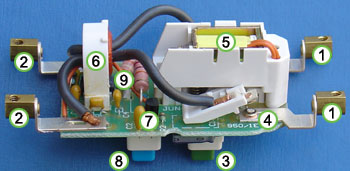
And here is a picture , if the link works, showing the inards of a typical inline device

ResidualCurrentCircuitBreak.jpg


The bits of the one I opened up weren't all numbered like that though!
 
As someone who uses a lot of RCBO in the course of his work I often see failures, normally they are undetected and only show up when tested with an external RCD tester..............
They almost always fail so that they do not trip in the event of a fault.
We have changed supplier this year as we also were getting the problem with the tag breking on the MG ones so we have switched to Moeller which do not have the tag. Of the 600 or so that I have fitted this year we have had 3 failures which have been replaced by Moeller.
Part nunmer is PKNM-16/1N/B/003-A-DW

Oh and as for testing a GI no I dont as I switched to an iso transformer
http://www.airlinktransformers.com/transformer/wp3230-waterproof-transformer.asp


Julian
who has just ordered another 350 RCBO .........
 
Top