Poking wire through pulpit tubing

I would first try to use a fishtape but often it won't go round odd bits. Then I use a strong magnet with a small piece of steel tied to a string. The magnet lets you direct the path in ways you can't do with a fishtape.

This sounds like a brilliant suggestion.

I had the same problem. The pulpit tube ends in a bolt with a narrow center hole at the deck. Here is where trouble amount. If you poke a string etc from the top it is almost impossible to hit the narrower hole in the bolt. Going the other way you face the trouble of hitting the sideways exit hole in the pulpit tube. I solved it by going from below with a string with a line attached and going past the exit hole. Then I fished out the line with another string. Using a magnet would probably have made this a lot easier.
 
If you have an old piece of rigging wire, pull off one strand to push through as a messenger - finer than the fishtape but should be stiff enough to twist towards the opening. Fold one end over to form a hook to use as a pull through...
 
Dunno if its any help, but when I rewired a bow light on one of my boats, I took the pulpit off and did it on the dock. It took less time when I finally decided to do that than all the hours Id spent messing about on board.
 
A fiddly job. I tried several ways to do this a couple of years ago. What with the restriction in size at the base, and no doubt internal restrictions where the uprights join the rail, I found that only one direction worked - up from the baseplate. In the end whatever went up (coat hanger?) held some whipping twine which I was able to hook through the hole using the equivalent to a bent paperclip. Then used the whipping twine to feed something a little bigger through, which then attached onto the cable (coax in this case).
+1 for this, after a lot of messing about I used a bit of SS welding wire with a tight "u" bent into one end to form a hook, pushed up from the base plate. Then I hooked some thin twine withe the "u" and pulled it through. I found it helped if I bent a the lower end of the wire through 90 degrees, so it was easy to rotate the wire, made much quicker to hook the thin twin, which was inserted into the top hole doubled to form a loop.
I hope that makes sense, it took me quite a lot of trial and error, until I came up with that solution.
 
I found that a plastic (nylon?) fish tape tended to retain the curve of its coil, which made its use difficult - and in several applications, the curtain wire solution was for that reason superior.
 
What an excellent thread!

This is just the sort of challenge that, with variations, so many of us will face at some point.

There's huge value in bringing together such an impressive range of approaches, experiences and techniques that might suit particular circumstances, for which I thank YBW and the posters above. This is such an important supplement to other sources which will so often will be either trying to sell a piece of kit or promote one egotist's pet solution.

I just hope I can remember the details, or find this thread again, when I next get faced by something like this. Thanks again all. (y)
 
What an excellent thread!

This is just the sort of challenge that, with variations, so many of us will face at some point.

There's huge value in bringing together such an impressive range of approaches, experiences and techniques that might suit particular circumstances, for which I thank YBW and the posters above. This is such an important supplement to other sources which will so often will be either trying to sell a piece of kit or promote one egotist's pet solution.

I just hope I can remember the details, or find this thread again, when I next get faced by something like this. Thanks again all. (y)

+100

I wish there was a way on here to bookmark / save threads!
 
I’d give the curtain wire (post #11) a shot first, it’s dead easy to put an eye on the end to pull through with.


?Click on ‘watch’ at top right?

That subscribes you to the post and then you get notifications when it's updated, but It would be great to have a bookmark system where you could file away posts you'd like to reference.
Yes, I can create bookmarks in the browser, but it would be nice if one could create an indexed reference library directly on the forum.
 
I have used 5’ x 5’ x 3mm ply ripped down to 10mm width. It is incredibly flexible, as well as stiff enough to wiggle the end so you get a response at the fed in end. In my case I tied whipping twine to the end secured with making tape, fed it through the gap, with a bit of prodding and twisting it went round a right angle. I then got it to the hole and more twisting and moving the feeder end aligned the twine with the hole which I then pulled out with pin. Retrieved the wooden ply stick and pulled the wire through. If the ply feels stiff passing it over the steam from a kettle spout makes it even more flexible.
 
I have used 5’ x 5’ x 3mm ply ripped down to 10mm width. It is incredibly flexible, as well as stiff enough to wiggle the end so you get a response at the fed in end. In my case I tied whipping twine to the end secured with making tape, fed it through the gap, with a bit of prodding and twisting it went round a right angle. I then got it to the hole and more twisting and moving the feeder end aligned the twine with the hole which I then pulled out with pin. Retrieved the wooden ply stick and pulled the wire through. If the ply feels stiff passing it over the steam from a kettle spout makes it even more flexible.

What use did you find for the remaining 5' X 4'11 1/2"?:)
 
On one occasion I found a pocket measuring tape invaluable to feed a cable around an awkward spot, as the tape’s lateral curvature allowed it to bend readily in only one direction.
 
+100

I wish there was a way on here to bookmark / save threads!

There is a way! First, click on the Bookmark icon in the post header (see below), this adds the thread to your Bookmarks list.

bookmark.jpg

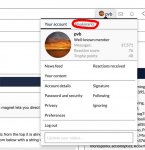
To retrieve it, click on your username at the top right of the forum page. This opens up a box, which by default shows your account details. To see your bookmarked threads, click on the word Bookmarks.

bookmark2.jpg
 
Although not inside a steel tube I had to feed some electrical cables through the boat and around some tight bends. I first installed some expanding sleeving and then fed the cables through the sleeving . The sleeving offers some protection to the cable during installation and in service .

example (a larger size may be required )
5 Meters, 4mm BRAIDED SLEEVING - EXPANDABLE BLACK BRAIDED FLEXIBLE CABLE SLEEVING - POLYESTER: Amazon.co.uk: DIY & Tools

I tried fibreglass rods to assist but some other products mentioned above look better. I found shore power cable as good as anything for feeding the sleeving into place and then pulling the smaller cables through but that is probably too thick in this case
 
Seen it done with an airline and a rag on a string. I use morse 33c cable inner, if not tight bends. I keep all old cables, lots of uses, very stiff stainless wire. Monofilament nylon 240lb fishing line, same as strimmer cord is good.
 
There is a way! First, click on the Bookmark icon in the post header (see below), this adds the thread to your Bookmarks list.

View attachment 84078

To retrieve it, click on your username at the top right of the forum page. This opens up a box, which by default shows your account details. To see your bookmarked threads, click on the word Bookmarks.

View attachment 84079

Brilliant, Thanks so much :)
 
Now that is a clever idea. Does it work?
Yes, it does. Surprisingly well. Commonly used to by bike mechanics where the owner has tried and failed to replace internal cables on time trial bikes.
If you search YouTube you'll find examples. example
You need to be able to close off other holes. And you use your hand on the nozzle to control the air flow. Even with a very small exit hole.
Sail makers thread is perfect for this.
 
Last edited:
Top