Refueler
Well-Known Member
I am west coast based (which is also where the photo was taken). Would love to revisit Stockholm archipelago, but most likely not this summer.
One day I hope to get round to the West Archi ...

I am west coast based (which is also where the photo was taken). Would love to revisit Stockholm archipelago, but most likely not this summer.
Your beautiful boatMy stupid boat. View attachment 154052
You are getting confused again. Just because a Beneteau cruiser chooses to widen out above the waterline to increase bow cabin space, this does not mean it is necessary with a plumb bow. Just look at all the traditional old gaffers for example. Or modern boats with a more performance orientation.The new shaped plumb bow Ben Oceanis 38.1 anchored next to us has a very blunt bow. At the waterline its not so blunt but as you rise up the bow it get progressively wider to the point at deck level where it is considerably wider than the bow roller fitting. You need reserve bouyancy somewhere. If it's not in an overhanging bow then it needs to be in the wider section above the waterline. Overhanging bows don't need to do this and can have a fine entry and carry the shape all the way up to deck level. If you Google some of the yacht design pages online it is well documented

Seriously, I am not confused. Just been studying the boat next to us that fits exactly what you can read online from yacht designers.Ben Oceania 38.1 it's bow is exactly as I described.You are getting confused again. Just because a Beneteau cruiser chooses to widen out above the waterline to increase bow cabin space, this does not mean it is necessary with a plumb bow. Just look at all the traditional old gaffers for example. Or modern boats with a more performance orientation.
Need to be careful reading selective “yacht design pages online”. I suspect few of the actual designers who are designing successful modern boats bother to post on these website.
And of course there is no single “best” bow shape. Longer LWL is generally better in almost all circumstances.
But whether a fine wave piercing bow is faster than a scow bow like used on many new IMOCA racers depends on many trade-offs.

If you look at the lines of a Vertue, the plan shape at the waterline is much the same as at deck level, with a similar fineness at the point of the bow. But the point of the bow is obviously that much further aft at the waterline.The new shaped plumb bow Ben Oceanis 38.1 anchored next to us has a very blunt bow. At the waterline its not so blunt but as you rise up the bow it get progressively wider to the point at deck level where it is considerably wider than the bow roller fitting. You need reserve bouyancy somewhere. If it's not in an overhanging bow then it needs to be in the wider section above the waterline. Overhanging bows don't need to do this and can have a fine entry and carry the shape all the way up to deck level. If you Google some of the yacht design pages online it is well documented

That is odd, because, after reading your post I was at the marina. I looked at some boats on the hard today. A Sadler 34 looked decidely fat against a Hanse 345. A Halberg 34 likewise against a Benny 323. I looked at several boats of past & newer designs ( cannot recall all the models) & I cannot say I saw any that backed your statement. In fact a newer model hanse 31 than mine, had a marked hollow in the hull as the lines approached the bow. I started to wonder if there was a moulding error. But it was even both sides. I have seen it on other late models.from the brief research i di, it appears that plumb bow boats dont actually have a fine entry. they have fuller bows due to their reduced reserved bouyancy
Words from Farr on one of their very high performance new canting keel designsYou are getting confused again. Just because a Beneteau cruiser chooses to widen out above the waterline to increase bow cabin space, this does not mean it is necessary with a plumb bow. Just look at all the traditional old gaffers for example. Or modern boats with a more performance orientation.
Need to be careful reading selective “yacht design pages online”. I suspect few of the actual designers who are designing successful modern boats bother to post on these website.
And of course there is no single “best” bow shape. Longer LWL is generally better in almost all circumstances.
But whether a fine wave piercing bow is faster than a scow bow like used on many new IMOCA racers depends on many trade-offs.
Indeed. Eye catching, interesting and probably fun to sail. But I note it has no anchor provision at all. Is that because it will come up via the bottom of the boat?!If one wants to see a different bow design then I suggest that one looks at Richard Mathews Oystercatcher 35.
I have seen it sitting on a mooring in the Orwell when not in use.Indeed. Eye catching, interesting and probably fun to sail. But I note it has no anchor provision at all. Is that because it will come up via the bottom of the boat?!
Then again, it probably won't be chartered. Yet.

I think, or rather I know, it is incorrect to compare classical plumb bows with their contemporary variants.
The classical boats with plumb bows had comparatively little saliant keel and to assure some windward ability, they were given a deep fore foot. The steeper the stem, the greater the greater the lift producing area under water. In this context someone posted a picture of a Brixham trawler, which type perfectly illustrates my point. The considerable volume below the waterline would have provided sufficient reserve buoyancy.
On these boats the anchors were retrieved on cat heads either side of the bows. Additionally, the bows were often covered with some sacrificial timber sheathing to prevent structural damage to the planking from the anchors or the odd growler, for that matter.
Another apples and oranges debate. I do love a bit of fruit.
I do think the Heard 28 is an absolutely lovely boat. It should however be remembered, that it is an interpretation of an inshore oyster dredger. In how much securing reserve buoyancy in heavy seas was a necessity, is open to debate.
Other than stretching the DWL and maximizing ones expensive slip length, the modern variety of the plumb bow has little practical purpose in a cruising boat, except perhaps to maximize marketing response by quoting styles that reflect contemporary racing craft. The last point is hardly anything new: designers were equally inspired by the bloated guppy looks of the IOR or the elegantly undernourisched and underbuoyed sterns prior.
Best, A.

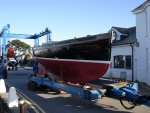


Works beautifully in that swimming pool. We see a lot of those hinged doors set at 45deg here in the Caribbean as the anchorages can be pretty choppy. Sunsail in Antigua had a pile of the platforms in a heap that had failed presumably due to thr bumpy conditions since charter boats aren't using marinas out here too often. It can be fun watching people trying to board their boat over an inclined platform in a chop.My perfect boat if it had a roller-furling main and no teak decks.
Plum bow? Like that is a buying decision? Bit of wrap-round stainless steel and sorted.
.... just look at that cockpit and bathing platform - that is a truly perfect platform for sunbathing, watersports, and entertaining friends.
View attachment 154223
Phil Bolger designed very simple boats. Many for home construction.In 1962 Phil Bolger designed a RORC ocean racer called Hesperus with long overhangs to exploit the RORC rules, which penalised waterline length. He later wrote:
"Overhangs like this don't make much sense, but like a good many people, I have a perverse liking for their looks. Logically, the waterline should be extended in long, sharp points under the overhangs. There would be more displacement in the ends without much increase in the middle of the boat, so she would be shallower in the middle. Then the cabin sole would have to be higher, with an increase in freeboard to keep the same headroom. The result would be a faster, abler and roomier boat than this one for about the same investment."
Fifty years of yacht design development in one paragraph!