Please pull my idea apart, or suggest whether this will work.

Oscarpop

Well-Known Member
Joined
31 Jul 2011
Messages
1,053
Location
Kent
Visit site
This should be right up the forums alley.

I am designing an outboard crane in my head that is collapsible and able to support a 30kg engine.

I propose to use 25mm 316 with bimini fittings.

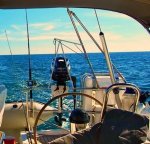
I have placed a simple diagram of what I propose to do over a photo of where I intend to place it.

i will use a simple slide fork to hold the horizontal part of the crane to the bimini strut.

i will then have a removeable support which will attach to the pushpit , again using bimini end eyes and drop pins.

finally I will have a 4:1 or 6:1 block and tackle attached to the end of the horizontal bit to lower the outboard.

I propose to rivet a pad eye to the end of the " crane" to hold the block and tackle.

As i see this, if the support for the horizontal part is near the the end of the crane, most of the stress will be placed directly downwards and not bend the horizontal crane.

when not in use I will simply remove the support bar and stow it in a locker, then fold the horizontal part against the bimini strut and hold it in place with suitable clips.

What do you think?

Will it work? Mods?
 

Attachments

  • crane.JPG
    crane.JPG
    43.3 KB · Views: 1
I'd give consideration to a boat being a moving platform and not stationary. Any surge will make the forces act in directions which are different from the planned ones, including horizontal forces (fore and aft, and especially side to side) on the bimini strut.

As a gut feeling, it's not strutted enough to be rigid.
 
Many thanks.

What about using 2 supporting struts at an angle of about 30 degrees apart. both connected to the horizontal " crane part"?
if I used 2 slide forks say 5cm apart on the crane , that should provide much more support in all 3 planes. these would then both attach to the pushpit.
 
that also raises issues about lateral forces, I think. 50kg of outboard swaying from side to side in a swell is a bit of a handful.
 
crane.JPG

So if I add a second support ( as seen in figure 1.1 :) above ), the entire rig can be dismantled and stowed in a couple of minutes. PLus this should stop problems from lateral movement.

thoughts?
 
Your main problem is that whatever you add, you are relying on your bimini pole.
If it all goes tits up that will be wrecked as well. There are already too many angles and forces involved. As Tim says a bit of chop or swell and it will become a lottery which bit gives first.
How about a vertical tube with lugs welded on bolted to your pushpit rail, top and bottom? Then a simple derrick jib that drops into that tube with a formed bend to create the offset. All in at least 50mm, and preferably thickwall, tube.

In fact, why re-invent the wheel? http://www.cooneymarine.co.uk/pages/davits-handilift-125.html

handilift-125illust.gif


or


4470.jpg
 
Last edited:
Not really a critique of your design concept, which I believe has been all but shot down already ;-} One of the problems involved is that a swivel is needed to bring the cargo inboard and that is an inherent weakness. How about two poles hinged at the quarter and joined at the peak with a short strop to attach the outboard. A tackle used to haul the assembly upright will both raise the outboard and swing it in over the taffrail (sheerlegs principle). Much easier to construct, too.

Rob.
 
You propose "25mm 316", but that only describes bar, when you're clearly planning on using tube. 25mm tube comes in varying wall thicknesses, and believe me, the regular 1.2mm bimini stuff will bend. I'd suggest thicker wall tube for the higher-stressed elements.
 
Most people go for too heavy structures. We have three solar panels, supporting steelwork, aerials, and an outboard hoist point mounted on a gantry that relies primarily on two sets of 25mm tubes on each side. In each set, one tube is mounted at the base of our pushpit, the other from the top rail, meeting at a point (so triangulated) with a reinforcing cross bar. The gantry supports are toed in, so that again there is some triangulation there. Mutually supporting the whole arrangement is a radar pole on the transom, braced to the top rail of the pushpit. This was there before the gantry, which supports itself, but it does provide some additional rigidity.

If you want to use this for a simple outboard hoist, then one set of two tubes arising from the base, and a third from the top of the pushpit would provide the lateral support? It is fixed, but might as well be for convenience? Without getting too involved, the lower tubes will be in compression and taking the load, and the upper tube will be in tension.

We use a 'handy billy' comprising a 4:1 purchase on a pair of snapshackles, with one block having a jamming cleat built in. However, the purchase we lead through a fairlead attached to a wooden outboard bracket on the pushpit, and with a clam cleat below the fairlead. Thus the raising and lowering of the outboard can be controlled standing in the dinghy, with the painter lead forward amidships, and the purchase cleated as necessary. The job can be done single handed, by launching the outboard off its storage bracket, so that it is hanging, when you can then climb down into the dinghy to lower it. Reverse this for shipping it. When we need a handy billy for some other task, it is simply taken off. We do use an independent safety line, never yet needed.

The hoist does not support the engine when underway, and generally conditions will be calm enough when it is under load.

I'll take a photo to illustrate, but in the meantime there is a picture of Rod who built the thing (against his better judgement) in 2004/5 on the occasion of its erection: it is still there. See www.syfuga.co.uk/enhancements.htm. Sadly we are trying to sell the boat, by the way.
 
Last edited:
Will it work? Mods?

The arrangement below seems to work quite well....


islay_lifeboat.jpg


....and you could visit your friendly neighbourhood lifeboat station and ask about 'scantlings', for you'd want to be able to lift a wet person back on board, wouldn't you?

And there's little point asking the mods. They'll only confuss things! :rolleyes:


( Edit: Er, no, I didn't mean the HIAB arm... )
 
Last edited:
The Americans do this sort of thing quite a lot. Perhaps peruse the US cruising sites for photos?

Myself I would hoike it up along with the dinghy on the foredeck by winch or windlass and take it from there.
30kg is a lot to hang on the sternrail?
I lift a aluminium sailing dinghy this way. Sometimes I split it into its two nesting halves, often I just flip it upside down over the forehatch, motor goes below if it is going to blow.
A mate clamps his in the loo(!) and hoiks it up thru the forehatch on a mast winch..
 
When I think of the sort of loads the average pushpit can take, as in, heavy well clothed guy heaving himself up, a little 30kg outboard does not need anything like 50mm tube. I bend 25x1.5 mm 316 ss in a hand bender and it takes considerable force. Bending resistance goes up as a square or cube of the section, so 30x2mm would be well strong enough. A clamp on the stanchion base with an 8mm pin hinge and another on the rail would take the loads. As it would mount near where the rail curves forward from the transom, that would counter much of the load on the top rail.

Your original idea of using the bimini strut: If you can hang off the stern with your feet on the pushpit rail and your hands on the bimini strut with a bit of bounce :<)) without it deflecting much, then it would haul up your 30kg o/b.
DW
 
I recently had one made and it works well, attached to the pushpit. The only comment I have is that when suspended the outboard does not move - the boat does. I tested mine by lifting myself out of the dinghy with it (to see if I could use it for MOB recovery), I weigh a bit more than my 28Kg outboard! and it worked very well.

EDIT: I don't think bimini fittings are strong enough though. Mine is 48mm dia x 2mm wall thickness SS for the upright and 35mm X 2mm wall thickness for the boom and a reach of 500mm. Two nylon bearings on the boom help it swivel and a thumb screw locks the boom in position. It dismantles quickly for easy stowage. Cost me 165 Turkish Lira in Fethiye.
 
Last edited:
Top