PBO #603 P84: Vaseline FFS

Using oil/petrol based products on rubber.....

caliperboot12.jpg


caliperboot13.jpg


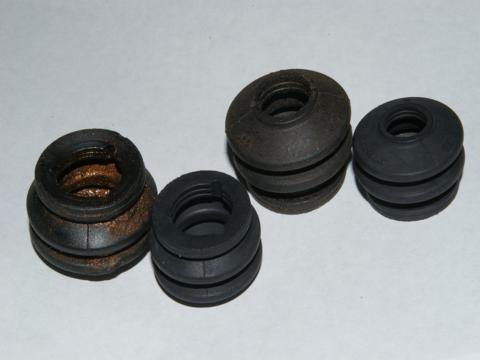
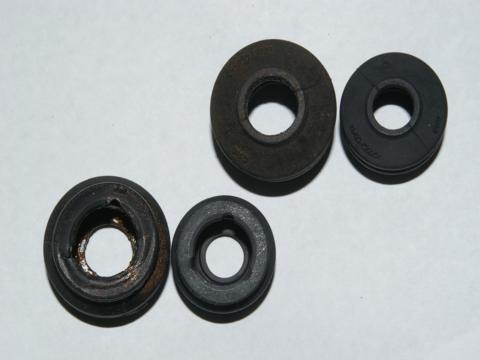
These are the same rubber boots, new and old. Old ones were greased and therefore swelled up.
 
There is no difference in the dielectric properties of vaseline, silicone grease or contralube and all are suitable for preserving the integrity of electrical connections.

However, the disadvantage with vaseline is that it will dry out if there is the tiniest space for the petroleum vapour to escape. Even a supposedly sealed jar of vaseline will turn cracked and hard if left long enough once it has been opened. Once it is hard it allows water to enter.

Silicone grease and contralube will probably do the same eventually ..... but you are talking years / decades rather than months / years depending upon the ambient conditions.

Richard
 
The only job of the grease in the connector is to keep moisture (and salt) away from the conducting metal bits, and pretty much any waterproof grease can do this job......

I second the thanks for this post which helped me understand the rather vague advice I'd been given about petroleum jelly. But I'm still in a quandry.

The Owner's Manual for our 11 year old boat says this about refuelling: 'Upon completion of the fueling activity for each tank, the deck fill cap should be firmly tightened to preclude the possibility of seawater intrusion. It is suggested that a thin coating of petroleum jelly be applied to the cap threads to enhance a watertight seal and to allow easy removal.' I mentioned to a marine engineer that I was using Vaseline for this job, he sucked his teeth and said he wouldn't recommend petroleum jelly anywhere on a boat. Turned out he was right in a way because we don't know whether the 'O' rings on the 2 fuel caps (or the freshwater or pump-out or 5 raw water strainer caps) are original or replacements, and therefore we don't know whether they might deteriorate if a petroleum product touches them. So I took advice from another engineer and went over to using RS silicone grease for threads with 'O' rings, only to find this comment on the RS website: 'This is more like a silicone sealant than a grease. I bought four tubes on Tue, 15 Mar 2011 thinking that , like the grease I still have from the sixties, it would last forever. In September 2013 I have opened them to use and found that the grease won't squeeze out of the tube let alone pass through the pointed nozzle, it has set almost solid. If it does that in the tube in just two years I dread to think what it would have done to any moving parts lubricated with it.'

I'm new to boating and the thing that frightens me most isn't the weather or the lobster pots or the MCA, it's the fear of using the wrong goo for some simple job and screwing up something important because the goo does the opposite of what I expect!
 
I second the thanks for this post which helped me understand the rather vague advice I'd been given about petroleum jelly. But I'm still in a quandry.

The Owner's Manual for our 11 year old boat says this about refuelling: 'Upon completion of the fueling activity for each tank, the deck fill cap should be firmly tightened to preclude the possibility of seawater intrusion. It is suggested that a thin coating of petroleum jelly be applied to the cap threads to enhance a watertight seal and to allow easy removal.' I mentioned to a marine engineer that I was using Vaseline for this job, he sucked his teeth and said he wouldn't recommend petroleum jelly anywhere on a boat. Turned out he was right in a way because we don't know whether the 'O' rings on the 2 fuel caps (or the freshwater or pump-out or 5 raw water strainer caps) are original or replacements, and therefore we don't know whether they might deteriorate if a petroleum product touches them. So I took advice from another engineer and went over to using RS silicone grease for threads with 'O' rings, only to find this comment on the RS website: 'This is more like a silicone sealant than a grease. I bought four tubes on Tue, 15 Mar 2011 thinking that , like the grease I still have from the sixties, it would last forever. In September 2013 I have opened them to use and found that the grease won't squeeze out of the tube let alone pass through the pointed nozzle, it has set almost solid. If it does that in the tube in just two years I dread to think what it would have done to any moving parts lubricated with it.'

I'm new to boating and the thing that frightens me most isn't the weather or the lobster pots or the MCA, it's the fear of using the wrong goo for some simple job and screwing up something important because the goo does the opposite of what I expect!

You mean a petroleum product such as diesel fuel? :) O-rings on fuel filler caps are bound to be resistant to petrochemicals for obvious reasons. They're also very cheap to replace, and your fuel filler cap is hopefully not in a difficult to access location, so if it looks cracked, just replace it - grease or not, O-rings don't last forever. The grease is mainly applied to keep them from sticking.

As for silicone grease going off, I've not seen it, and wouldn't give much heed to a single comment. Somewhere above I've linked where I buy mine, a 500g tub of plumbers supply stuff. Like any other grease, in moving parts exposed to dirt (like the winch gears on a sailboat) the grease will eventually have mingled with enough dirt to become less efficient and eventually gets thick and hard from all the crud in it, but that's why we service winches regularly, replacing the dirty grease with fresh.
 
I have a tube of RS silicone grease that came with a boat I bought in 2008 and it is still fine, I used some yesterday in fact.
RE vaseline, yes it will affect natural rubber, but the chance of encountering any now is remote, O rings and the like will be synthetic.
I was in the battery industry for many years dealing with large installations supplying hundreds of amps continuously for significant periods, not just starting. Terminals were usually done with a mix of vaseline and lanolin.
 
My conclusion from all this is that Vaseline is OK but there are better products now such as silicone grease stolen from the BBC or Contralube which don't dry out.
I have half a tub of Vaseline in my toolbox which I'll continue to use and then get some silicone grease from tool station.
 
Alas I don't think toolstation sell silicone grease?
I happen to want some, mine has gone walkabout.
I've ordered some from simplybearings.co.uk
 
If you don't mind my asking, when was this?

Quite a while ago. There may be better products now but I can't imagine using a bucket full of Contralube on a battery of 600 cells with large terminals!
My point is that suggestions of vaseline interfering with the contact and limiting current are BS. Ditto the scares about rubber. The synthetic rubber seals round the terminal posts were also set in vaseline. Problem is only with natural rubber which is a rarity now.
Vaseline with or without lanolin is much nicer to handle and less contaminating than silicone grease. I think its biggest drawback is easily melting off.
 
I used to use Vaseline on the connectors of my Moto Guzzi, which were poorly designed and subject to salt spray from the wheels etc. It helped a great deal.
These days I use silicone grease and don't tolerate having such rubbish connectors in the first place.
 
I've been using Dow Corning DC4 for many years with success. B & G recommended silicone grease for the masthead connections so it isn't surprising that it works.

Their webpage http://www.dowcorning.com/applications/search/products/details.aspx?prod=01903128 describes it's components and use.

The Automotive Datasheet popup on the webpage describes the detail of suitable solvents for it's removal and the need to remove it prior to painting.

I haven't experienced problems with rubber in contact with it and have used it to lubricate 'o' rings, but the webpage does describe potential swelling issues.
 
Last edited:
Top