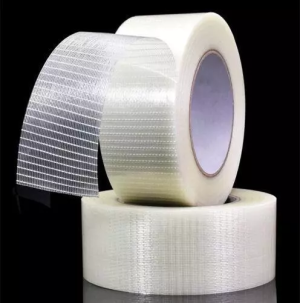
Parcel Tape Standing Rigging?

ducked

Well-Known Member
Joined
6 Oct 2024
Messages
1,666
Location
Tainan, Taiwan
Visit site
I'm wondering if that yellow tape stuff that comes on parcels, 'which appears to be a polypropylene matrix with a glassfibre reinforcing mesh, MIGHT have application for making things like composite chainplates and deadeye links.

I suspect (though Ive seen no numbers) that strength would be adequate if sufficient layers of the tape is used, but bonding might be a problem, (It seems to be welded when it arrives on parcels. Perhaps it could be sown) and the plastic would probably have to be protected from sunlight.

Can anyone tell me what its called, so I can try and look its properties up?
 
I think you're thinking of heavier duty tape than immediately springs to many people's minds. You're right that the heaviest parcel tape is glass fibre reinforced. Something like this... Crossweave tape ... but that is still adhesive and not as far as I know weldable. (I think if your parcels arrive with welded tape you're probably ordering heavier machinery than I ever did...)

I think it's worth paying quite a bit for certainty in bonding over time. You might be able to make a strong block of something, and it's an ingenious idea, but it would be really hard to be sure that its coatings or surface construction guaranteed it staying together. I suspect if you really need to make a composite chainplate the cost and effort of using conventional composite materials would probably work out worth it just in reduced risk of failure or having to do-over.

Composite chainplates do seem really neat in terms of spreading load across a big area of hull and avoiding all those crevice-corroding bolts. I can see the appeal if in the middle of a really big refit. But failure of the original chainplates seems not THAT common and really unevenly distributed across old boats so the odds of actually needing to change can't be that high?
 
It would seem you are thinking/simulating thinking of sticky tape.

This stuff isnt sticky, is quite thick, and probably very strong, but adequately joining it might be an impossible problem.
Do you mean plastic strapping (e.g. Amazon.co.uk) You'd need to use crimp fasteners to join it, and they would probably damage the tape and reduce its strength.
 
Do you mean plastic strapping (e.g. Amazon.co.uk) You'd need to use crimp fasteners to join it, and they would probably damage the tape and reduce its strength.
Could be that, though I've only ever seen yellow.

310 kg "brake strength" (presumably breaking strength) is, i THINK, quite a lot less than typical rigging, but one would use multiple layers IF you could join it.

I wonder if you could "stitch" or "seize" it with hot wire, or a hot needle, which might melt and penetrate the polypropylene but leave the glass intact. Bit speculative for life dependancy though, and since the amounts involved would be fairly small. I suppose there isn't a good reason not to use more conventional composites.
 
Last edited:
Local friend went to buy ss wire for rigging his new gaffer. They suggested Dyneema, as cheaper and easier, even included the needles to make the splices.
While it is interesting to think about new materials to rig sailing boats, I seriously doubt that this parcel tape idea is a good idea....
 
Could be that, though I've only ever seen yellow.

310 kg "brake strength" (presumably breaking strength) is, i THINK, quite a lot less than typical rigging, but one would use multiple layers IF you could join it.

I wonder if you could "stitch" or "seize" it with hot wire, or a hot needle, which might melt and penetrate the polypropylene but leave the glass intact. Bit speculative for life dependancy though, and since the amounts involved would be fairly small. I suppose there isn't a good reason not to use more conventional composites.
There's many other properties that are important, not merely strength. What is its elasticity? If it is too elastic, it will stretch, and even if within its elastic limit, it won't do much for holding a mast up! Strength has various measures too. The elastic limit is one (that's the force that it will take and still return to it's original length when the force is taken off), ultimate yield stress (how much it takes to break it) and others. You don't just need something as strong as steel rigging, but something with similar properties. Composites such as banding might well creep under a continued load, for example.
 
Top