Parasailer experience?

Blue Seas

Well-Known Member
Joined
29 Jun 2024
Messages
330
Visit site
Does anybody have any actual experience of Parasailer's for extended miles / time? Usability / Durability etc. Would you fly them overnight conditions permitting? Short handed etc?

Comments appreciated.
Ta.
 
I sailed on a 50 foot fully crewed boat with one it was kept up for 2 days and nights because it required very little management, iirc we had a couple of tweakers on it. It came down when the apparent wind hit 20 knots. It was easier to handle because there was no pole or guys and had a snuffer, so because there is less stuff to handle pole etc it is easier.
If I was running my own cruising boat now and I sailed with either a light crew or single handed most of the time I would have one. With todays forecasting and routing I guess once you were settled with it and knew what was in the offing running through the night becomes a possibility.
 
Last edited:
I have not bought one of these but have met several people who have. As with all things there are pluses and minuses. The good thing is that they are easy to sail as above, no poles etc and you can set them on a dead run. However the other side of this is that they are expensive, really bulky to store, because there are so many strings if you get in a muddle for any reason it is a mission to untangle and lastly I have heard reports of them blowing out. Well all sorts of down wind sails can blow out so I don't know if these are more pre-dispositiond to that or not. Personally I would love one but in the end it was the price and bulk that put me off. If you look around there are often Parasailers for sale second hand, you might find one that someone who has done the arc is selling.
 
Perfectly possible to fly one with the mainsail up some do some don't nothing to stop you. They are not a performance sail they are intended for cruising yachts because they simplify the use of a down wind sail.
 
I was "unimpressed" by the UK distributor for parasailor who made price commitments to a friend at the boat show which they then denied making when he came to order a couple of weeks later. I was standing right next to him when the conversation happened. I was actually in the market for one of these myself: it's not about performance, it's about a stable and easily managed downwind sail. Oxley do a similar product based on the original parasailor design. I see that Yachting World did a bit of a write up on the alternatives last year: The best downwind sails: Options explained by over 200 experienced sailors

Apologies: no personal experience but there's a fair few posts on other forums (e.g. cruisersforum ) relating people's personal experience
 
We're quite happy with ours. We fly it in winds 5-20kn. Makes the motion of the boat much smoother, and spares the noise (and wear!) of sails slatting in light airs.
We also fly it at night, just using the steaming light to illuminate the sail shape for the watchkeeper. This is with two people on board.
IMG_1746.jpeg
They're easy to operate and easy to take down when needed. I've had to twice take it down during an around 25-27kn gust, and it is quite manageable with the sock.
The only downside really is the cost. They're quite expensive new, and there aren't a lot of used ones going around.

I wrote some more about it in our Atlantic crossing retrospective.
 
Thanks for all the comments folks, I've read plenty of theory about them but just wanted to hear from anybody with real experience. I'll digest the articles provided and come back with any questions if I may.

Thanks again.
 
Apparently Parasailor are now out of patent protection and several alternatives are being lined up - I can already see a significant price reduction with the quote I received yesterday from Oxley.
 
I think the original parasailor was out of patent about 6 years ago: I was looking at oxley copies at Boot in 2020. To counter this istec introduced a new version, although they were continuing to sell their old (rebranded “classic” or some such iirc) version.
 
We cruised in company with friends with exactly the same boat as ours except we are ketch rigged and they are sloop rigged. They have a parasail. We have an asymmetric spinnaker that is always flown on a pole. In a long down wind leg, sailing in company with were substantially faster. We both sail as husband and wife. We set a mainsail, they just set the parasail.
Our friend now routinely flies his with a pole and sets the main. I think in this configuration, it has little advantage over our spinnaker and the spinnaker is substantially cheaper. We chose an asymmetric on the advise of the sailmaker for stability. The sail is designed to be flown on a pole
 
Parasailor isn't the fastest sail, for sure. But easy to fly and to take down, and makes the ride smoother. If we were a fully crewed race boat, I'd go with a regular spinnaker for sure. But for double-handed boat doing long passages, easy is a big plus.
 
We have had one for several years now. I have used it extensively as they are fun and relaxing to use when the wind is in the right conditions. I mostly sail short handed, and for this it is much easier than the traditional spinnaker which has now been firmly housed in the garage.

The advantages have been listed above, and are advertised by ISTEC.

I don't race. So I cannot comment on real relative effectiveness, but I imagine that compared to a spinnaker and a fully crewed boat in race setting we will be going slower. That is not really the point.

Have we had "hairy moments"? Yes, mostly due to inexperience. Sometimes equipment failure (not the sail: the halyard shackle parted in a full F5 off the rocks in Connemara (!) last summer; we recovered the sail from under the hull/keel/rudder - it took about an hour and some patches were needed... :-O).

Also, it is definitely better without a mainsail, as the airflow through the parachute slit is essential for it to work properly. I understand the point about using the main to blank it for an emergency drop. But I managed this OK, without the main, a couple of weeks ago with the wind piping up to 26-28: follow the instructions online - depower by releasing most of the active sheet, and then dowse it with the aid of the sock.

I also definitely recommend rigging the "tacker", instead of the pole, and always both sheets and guys.

The challenge is always remembering how to rig all the lines correctly so they run without chafe and tangles. But that applies to just about everything rope-y on Tigger.

I may not have ever bought it, if I hadn't found a second-hand one, from a great guy who sold it to me online. He told me his cruising had become very local, so did not want to use it anymore. Would I buy a new one? If I had money to spare....perhaps
 
The Parasailer is a overpriced, less powerful spinnaker sold though clever marketing to cruisers who generally have little experience with spinnakers.
For much less cost you can buy a smaller regular modern spinnaker which is easier to fly, easier to snuff without the wing and large funnel, outperforms the parasailer and takes up less space. If your on a mono-hull and don't hoist the mainsail, you can easily fly a spinnaker without a pole. With the mainsail hoisted its difficult to fly the parasailer or a regular spinnaker without a pole- there is no difference. Catamarans can fly a spinnaker without a pole due to the width. The wing doesn't make it more stable or lift the bows, it really doesn't do anything other than look pretty.
 
The wing doesn't make it more stable or lift the bows, it really doesn't do anything other than look pretty.
Just to check, is this an opinion, or based on actual experience with the product?

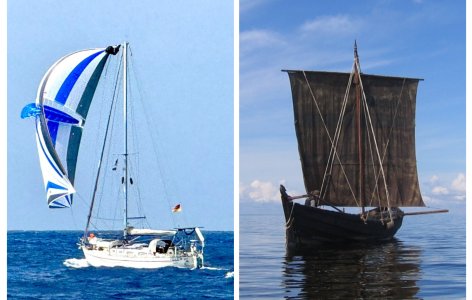
On our boat the wing definitely stabilises the sail, operating almost like an inflatable yard. Reminds me quite a bit of how things worked on the Viking ship replicas I've sailed.


Lifting the bow I can't comment on. Hard to see on a small heavy boat like ours.
 

Attachments

  • IMG_1758.jpeg
    IMG_1758.jpeg
    1.2 MB · Views: 10
Just to check, is this an opinion, or based on actual experience with the product?

On our boat the wing definitely stabilises the sail, operating almost like an inflatable yard. Reminds me quite a bit of how things worked on the Viking ship replicas I've sailed.


Lifting the bow I can't comment on. Hard to see on a small heavy boat like ours.
Kestrahl is a fellow sailmaker and a very experienced sail designer, he knows his stuff!
personally as a sailmaker onf designer of 40+ years. I concur with his analysis of parasailer. They aren't that bad but not any better
 
Just to check, is this an opinion, or based on actual experience with the product?

On our boat the wing definitely stabilises the sail, operating almost like an inflatable yard. Reminds me quite a bit of how things worked on the Viking ship replicas I've sailed.


Lifting the bow I can't comment on. Hard to see on a small heavy boat like ours.
This was my experience sailing with the Istec parasailer. Given that I have much much more experience trimming regular spinnakers racing over 20+ years. The sail edge was folding first above the paraglider wing and then folding though the wing without any resistance and the edges have heavy webbing on them which also doesn't help. The wing certainly didn't act like a solid yard even in 15-20 knots. The spinnaker part of the parasailer appeared to be based on old northern European design with a narrow foot and really wide middle like the X-99 class spinnaker from the 80's. At the time they only rated the foot length and not the mid girth so it was free area, but it made the sails more suited to running and harder to trim. Modern spinnaker designs have moved on since then and are a lot more stable and easier to trim.
 
This was my experience sailing with the Istec parasailer. Given that I have much much more experience trimming regular spinnakers racing over 20+ years. The sail edge was folding first above the paraglider wing and then folding though the wing without any resistance and the edges have heavy webbing on them which also doesn't help. The wing certainly didn't act like a solid yard even in 15-20 knots. The spinnaker part of the parasailer appeared to be based on old northern European design with a narrow foot and really wide middle like the X-99 class spinnaker from the 80's. At the time they only rated the foot length and not the mid girth so it was free area, but it made the sails more suited to running and harder to trim. Modern spinnaker designs have moved on since then and are a lot more stable and easier to trim.
I have heard quoted by several people that the parasail is more stable. We sailed in company with a friend with a parasail. There was no noticeable difference in stability comparing our modern asymmetric spinnaker set on a pole and his parasail. What was noticeable was the vast difference in performance. We were far faster dead down wind.
Comparing our asymmetric on a pole with the original bell shaped spinnaker that came with the boat, there is a vast difference. The old spinnaker was inherently unstable. It spent most of its time oscillating from side to side. No amount of trim would cure it. By comparison the newer spinnaker is a pleasure to fly. In rolly down wind conditions, it settles the boat down beautifully.
 
Thanks for all the comments folks, I've read plenty of theory about them but just wanted to hear from anybody with real experience. I'll digest the articles provided and come back with any questions if I may.

Thanks again.
I have a 85sqm parasilor suited for a 33 to 38' boat. The main positives I found when flying mine was stability in gusts, with no broaching. also we found we could reach up wind as close as 70awa. easy to use and dowse with 2 people. the wing keeps the sail rigid. The only negative I would suggest is its not the fastest sail in the world, if you want speed buy a spinnaker. Mine is 6k new and im thinking of selling for 3k. Black and red.
 
Top