Parallel solar panels - blocking diodes required?

captainboo

Well-Known Member
Joined
11 Dec 2008
Messages
501
Location
Near Glasgow
Visit site
I am mounting two 100w panels on an arch and having researched the advantages and disadvantages of both series and parallel connections I am leaning towards a parallel connection due to potential shading from the mast/boom etc. across one panel at a time.

The cable runs from the panels to the controller are reasonably short, 5m ish, so losses due to higher current are not a problem and it is Scotland so the theoretical maximum output will probably be infrequent!

Do I need a blocking diode on the output of each panel to prevent feedback into a shaded panel from the 'good' panel or is the permanent voltage loss from the two diodes likely to result in greater power loss than the few times that one panel is likely to be shaded?

I had read somewhere that even with partial shading the output voltage on the panel is likely to be fairly close to normal and therefore the difference between a 'good' panel and a shaded panel will be small and therefore little current will be driven the wrong way through the shaded panel.

Thoughts?
 
I am in a similar situation, albeit I am only adding 2 x 60w panels. I queried this issue with Photonics Universe and their response was:


Thanks for getting in touch about our solar panels. If your two panels are
facing different directions (aka will be generating different amounts of
power from each other depending on the time of day), then you would notice a
small boost in efficiency if you had a blocking diode in the positive solar
cable for each panel. However, if both of your panels are oriented the same
way and you have a suitable solar controller between them and the battery,
blocking diodes would not be required.

I am going to add the blocking diodes as the panels may suffer different levels of shading.
 
I can’t see how blocking diodes could help in a parallel setup but they are of course essential in a serial one with any shading.
 
If a panel is shaded it can give a reverse voltage and in series it can actually become a heat sink taking the power from the non-shaded panel. The diode allows the current from the non-shaded panel to flow almost freely past the shaded one as if it didn’t exist.
 
I wrote this before but just to say again .
I have 4x180w two in series and two in parallel on two different MPPT all four facing up.
In the end of any days over the last two months there been very little difference in what any pair of panels produced, I'm , talking a couple of Amps and no more then 10 in any day .
 
If a panel is shaded it can give a reverse voltage and in series it can actually become a heat sink taking the power from the non-shaded panel. The diode allows the current from the non-shaded panel to flow almost freely past the shaded one as if it didn’t exist.
Are the diodes in parallel with each panel to achieve that?
 
I added a 50w panel to my existing 100w panel during the summer. Photonic Universe suggested I should put a blocking diode on the smaller panel which I didn’t get round to. I’m getting exactly the increase in charge I would expect from the new set up, although I will probably add a blocking diode to the smaller panel this winter just to be sure.
 
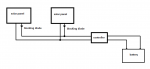
Blocking diodes are in series with the panels where the panels themselves are in parallel with each other

View attachment 105092
This is exactly the setup I am looking at but according to the reply that Blue Drifter got from Photonic Universe it would appear that they are only required if the panels are facing different directions and therefore likely to have a bigger difference in output at any one time. My panels will be next to each other with the same orientation and therefore it would seem they do not need the extra diodes.

The question was "Would an unshaded panel in the above setup try to back feed a partially shaded panel if the extra blocking diodes were not fitted?" I assume therefore that as the panels will be in the same orientation the difference between them would be small enough to ignore and the overall voltage loss produced by the two diodes all the time would be of greater impact.
 
There is theory and then there is practice!

I've experimented with two panels on each side rail. One or other is often in the shade. Wired in series or parallel, series works (only slightly) better. Why? It shouldn't. I think the shading problem is offset by a higher differential voltage causing the MPPT to start charging sooner. It might be because of less line loss, but the cable runs are short.

Therefore will a diode make much difference.?
 
This is exactly the setup I am looking at but according to the reply that Blue Drifter got from Photonic Universe it would appear that they are only required if the panels are facing different directions and therefore likely to have a bigger difference in output at any one time. My panels will be next to each other with the same orientation and therefore it would seem they do not need the extra diodes.

The question was "Would an unshaded panel in the above setup try to back feed a partially shaded panel if the extra blocking diodes were not fitted?" I assume therefore that as the panels will be in the same orientation the difference between them would be small enough to ignore and the overall voltage loss produced by the two diodes all the time would be of greater impact.
I'd agree two panels adjacent to each other should not need blocking diodes.
My understanding is that small panels used without a controller "need" diodes to stop back flow from the battery at night A controller will normally stop this
However, there is a school of thought which says that the loss is so small that its less that the loss caused by the volts drop across the diodes when working. A similar argument would apply to a shaded panel in a parallel configuration.
 
Top