Paper charts versus Chartplotter

dukes4monny

Well-Known Member
Joined
4 Feb 2008
Messages
963
Visit site
The following is quite a long post, but I hope that some might find it useful.........

I've done the RYA DS and YM theory courses and a DS practical course, all have been very useful, BUT, now I have my own yacht I was not happy with using some of the navigation methods which I had been taught......I'll try and explain:

I find that taking manual plots (hand bearing compass) with a small chart table onto a chart is frought with possible errors and I end up double and treble checking everything...........basically it was taking too long down below especially when short / single handed and trying to show an inexperienced crew how to do this would take too long.

My yacht came fitted with a nice Navman plotter, the dogs dooda's, turn it on and I know where I am, job sorted........but, as we all know these things are prone to failing and should not be relied on too much.......and I did want a backup of my position on the paper chart just in case this happened.
Yes, I can get the Lat/Long from the plotter (fitted in the cockpit) and plot this directly on the chart, but as we all know this is fairly easy when navigating a desk in the classroom, but when doing this in a choppy sea under way with a small nav station it is far from easy.........or accurate.

After considering my options, I have come up with a solution which has made my navigation a lot easier and accurate and I am actually starting to enjoy it and it's fairly easy to teach a novice........

I now use my trusty handheld GPS and charts in the following way:
For each chart I create a waypoint (or two) which I call my waypoint 'datum' e.g. WPD1. This is simply a convenient point on the chart which allows me to enter a simple (round) lat/long, this reduces possible typing errors. This is marked on the chart and is entered into the GPS with the same name. Some books suggest using the center of the compass rose.......this is ok if this coincides with a nice 'round' lat/long.........which is not always the case.
I can then enter my route waypoints with appropriate names (WPT1 - WPT2 etc.).

When underway and I want to plot my current position on the chart I simply select the waypoint datum for the current chart (WPD1 etc.) in the GPS and this instantly gives me the range and bearing TO that datum, which I then simply plot directly (adjusted for True) onto the chart to the datum point with my Breton plotter and dividers which takes seconds...........
When done simply switch the GPS back to the current route waypoint.

I know that this relies on the GPS.......my handheld uses batteries which will run it for 24 hours, and I still have the chartplotter as back up........and if all that fails I still have my paper chart too.......

I like to keep things simple and as you can probably tell I'm definately a belt and braces (with a spare belt.......and braces) type of person.

I'm sure that some people might be able to pick holes in my method.........but I'm happy with it. It's got me doing my navigation using paper charts, and I am able to relax a bit more on longer passages /forums/images/graemlins/grin.gif

PS, having re-read this it's probably a more appropriate method for those with small chart tables..........
 
Sounds good to me but why don't you leave the GPS on true. Round here the difference between true and compass is only a couple of degrees and you can't steer to a compass within that tolerance - unless you have GPS and tillerpilot linked.

I use a Yeoman and that avoids trying to lat and long at night in a bumpy sea and can be done by anyone.
 
I reckon you should persevere with your paper charts, hand bearing compasses, breton plotters etc. It's all old school stuff, but it's all good stuff.

Whenever I take a fix, I do it with paper methods (3 point fixes, running fixes, transits, whatever position lines are about) and generally take a GPS fix as a backup. I plot both on the chart and then I gain confidence in my paper chartwork. I've now got to the stage where I sometimes don't even bother plotting the GPS fix as the chartwork always seem to be spot on these days.

I use paper chartwork when single handing on a small boat (Contessa 26): but she does have a proper chart table - larger than A2.

So I reckon, it's practice makes perfect.

There was some other thread about "why do you go sailing" and it was all about whether you go for the pure joy of it (setting the sails, handling the tiller, ...) or you do it to get somewhere (floating caravan). One of the main aspects I like is the navigation. If you navigate with the paper charts, I think you're a lot more involved: keeping an eye on the coast, places to take fixes etc. so it adds another dimension. I guess it's all horses for courses though.

I'm pretty sure that 95% of good fellrunners navigate with paper maps rather than GPS, so there must be something to be said for paper.

But, I guess your post was about a method that works for you and it looks like you're happy with it: great.
 
I think what you are doing is pretty sound. So long as you are keeping up a regular record of your position, course and speed then you should always be able to work out a sensible course to take yourself to safety, even if all your electronics fail. Eventually you will find yourself without some piece of kit that you normally rely on.

You should probably take every opportunity to practice plotting fixes, DRs, EPs, courses to steer and so on. With practice you learn to do it both fast and accurately; I found a strong incentive to become quick at plotting etc. was to be spending as little time as I could manage below in rough conditions when I was learning
 
"I've done the RYA DS and YM theory courses and a DS practical course, all have been very useful, BUT, now I have my own yacht I was not happy with using some of the navigation methods which I had been taught......I'll try and explain:"

Pretty sure the method you describe is explained in the RYA YM book, or should have at least been covered in your theory, (perhaps briefly). It definitely cropped up in my YM as a good method for fast motor boats.

All the methods taught have their place but, personally, I open up an Imray chart on the chart table, turn on the plotter at the wheel, the plotter on the laptop, and away I go /forums/images/graemlins/smile.gif.

Cant remember the last time I plotted a position on a paper chart, (probably during YM in 2007), and the plotters havent failed in 3 years.
 
No one has mentioned common sence

Ie "dead Reckoning"

The GPS well I have had the whole system go down regularly, so it's very good but can have problems.

So BACKUP and backup
etc
 
As others have said, your method is fine, though not how I used to do it as I got used to plotting Lat/Long. We all get used to our own favourite bits of equipment and the world would be a dull place otherwise. I used to use Capt Fields' happily and now have a ruler I bought at a boat show with a couple of tape thingies that keeps the ruler moving parallel and can be worked with one hand.

If driven by conscience or necessity I use this and a pair of dividers and that useless bit of garbage called a Breton Plotter that SWMBO picked on her RYA back-seat-skipper course is relegated to the carpentry department.
 
My method which relies on GPS but gives good fall-back if it fails - which IMHO is rare.

Set your wpts and draw course lines. They then match plotter and paper. On paper course lines mark of distance marks to next wpt.

Now it's simply a matter of taking DTG to next wpt from plotter and marking the course line on paper. You can estimate reasonably between the marks and also XTE from the line. Once a few points have been marked - you have a good average to use for DR / EP determination until tide / current / wind changes.

A tip that helps many - forget roller rules, breton plotters, etc. on a piddly chart table ... a cheap set of schoolboy drawing compasses is all you need and a set-square (triangle). From convenient latitude set compasses to the latitude of position ... now draw an arc on nearest longitude line for latitude. Now set compasses to longitude and from that point draw an arc to set long. Triangle now used to set it 'square'. Takes a bit of practice - but once mastered - you'll wonder why you ever bothered any other way when ships rolling etc. !! Second one of the most accurate methods is the two triangles method used to 'walk' the chart. Given small chart tables - you can use these easily. (I was a ships navigator before coming ashore ...)
 
Thanks for all replies. It's nice to know that my method stands up to some scrutiny by others.

To answer a few of the comments made........Moodysabre: I prefer to keep all of my equipment that displays a bearing set to magnetic....that way when I do sail in an area which has greater variation there is no doubt as to whether it needs accounting for.
I have never seen or used a Yeoman, perhaps it's something I'll take a look at in the future.

Zlod and KenM: yes I agree. I wasn't 'enjoying' the plotting previously and if anything is a chore it's human nature to try and avoid it. Now that I have a decent method for my small chart table I will now be practicing a bit more with other methods too........

RichardM44: Although I'm not claiming to have invented it as it is indeed mentioned in the RYA YM reference book (using the compass rose), it was certainly not discussed in any detail by any of my instructors. In fact the bulk of any navigation was all about paper chart work and GPS was almost a side issue with a very brief explanation but no practical use.

Refueler: Some interesting idea's for using GPS with charts, thanks. Again these are mentioned in the YM book, but I've not heard of anyone using them.......until now /forums/images/graemlins/wink.gif
I will be popping into WHSmith on the way to the boat tomorrow.

And on a general note......I think it's time for a bigger chart table.....now does that mean I have to get a bigger yacht ....... /forums/images/graemlins/laugh.gif
 
[ QUOTE ]
"And the plotters haven't failed in 3 years."

They will, so best anticipated IMHO.

[/ QUOTE ]

Sorry if that sounded a bit blase, but it's a fact - I dont actually know anyone who has had a plotter fail on them, and definitely not 2 systems at the same time. Power failures are possible, but one would hope that backup is available, or a lead can be taken from a working battery.

The plotter can be powered from a Halfords battery pack, and the laptop has about 5 hours worth of battery, (turning either on for long enough to get a position, they would last for ages).

So, unless the GPS system goes down, the chances of me losing both my GPS sources are slim to nil. (I've also got 3 other sources, but that wouldnt necessarily apply to the average boat).

Having said that, if I lost the lot out of sight of land, I can make an educated guess as to where we are, and use DR with the best of them. In sight of land, I can take bearings and running position lines, and all that stuff, so I'm quite satisfied that I'm prepared for all eventualities in relation to losing the plotter and all GPS position sources.

After all, when crossing the Irish Sea 25 years ago, we never really knew where we were, and usually got to where we were heading - didnt we? /forums/images/graemlins/smile.gif.

I also recall a trip from Australia to Khor Fakkan, (Muscat), where we sighted land, but had to sail up and down the coast until we saw something recognisable - and that when I was a professional /forums/images/graemlins/smile.gif, although not "in charge"

Richard
 
Although the RYA requires that everyone knows manual plotting, its best for an instructor to assume that realistically, most people will go away and use GPS or plotter 99% of the time. Then teach to plot the GPS position every hour, using dividers, or Portland plotter, or waypoints and bearings, or parallel rule, whatever suits the navigator.

The Yeoman plotter gives the best of both worlds on a small boat, IMHO.
 
My plotter has gone of a few times - but that's due to outside influences like one guy unplugging to put his mobile charger in the ciggy socket ... another was when the bus bar connector to solenoid broke and positive feed to domestics was lost ... I now have it's own power socket independent !
 
I've just taken a look at their website, an interesting looking piece of kit, although a tad pricey for me at the moment.
I'll try and have a look at one at a boatshow and see if I can convince myself and SWMBO that we cannot possibly survive without one /forums/images/graemlins/grin.gif
 
Just a thought - while on a passage, does everybody on here make a note in the log regularly (eg the top of the hour, or more frequently if necessary) of the position from the GPS?

This would probably be quicker than manually plotting a position on a paper chart (useful if feeling queasy from going below) - yet if the GPS did decide to pack up later, you still have a record of the positions, which can be then converted into a track on the paper chart if required.

And of course it is good practice (and fun) to do manual fixes as well to check how the GPS is doing....
 
I have log-sheets drawn up myself for it ... simple : Time / Date, Lat, Long, speed, course, remarks.

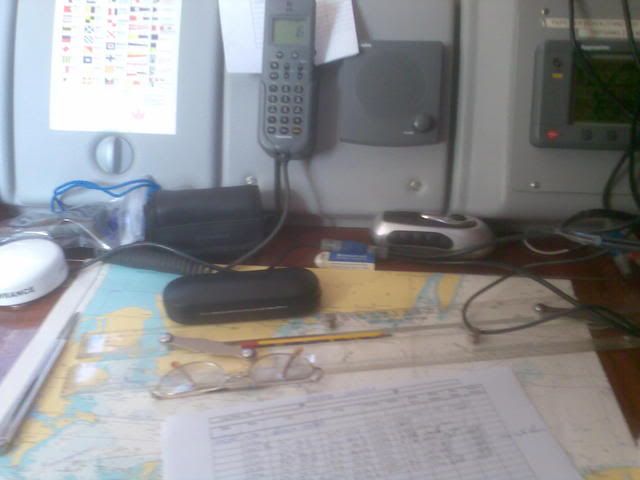
Here's my delivering a Bav Match 35 .... chart, rules, log sheet.

Image034.jpg


RostockVent18_23May2008_023.jpg


RostockVent18_23May2008_043.jpg
 
SWMBO would love it - the most intuitive piece of kit on a boat!

They do come up second hand.
 
"I don't actually know anyone who has had a plotter fail on them, and definitely not 2 systems at the same time"

When my domestic battery died in france the gps crashed and needed serious repair back home. I now have twin batteries!

"While on a passage, does everybody on here make a note in the log regularly of the position from the GPS?"

Yes, converted to distance and bearing from something conspic - no more flaffing around looking for reading glasses to decipher Lat & Long. (I hate those protracted pauses when someone at Beaulieu Entance runs out of fuel and shouts for Solent Coastguard!)
In real emergency the DSC radio gives position of course.

Need a bigger boat with a bigger chart table?
As John Illingworth said: A boat is controlled from chart table and galley.
 
Top