Pagura 5000 generator with farymann engine manual

Beamishken

Well-Known Member
Joined
24 Dec 2001
Messages
531
Location
north ayrshire
Visit site
Hi I recently bought a pagura 5000 generator off a forum member but he had lost the manual does anyone have an electronic copy or a link to an english copy of the manual? I can find it in Italian but thats no use to me unfortunately.
I specifically need the cooling hose route as there is two hoses in and out but neither goes to the seawater pump , I suspect they are for a calorifier take off which I wont use so i need to either re route or blank them
A copy of the relevant cooling circuit page would do
The 3000 & 4000 are the same engine so any one of them will do
Thanks in advance
Ken
 
Last edited:
Hi I recently bought a pagura 5000 generator off a forum member but he had lost the manual does anyone have an electronic copy or a link to an english copy of the manual? I can find it in Italian but thats no use to me unfortunately.
I specifically need the cooling hose route as there is two hoses in and out but neither goes to the seawater pump , I suspect they are for a calorifier take off which I wont use so i need to either re route or blank them
A copy of the relevant cooling circuit page would do
The 3000 & 4000 are the same engine so any one of them will do
Thanks in advance
Ken

Are you sure the hoses are not for an antisyphon loop?
 
Thank you everyone for the info the hoses I'm looking at are in fact for an air vent.
I'm unsure whether to install a vent or not , it would be easier not to & to just bypass the two hoses. The instructions say if the generator is 600mm above the waterline then a vent is not required. This gen will be roughly 400mm above waterline which is significantly higher than the propulsion engines & their exhausts dont have vents installed. My feeling is the instalation instructions are intended more for sailing boats that would be more likely to heal and potentialy put the unit closer or below the waterline. Quite honestly we'd be in big trouble if this thing ever got below the waterline. It also looks like it would be sensible to close the seacock when not running the generator to prevent water being forced into the unit at speed.
How are everyone elses gennys plumbed?
Thanks again for the help
 
Thank you everyone for the info the hoses I'm looking at are in fact for an air vent.

How are everyone elses gennys plumbed?
Thanks again for the help
Those Farryman set ups have a high exhaust water in manifold .
There’s not much height difference or not as much as they could design if they use the whole brain instead of 1/2 of it .
The risk is on many levels .
Firstly when stoped sea water being close to an open exhaust valve ( Ok maybe closed —— who knows !) ...if not used for a long period could start to rust the valve and inside of the cylinder .
If the boats tips ....wash / wake ( accept it’s not heeling like a sailboat ) then water could enter the cylinder.
So you exhaust run needs a greater drop as possible to help the thing drain down after shutdown.

Second as you infer there’s a potential issue regarding the relative heights of the WL , the geny , and the position of the seacock / strainer for the water in .
It’s possible to get a inadvertent siphon starting when it’s not running and this could rise the water level in the exhaust .
Without the gas pressure to force it through like when it’s running the engine may fill up .....hydrolock later at start up ...not good or just cease up if least say over the winter .

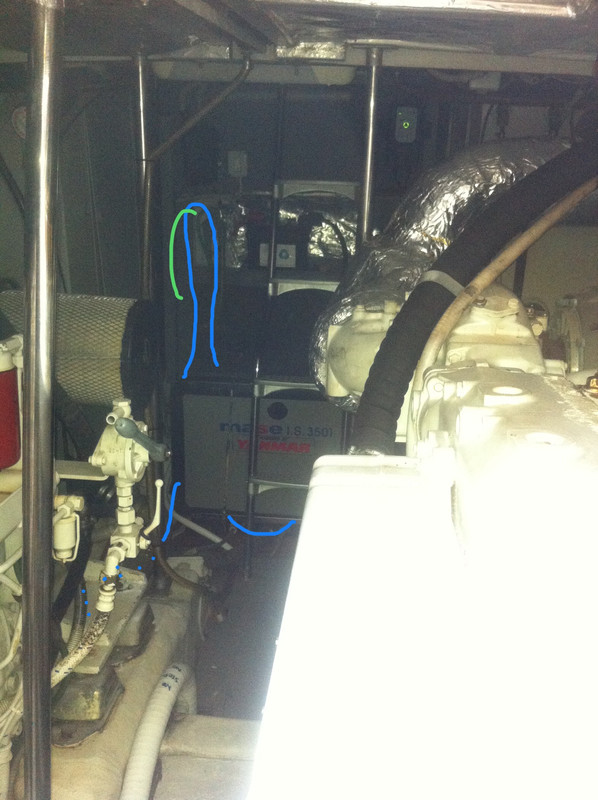
Here’s my set up it’s a Yanmar powered thing which has imho a better exhaust set up ...less chance of a engine fill because the water IN position is lower .on the E pipe so greater height diff ,....pics to follow .

Point is there is a anti siphon bend as you can see on the pic . I would strongly recommend one .Never mind man or real maths calculating relative height postions,......it’s an insurance and with a Farryman you need it !
Blue line is the water trail .
The WL I guess is somewhere 1/2 way up say 20 cm below the “ MASE” name on the case .
The cock and strainer are just in front at the bottom of the V , mid boat station 5 .
The exhaust is vetus 50 mm black pipe that runs to the stern taking gas and water .
Bat is above it and a small Bosch charger to the rhs ( on the pic behind the ladder ) .Additionally I have a cross over switch to nick 12 v from somewhere? If the starter bat is dead .


Anti Siphon bend

Btw we run with the seacock open all the time and it stays fully primed ....on the button so to speak .
 
Last edited:
Just widening the thread re tiny geny motors and the finer nuisances for information.


Yanmar set up with Stainless steel exhaust and finned air cooled cylinder.
You can see the temp overheat guard a bit downstream.


No fluids circulating in the engine block . The sea water entry to cool the gasses Is from under neath below
Less chance of a any cylinder ingestion when it’s off and the boat rocks about for what ever reason .


Farryman with a alloy wet exhaust and the water IN is near the top so never far from the E valve so a grater chance of water ingestion


Engine casing showing signs I’d external corrosion. Imagine the inside ?
This was a older Fisher Panda .I believe newer are indirect cooled via a HE .
Ticking £££ bomb I sold the boat and buyers surveyor never picked up on it .Mind you Perhaps he wasn’t built like a racing snake to access it :)

picupload
 
Last edited:
Thank you everyone for the info the hoses I'm looking at are in fact for an air vent.
I'm unsure whether to install a vent or not , it would be easier not to & to just bypass the two hoses. The instructions say if the generator is 600mm above the waterline then a vent is not required. This gen will be roughly 400mm above waterline which is significantly higher than the propulsion engines & their exhausts dont have vents installed. My feeling is the instalation instructions are intended more for sailing boats that would be more likely to heal and potentialy put the unit closer or below the waterline. Quite honestly we'd be in big trouble if this thing ever got below the waterline. It also looks like it would be sensible to close the seacock when not running the generator to prevent water being forced into the unit at speed.
How are everyone elses gennys plumbed?
Thanks again for the help

The important distance is how high the water injection point on the exhaust is above the loaded water line, if this distance is less than 600mm. You need to fit an anti siphon valve. You should not fit a scooped sea water inlet either, just an open type skin fitting.
 
The important distance is how high the water injection point on the exhaust is above the loaded water line, if this distance is less than 600mm. You need to fit an anti siphon valve. You should not fit a scooped sea water inlet either, just an open type skin fitting.

Bear in mind ARE has forgotten more about generators than we have ever known. Do what the man says !
 
Thanks again folks lots of good info I'm definitely less than 600mm above waterline so I guess the antisiphon is necessary, what puzzles me is the two pipes you have to extend to reach the anti siphon connect 1 to the stainless exhaust elbow the other the return from the head . This seems an odd place to locate it as every time you stop the genny the volume of water in 1 leg of the hose to the anti siphon will dump into the exhaust adding to any water already there. Its plumbed this way from the factory so must be what they intend but it does seem odd
 
Thanks again folks lots of good info I'm definitely less than 600mm above waterline so I guess the antisiphon is necessary, what puzzles me is the two pipes you have to extend to reach the anti siphon connect 1 to the stainless exhaust elbow the other the return from the head . This seems an odd place to locate it as every time you stop the genny the volume of water in 1 leg of the hose to the anti siphon will dump into the exhaust adding to any water already there. Its plumbed this way from the factory so must be what they intend but it does seem odd

You have it correct, every time you stop your generator the water in the hose should run into the exhaust muffler. This is why the exhaust hose from the generator to the muffler should be continuous downwards to drain correctly. If it ran the other way you would fill the engine with the sea water. The muffler should be sized to be only 1/3 full once switch off, this allows for a couple of false starts before you start to back water into the engine.
 
Hmm I cant get a continuous downward it can only go horizontal then up about 400mm to the overboard skin fitting the run from genny to skin fitting is about 1.3m, it cant go overboard anywhere else due to the fuel tanks either side of the engine bay. Skin fitting is already in place from a previous install removed before we purchased. I'm aware how susceptible to water intrusion this will be and wonder if it may be best to drain off the exhaust after every shutdown? Bearing in mind we have used the boat for 5 years and not realy missed the genny but having 2 small children onboard we now think it will be handy. Draining the exhaust could be part of my daily checks before we go anywhere so not realy that much of a pain
Thanks again
 
If the exhaust runs up then when you turn it off the water will run back into the engine.

There are water silencers ( no idea as to the name ) I have one that is below the generator, the pipe then goes up from that and into the exhaust via a water separator ( so most water is discharged under water as the exhaust would be noisy with lots of water flowing out.

That may be a solution eme will advise but you can’t have it running up hill !
 
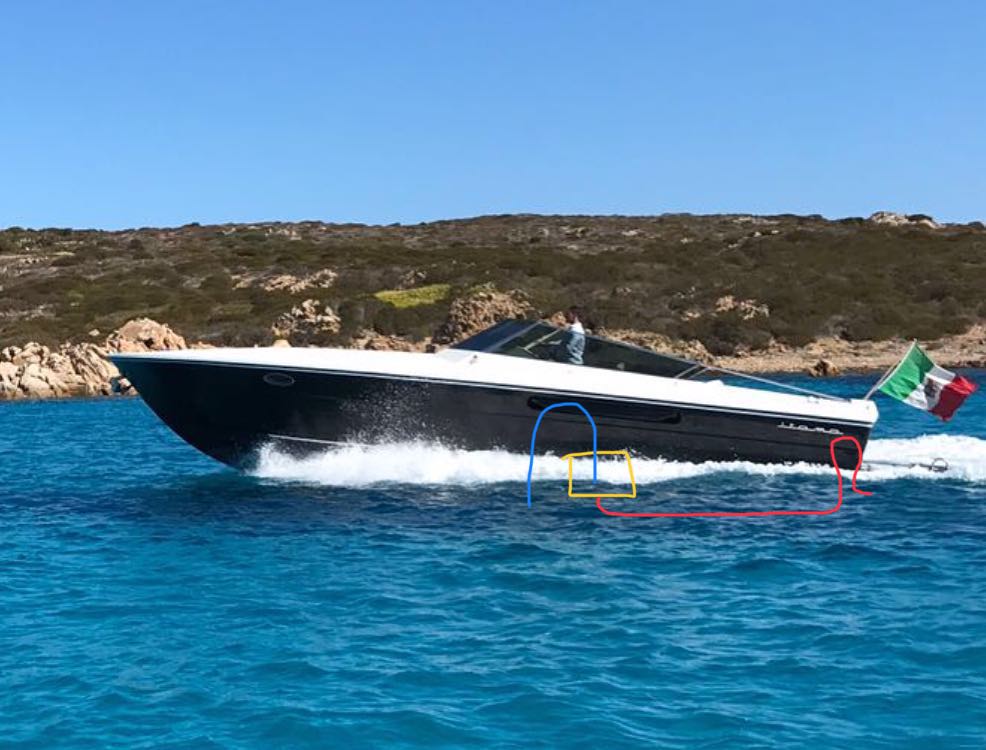
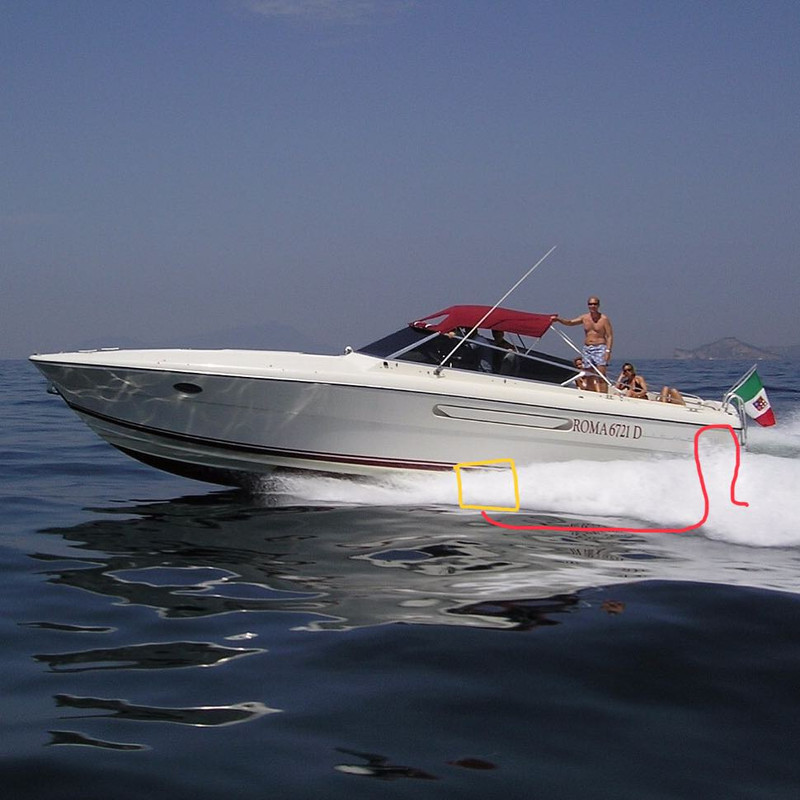
My exhaust just runs back in the V ( geny in the centre line ) under the rear cabin sole but then then run up high in a loop
before exiting .
So presume when stopped any residual water drains from the top of the loop either out or in a sump .
The exhaust OUT on the geny is under it .Its actually mounted on a frame raising it say 15 cm above its pair of inner bearers .So somebody’s thought about the relative heights .
Also when the boats running with it off any residual water ( there will be some ) runs to the transom .
Additionally the end high loop will prevent water ingress when going slow in a following sea or suddenly dropping off the plane .
So similarly if the OP s gonna for a lateral exit he needs to be aware of a wave slamming in the side of the hull potentially forcing water in the exit .....then a unfavourable boat roll may swill the water back if the relative height of the exhaust manifold is not high enough.

So would a loop before the exhaust out be helpful?


img host
 
Ok, so let’s start at the generator end.

The exhaust hose from the generator should run down to your muffler, this muffler would normally be a side entry and top outlet. As before this muffler collects the water on switch off and ideally should located below the exhaust gas water separator if fitted. The hose from the generator to the muffler should be as short and straight as possible. The exhaust water separator should be 450mm above LWL. The water drain hose should go directly down and straight through the hull. The dry section should then down to the dry outlet.

If no water separator fitted, the hose that comes off the top of the muffler should go up above the outlet to a swan neck, then drop into the outlet.
 
Ok Thank you for your assistance looking at vetus & vernalift 40mm waterlocks the entry heights look about 120mm to 200mm which would mean exhaust going uphill to them .genny location makes it difficult to get the exhaust to run down without seriously extending the hose runs. I could drop the waterlock into the bilge but that will mean the eventual lift will be much further and longer exhaust runs. No problem getting a goosneck above the exhaust skin fitting under the coaming but getting the exhaust run correctly is a bit of headscratcher. Setting the genny on a plinth might be an option if no other solution I guess but would prefer to keep the weight as low as possible
 
Ok Thank you for your assistance looking at vetus & vernalift 40mm waterlocks the entry heights look about 120mm to 200mm which would mean exhaust going uphill to them .genny location makes it difficult to get the exhaust to run down without seriously extending the hose runs. I could drop the waterlock into the bilge but that will mean the eventual lift will be much further and longer exhaust runs. No problem getting a goosneck above the exhaust skin fitting under the coaming but getting the exhaust run correctly is a bit of headscratcher. Setting the genny on a plinth might be an option if no other solution I guess but would prefer to keep the weight as low as possible

A glass fibre vernalift is the best for noise levels, you really need to get this as close to the generator as possible if height is an issue regarding getting the hose running downwards. Are you planning to fit an exhaust gas water separator?
 
Top