Outboard spark test multimeter

Suzuki 2hp. How would you test for a spark with a multimeter?

You wouldn't.
You need to check what air gap a spark will jump.
Ideally use an adjustable air gap spark tester in which the spark is made to jump between two electrodes with an adjustable gap between them.

If the engine is an older model with points ignition the spark should jump 5/16 inch. If it is a more modern one with CDI ignition it should jump 7/16 inch.
 
Suzuki 2hp. How would you test for a spark with a multimeter?

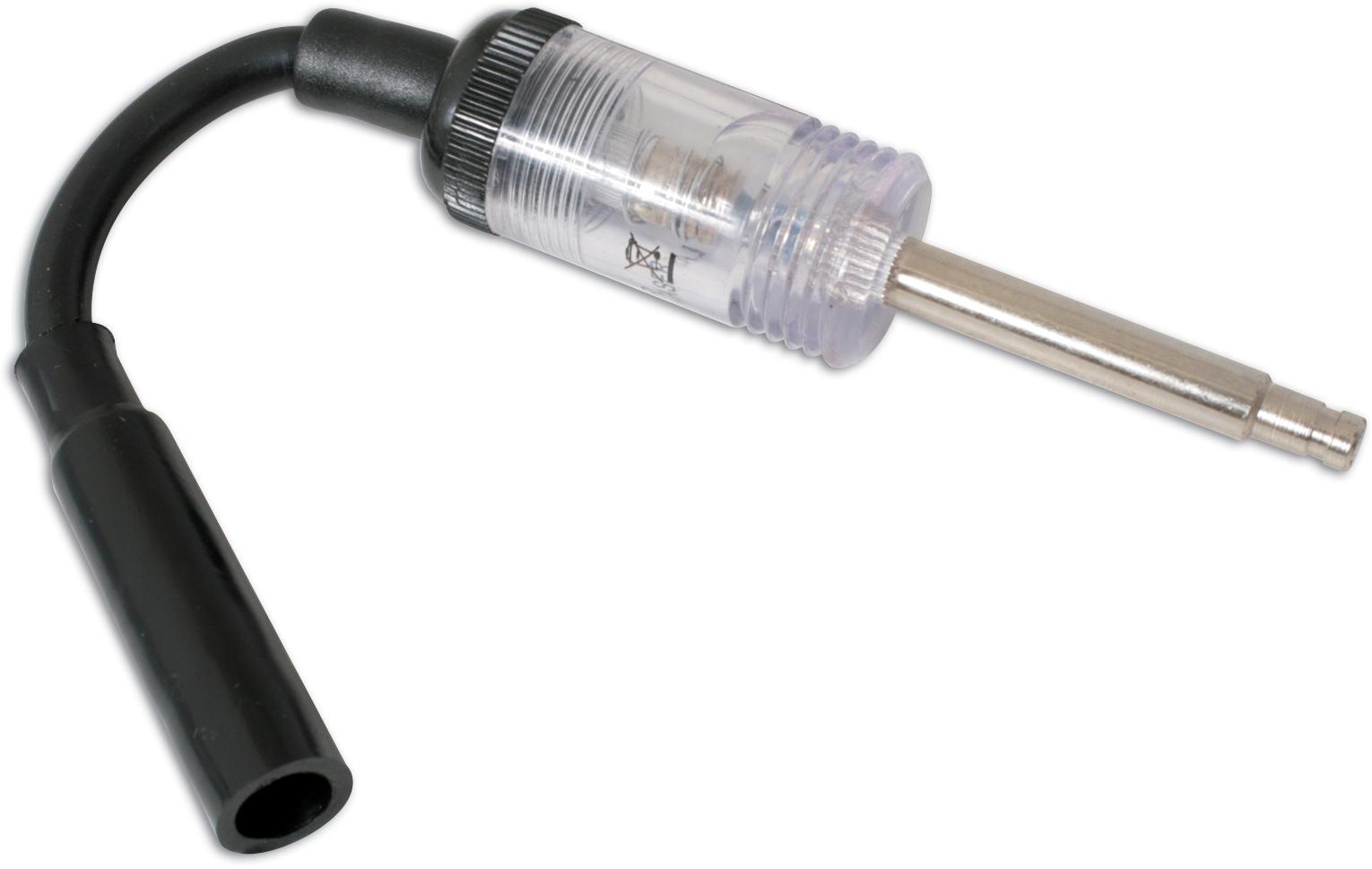
As Vic says, you need the right tool for the job, one of these ..

208694.jpg


About a fiver on Ebay.
 
What PaulRainbow said above, a nice fat spark gives an indication as to condition.
The colour of the plug gives an indication as to how the engine's running. There's a nice picture reference in old Haynes manuals (for petrol engine cars obvs!).
Plugs aren't generally v expensive - or at least they used to be pretty inexpensive though its been a while since I checked -
If you have any doubts swap it out for a properly gapped new one.
 
Back in my youth when learning about vintage car magneto ignition systems my mentor would hold a spark plug lead and allow a spark from his index finger to the engine block while commenting on the yellowness and length of the spark. If you do this it is best to hold the lead in the same hand as the sparking finger!
 
Back in my youth when learning about vintage car magneto ignition systems my mentor would hold a spark plug lead and allow a spark from his index finger to the engine block while commenting on the yellowness and length of the spark. If you do this it is best to hold the lead in the same hand as the sparking finger!

Even better is getting someone else to hold it :)
 
Back in my youth when learning about vintage car magneto ignition systems my mentor would hold a spark plug lead and allow a spark from his index finger to the engine block while commenting on the yellowness and length of the spark. If you do this it is best to hold the lead in the same hand as the sparking finger!

You definitely don't want the voltage from a coil crossing your body, it'll give you a proper tickle - even a little OB.

We used to have lots of fun when I was a young engineer pranking each other doing what Paul said. Anyone trying that now would likely lose their job! Oh the stories ? ?
 
Thousands of volts. Momentary discharge of coil. - Try it. You'll find out. Or take the advice of the people who know. ;);)
 
Its electrical so I dont understand why you cant use a multimeter?

Due to the way the current is delivered. It's very high voltage, very low current and delivered very quickly, for a short period of time. Multimeters have a hard time on that type of electrical output.

You can use a multimeter to test if the spark plug has a dead short, but again due to the voltage needed you would need something like a mega-meter to test the insulation properly.

That's why the simplest test is the one most often used - unscrew plug from engine, put HT lead on, ground the plug and pull recoil. The old-school engineers would say that if you can see the spark in bright daylight, it's strong enough.

If you are in any doubt as to the condition of the spark plug, just change it. If you want to test the ignition circuit properly it takes some very specialist tools, hence why the common method is the spark tester someone showed above, or the old-school manual method.
 
Due to the way the current is delivered. It's very high voltage, very low current and delivered very quickly, for a short period of time. Multimeters have a hard time on that type of electrical output.

You can use a multimeter to test if the spark plug has a dead short, but again due to the voltage needed you would need something like a mega-meter to test the insulation properly.

That's why the simplest test is the one most often used - unscrew plug from engine, put HT lead on, ground the plug and pull recoil. The old-school engineers would say that if you can see the spark in bright daylight, it's strong enough.

If you are in any doubt as to the condition of the spark plug, just change it. If you want to test the ignition circuit properly it takes some very specialist tools, hence why the common method is the spark tester someone showed above, or the old-school manual method.

A multimeter is not really suitable for any test on a spark plug, it may detect a short circuit as stated above. However spark plug insulation can break down under the high voltage (HT) surge of the ignition pulse. A multimeter will never detect that.
 
Last edited:
If you're trying to diagnose a problem in the ignition /electrical system without the specialist testers mentioned above then the generally accepted way to do that is to check for obvious signs of a fault and then systematically change old /existing components for known good or new ones.
Start with the bits that are most commonly at fault & easiest to get at - start by cleaning corrosion off any of the connectors then check them for tightness/good connection then test.
If that hasn't improved matters swap out the HT lead & test or the plug then test then check continuity in the cables (which will deteriorate over time) and then swap the coil and on & on until you have a brand new system & still no signs of life....
At which point check that there's fuel in the tank, the tap's open & the kill switch isn't the problem. Duh! Been there, done that.
Broombroom
 
As Vic says, you need the right tool for the job, one of these ..

208694.jpg


About a fiver on Ebay.
I haven't had to do it since the days of trying to waterproof the distributor on a rally Cooper S, but I used a nail of suitable dimension stuck into the lead and held close to the block (by the plug cap, unless you're feeling masochistic! Rubber gloves optional, but advisable, especially if things are damp...
 
I haven't had to do it since the days of trying to waterproof the distributor on a rally Cooper S, but I used a nail of suitable dimension stuck into the lead and held close to the block (by the plug cap, unless you're feeling masochistic! Rubber gloves optional, but advisable, especially if things are damp...
I have vague memories of home-built spark gap testers, using a screw and a couple of blocks of wood!
 
I have a coil and condenser bench tester. In my opinion its the only reliable way i know to test coil snd condensers
 
Top