Outboard hints required

Is it possible rather than a simple piece of bar between the holes it was a piece of plate with the bar locating it. Seems the only way as I’ve never seen an other that locks on the very back plate. As said this is normally just to hold the casting worst and stop it splaying. This would normally be against normally be flat against the transomnand this would stop the hooks engaging. Not sure why you would want the leg to go forward ahead of vertical unless the original transom was angled forwards.

I agree. If I could weld a piece of steel plate between a pair of pipes, each pipe could hold a rod that could lodge securely in the holes...

...and the plate could stick up above the pipes. The difficulty with using the holes to position a single rod or bar, is that one on its own will just twist in the holes, so the plate (which must project upward half an inch, in order to be caught by the hooks) will flop over and hang beneath, under gravity.

I can make something that will work from stainless off-cuts, but it's a lot more difficult than it ought to be for no apparent reason.

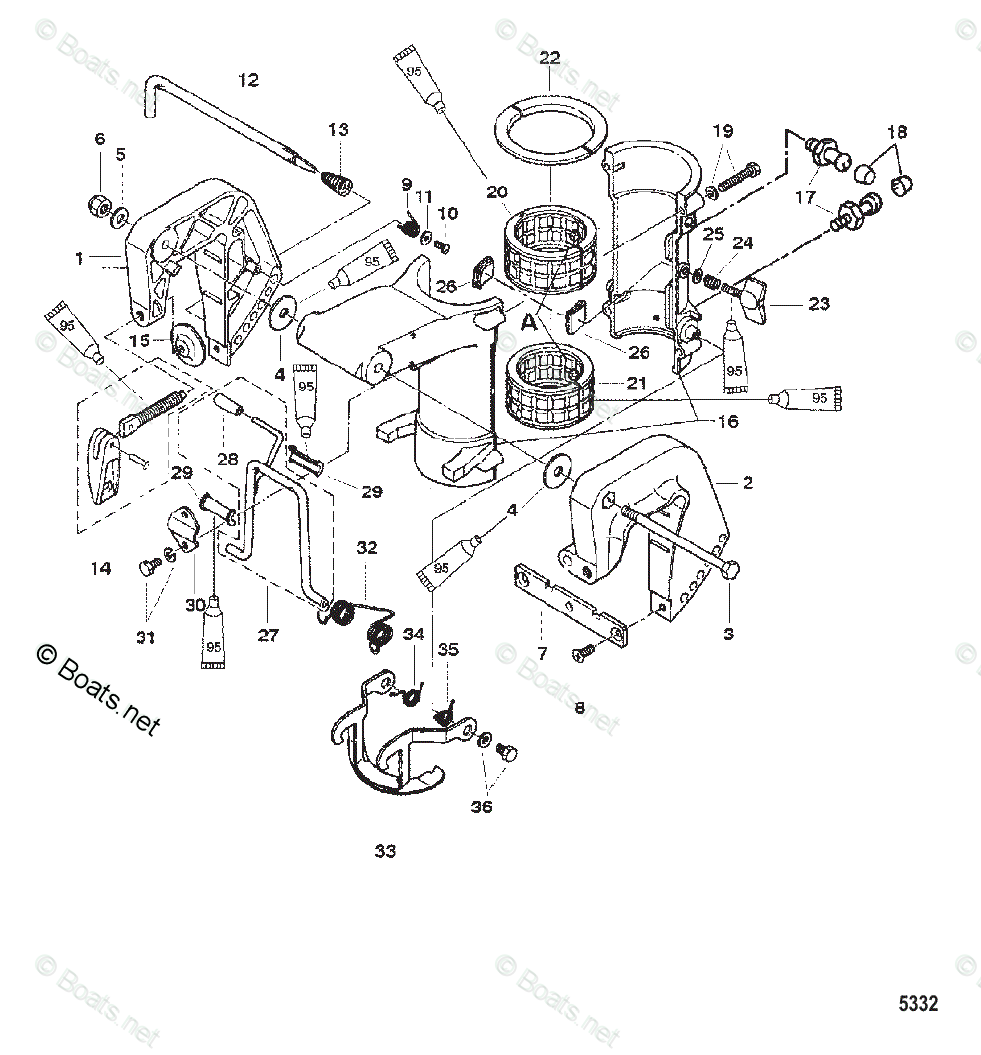
It is an ordinary drop -nose pin.**.... It is shown in the parts diagram to which I posted a link in #3 ... it is a common arrangement. If the angle is not going to be altered frequently A piece of round bar threaded at each end for nuts can be used. There must be something preventing the hooks on the reverse latch engaging with it when reverse is selected.' The "shiny steel pin", , which is the top of the lower shift rod, lifts the latch out of engagement in forward gear , and I assume neutral,

Are the springs, #34 and #35 in place and functioning correctly

**Shown again here part #12
MTcwODY1-ca952bf0.png
 
Thanks Vic. I understood what you meant. I wanted to explain why it doesn't seem to apply here, but I couldn't get photos till now.

Apologies in advance, if my description here overlooks something I've missed or misunderstood in an earlier post.

In the photo below, I've pushed up the hooked frame so that it is in the 'forward' gear position. I ought to have engaged forward, so the pin would be up at its maximum visible extension, holding the sprung frame in this position. The arrow is pointing at the pale bottom edge of the pivoting frame, which in neutral, makes contact with the solid metal bar whose unpainted end is visible here...

49147519986_f18744ef5f_c.jpg


...so, in the pic below, I hope it's clear that I've let the hooked frame return to its lowest position (the blue is the contact area) and conspicuously, in this position, the under-part of the frame is at rest half an inch above the silver pin position in reverse-gear.

49147722627_19a46f8815_c.jpg


Still in the lowermost position in the pic below; again, I've blue-highlighted the solid impassible contact area, which (I think) shows that the pivoting frame cannot even have been designed to swing any lower...it is well out of range of the holes in the frame below.

49147507036_5e5c78b967.jpg


The whole set-up is fine in forward gear when the engine can swing up, but this little pivoting frame's range of movement does not allow it to drop low enough in reverse, for the hooks to engage with a bar positioned between the holes.

It is very strange because even though it looks old and battered, there is zero sign of bending, distortion or re-positioning which might explain why the reverse-lock action doesn't and cannot engage. It looks more like this particular model featured some design glitch which left the assembly in place on models sold, even though they couldn't function as originally intended.

Might that account for the tiny slots cut in the spacer-plate, located so they do engage with the hooks (that surely can't be chance?) and which thereby allow the engine to be locked down, in reverse? Not a slick solution, but better than no means of locking.
 
Last edited:
Yes, and that choking smoke is full of cancerous substances. I use alkylate petrol (Aspen is one of the brands) its hellishly expensive, but far less unhealthy, and if the engine is on a tender, a season's use is probably fairly low. I am not so sure about the burnt oil from a two stroke, though.
 
Thanks Vic. I understood what you meant. I wanted to explain why it doesn't seem to apply here, but I couldn't get photos till now.

Apologies in advance, if my description here overlooks something I've missed or misunderstood in an earlier post.

.
.
.
Might that account for the tiny slots cut in the spacer-plate, located so they do engage with the hooks (that surely can't be chance?) and which thereby allow the engine to be locked down, in reverse? Not a slick solution, but better than no means of locking.

I see what you mean.
Presumably it also means that you would not be able to use the alternative positions for the ( missing) tilt adjusting pin if the motor is used on a boat with a sloping transom.

Very odd . Something not original perhaps ? I wonder if the transom clamp bracket assembly from a different model has been fitted for some reason.

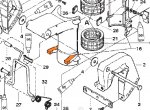
What i call the tilt adjusting pin is called the thrust rod in the parts diagram because the two lugs I have highlighted in the diagram attached to this post should rest against it to transmit the forward thrust to the transom clamp brackets. Hopefully they rest against the spacer plate in your case .

I guess you will have to live it it as it is.

Dan's outboard.jpg
 
Very odd. Something not original perhaps? I wonder if the transom clamp bracket assembly from a different model has been fitted for some reason.

That's a smart deduction, and very likely the case: something isn't standard. I'll take another decent look in daylight. :encouragement:
 
I don't suppose its latching properly because its sitting in the shallow water position!!

BTW when fully down the latch stays latched (to the missing bar) in neutral as well as when in astern.
 
Thanks to the positive and instructional feedback of this thread, I have resurrected my
saloon table.

I'm delighted to hear it, L.K.

But is it possible you placed this good news into the wrong thread? :confused: :biggrin-new:

...when fully down the latch stays latched (to the missing bar) in neutral as well as when in astern.

Assuming we're discussing engines rather than tables, I appreciate the input. But I believe Vic hit the nail on the head - something in my engine has been retrofitted other than as standard, so the neat well-designed system does not work as it ought to.
 
I'm delighted to hear it, L.K.

But is it possible you placed this good news into the wrong thread? :confused: :biggrin-new:


Assuming we're discussing engines rather than tables, I appreciate the input. But I believe Vic hit the nail on the head - something in my engine has been retrofitted other than as standard, so the neat well-designed system does not work as it ought to.

Thanks Dan.

Just another age experience for me.
 
Top