Ore/Alde first-timer this weekend. Advice sought.

fredrussell

Well-Known Member
Joined
24 Mar 2015
Messages
4,154
Visit site
Up the Alde this weekend (from Orwell) for the first time. I've printed off the most recent chartlet on the ECP website and it looks fairly straightforward. My East Coast Pilot and charts are on the boat so any tips would be appreciated. My boat draws bugger all (Super Seal 26 = 40cms with keel up) so that should help, and my engine is capable of pushing boat at no more than 6kts at slack water.

When do the panel think is best time to tackle the entrance? HW -1? I'm hoping to anchor somewhere up the Butley River, as I'm assuming the anchorage(s) in the vicinity of Havergate Island will be busy and I may as well reap the rewards of a lifting keel by spending the night up a muddy creek! Also, when is the best time to 'exit the entrance', so to speak?.

Any tips or advice from those who are well acquainted with this entrance would be appreciated muchly. I've done the Deben a few times so I know these entrances should be treated with respect.
 
This evening I'm adding an advisory to the note that accompanies the Ore ECP chartlet, saying that local reports suggest it's best to go straight between the Haven and Weir buoys. It seems it may be shallowing near the Oxley, as happened last year.
 
Butley Creek is a great anchorage with your draft but we once went aground on a bank at low water in the middle of the night and dried out at a very odd angle so we now anchor in Abraham's Bosom. We've stopped there often and like to visit Orford and Aldeburugh and take the dinghy to Snape but with your draft you could get all the way up yourself.

For sheer magic though, nothing beats taking the flood in a dinghy all the way up Butley Creek, the upper reaches are breathtaking.
 
Been up the Ore and Deben this week. Very quiet. Only boat at anchor in Abraham's Bosom, only one on visitors' mooring at Orford. There were a few anchored at the Rocks on Sunday afternoon but only 4 of us overnighted. Came out of the ore this pm. -2 and had minimum of 5 ft under keel and draw 5ft. You need to allow a good hour at 5 knots to plod from Orford to Weir point against the tide when leaving. Enjoy.
 
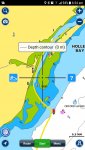
Screenshot_20170601-065445.jpg This is my track inbound from last week. HW-2. Plenty of water all through I'd suggest once past the Weir buoy keep slightly over to the starboard side adjacent to N. Shoal for deeper water. Departing was LW+2 again keeping to the N. Shoal side if the River before cutting across to middle if the river. The disturbed water by North Shoal seems to indicate deep rather than shallow water. I draw 1m bilge keel so not usually too much of an issue.
 
With 0.4m draft you should be able to get in at pretty much any state of tide. I would certainly be looking to go in somewhat earlier than HW-1 - it's easier and less daunting if you can see the lumps sticking out of the water rather than them being mostly covered. I would also exit reasonably early - you'll have plenty of tide to carry you back down to the Orwell then. It's quite a hard slog over the tide as you approach the exit, but if you can do 6 knots through the water then you'll be fine.
 
With 0.4m draft you should be able to get in at pretty much any state of tide. I would certainly be looking to go in somewhat earlier than HW-1 - it's easier and less daunting if you can see the lumps sticking out of the water rather than them being mostly covered. I would also exit reasonably early - you'll have plenty of tide to carry you back down to the Orwell then. It's quite a hard slog over the tide as you approach the exit, but if you can do 6 knots through the water then you'll be fine.

An old trick, which few people seem to use now, is to go down on the last of the ebb and anchor inside North Weir Point to wait for enough rise. [see my avatar]
The tide flows out for some time after low water. This can save a long slog against the tide and it's a magic place to anchor.
I suppose modern more powerful engines make this less necessary and can only be done in settled conditions.
 
An old trick, which few people seem to use now, is to go down on the last of the ebb and anchor inside North Weir Point to wait for enough rise. [see my avatar]
The tide flows out for some time after low water. This can save a long slog against the tide and it's a magic place to anchor.
I suppose modern more powerful engines make this less necessary and can only be done in settled conditions.

I leave as the tide turns at Orford, in a s/w wind its a great sail,keeping in zero water close in the ness side & a great big eddy at N W Pt, its easy to beat boats under engine :)
 
We went in on 24th @ HW & found plenty of depth by Oxley buoy (almost 5 metres). However, once inside we found a very shallow patch (2.3m) in midstream alongside N. Weir Point. On the way out again on 29th (HW-2) we used sailorman's trick again (sticking very close to Eastern shore at North Weir Point, then shooting across to midstream at the end) we found 3.3 metres was the shallowest it got.

You've got the perfect boat for exploring the Butley River.
 
When entering the Butley do not cut any corners when approaching the entrance withies, there is a very shallow bank on the corner.
Keep to the portside of the river until well past the quay. There is a massive mud bank along the right hand side.
I usually anchor in the middle of the river just past the quay or further up more to port bank.
There are sometimes late night parties on the quay but all fairly tame stuff.
The huge pale blue cat fishing boat can leave as early as 5am but they tend to slow down when passing anchored boats.
Don't anchor past the ferry as there are moorings and oyster beds past there.
Its about half an hours walk into Orford from ferry stage.
Enjoy.
 
Top