
Opinions please - New sails from Elvstrom.

Some more background about this upgrade.

This will probably be my last boat, I intend to keep it for over a decade and I'm about 3 years away from retirement. I have three years to turn it into a reliable, energy independent, long-term live aboard. I'm not going to call it "blue water" because to me, the term is meaningless ... I have no fixed plan other than I will be starting off in the eastern Med and a trip to the caribbean, maybe further, is not off the table. I'm not interested in comments about having the wrong boat, it will be fine for whatever I want to do with it. The boat is 2008 but in extra-ordinary condition for its age, showing no signs of extended use.

The problem with a 2008 boat is that it was produced before main, jib and furling code zero was a thing on AWBs, so as well as new sails, the rig is being converted to fit an electric furling code zero in front of the genoa with the necessary clearance top and bottom.

I've got issues with the original sail layout regarding the genoa, as it was originally designed for a large one (151%), so the genoa tracks are intended for a sail of this size. The compromise here is a 120% jib, I wanted a 110% but the clew is not far enough aft for the current tracks - they can't be extended because the stays are in the way, and their positioning means an in-hauler would pull the sheet hard against the stay (see pic in an earlier post) .... so 120% jib it is - it's still 45,5m2 which is big enough for me, and I'm happy with an 83m2 code as we are a small sailing couple.

The boat is already set up with everything electrically controlled. Electric cabin top winch for main furling, outhaul and sheeting, two electric genoa sheet winches, and 2 manual second winches for spinnaker etc. The genoa furling is also electric - hopefully means I can continue sailing for a long time and my partner (48kg) can also operate the sails with ease.

Then comes the question about the sails themselves, it is advantageous for me to get everything done by one company - the company I have chosen is based in Bodensee, Germany - sourcing the sails from Elvstrom and measuring and fitting themselves - they cover Croatia where my boat is kept. AFAIK Elvestrom manufactures in Denmark, France and Tunisia (since they have closed their UK loft) ... the sail material comes from Dimension-Polyant.

I am aiming for the best compromise for sail shape, longevity, sail size and price. AFAIK Dimension-Polyant Pro-Radial sail cloth delivers this, and the samples I got seemed very robust (mechanically). The sails will be radially cut. The vertical battens are something I have always wanted to try since I saw them in action on a Halberg-Rassy, and I'm seeing more and more of them in use - perhaps their time has come? I've been assured that in my particular mast they will present no problems at all. Only stipulation was that the mast needs to be straight when furling. The adjustable backstay will be set up to easily enable this.

The purpose of these posts were to see if there are any showstoppers or something fundamental that I have missed, and hopefully to get some ballpark idea of what this should cost.

So far the advice has been very helpful and I am broadly happy with my plan so far, at least there have been no OMG moments and while I respect the opinions of everyone, buying in the UK with delivery in Europe is just too difficult these days, and I have looked into it. This rules out many suggestions. Sounds like Sanders would be an ideal choice, but again, it's that B-word problem with dealing with companies not in the same customs area. There seems to be a lot of support for Vectran - will look at the cloth I have chosen again.

Thanks for all the replies. This is unfortunately not just a sail-replacement project - that would be too easy :ROFLMAO: :ROFLMAO: :ROFLMAO: ... I want create a boat I can really enjoy sailing with the stipulation that it must be in-mast reefing, and the major sail-controls need to be usable by a 48kg, 5ft tall woman. Hopefully the planned modifications will give us that.
I think the overall plan is a very sensible one.

My main comment would be to take a really good look at the sheeting angle and determine if a small extension of the track, or maybe a flying system would help you get the jib you actually want.

And I'm also very nervous about the electric furling on the code. If I've googled the right unit it looks like it'll be brilliant whilst it works but doesn't look like it has a manual backup.... Relying on a waterproof socket at the bow seems like recipe for it deciding not to work one day....
 
I think the overall plan is a very sensible one.

My main comment would be to take a really good look at the sheeting angle and determine if a small extension of the track, or maybe a flying system would help you get the jib you actually want.

And I'm also very nervous about the electric furling on the code. If I've googled the right unit it looks like it'll be brilliant whilst it works but doesn't look like it has a manual backup.... Relying on a waterproof socket at the bow seems like recipe for it deciding not to work one day....
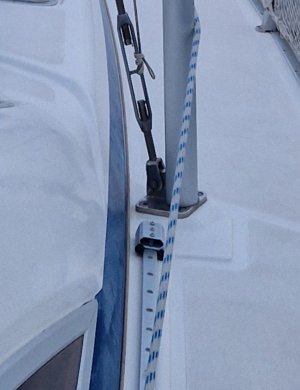
It's a Profurl NEX Lite 4.0, mainly because the Selden furler (CXE 25) doesn't lock to prevent unfurling - you have to manually lock it off which means a trip to the foredeck.

I intend to carry a manual furler as backup ... both are from pro-furl and they are interchangeable so if it goes t!ts up I can swap it out for a manual furler until I can fix it. I have a similar setup with the genoa, it has a manual backup and the previous owner showed me how it works - he needed it when an internal belt went pop - so he bought 3 spares. It hasn't failed since.

I appreciate the electrical aids are another source of potential failure, but I expect it to be in-service more than out-of service so the risk is worth it for the convenience IMO.

I'll get them to have a look at the track and sheeting angles when they go to measure up .... maybe something can be done. Removing the tubes over the shrouds would give me an inch or so - I guess the last owner probably put them there to avoid chafe on the sheets.
 
Cutting the 110% jib with a higher clew would solve the sheeting angle issue. Yes it would be very slightly less efficient but I doubt that would bother you. Perhaps it should be part of the conversation with your sailmaker?
 
Cutting the 110% jib with a higher clew would solve the sheeting angle issue. Yes it would be very slightly less efficient but I doubt that would bother you. Perhaps it should be part of the conversation with your sailmaker?
But if the boat was designed for 120% or bigger jib, and the tracks are well back, I would stick with at least 120% (and ditch the jib battens). High clewed jibs definitely don’t go to windward as well.
And personally I prefer a moderate sized jib which can be used in all conditions, than a tiny jib which means need to swap to a Code 0. This just creates extra work.
 
But if the boat was designed for 120% or bigger jib, and the tracks are well back, I would stick with at least 120% (and ditch the jib battens). High clewed jibs definitely don’t go to windward as well.
And personally I prefer a moderate sized jib which can be used in all conditions, than a tiny jib which means need to swap to a Code 0. This just creates extra work.
In my opinion if you don't want the "work" of sailing, just buy a motor boat.

Agree re a 120 being better than a high cut 110 though.

A 105% cut to sheet inside the shrouds would be where I'd be looking on that boat I think. Might need a bit more track at the forward end if that's possible.
 
In my opinion if you don't want the "work" of sailing, just buy a motor boat.

Agree re a 120 being better than a high cut 110 though.

A 105% cut to sheet inside the shrouds would be where I'd be looking on that boat I think. Might need a bit more track at the forward end if that's possible.
1000015700.jpg

Not very optimistic in terms of extending the genoa tracks.
 
View attachment 186292

Not very optimistic in terms of extending the genoa tracks.
I think you'd be looking at a short separate track in front of the shrouds. Or moving completely to a 3D system.

Another thing worth mentioning though is that low cut, high aspect ratio, jibs are generally quite a lot more sensitive to car position than big overflappers. So I actually would say that if you wanted to go to your jib plan as above you really need adjustable cars, or a 3D system. If you aren't able to / don't want to do that, then stick to your sailmaker's 120% genoa plan.
 
I think you'd be looking at a short separate track in front of the shrouds. Or moving completely to a 3D system.

Another thing worth mentioning though is that low cut, high aspect ratio, jibs are generally quite a lot more sensitive to car position than big overflappers. So I actually would say that if you wanted to go to your jib plan as above you really need adjustable cars, or a 3D system. If you aren't able to / don't want to do that, then stick to your sailmaker's 120% genoa plan.
I'm tending towards going with the 120% .... don't really want to start drilling more holes in the deck or cabin top. The adjusting lines for the cars are not fitted in the photo even though all the hardware is there ... they don't seem to be on the boat anywhere, so I can only assume the previous owner wasn't that bothered about adjustments.

On my last boat I had no adjustment lines but I was able to stand on the sheets and move the cars ... this boat, I stand on the sheet and not a lot happens - I'm not heavy enough.

Everything about boats is a compromise in some way, and in this case, I'll go with the 120% unless the sailmaker can come up with a cunning plan when he visits to measure up.
 
But if the boat was designed for 120% or bigger jib, and the tracks are well back, I would stick with at least 120% (and ditch the jib battens). High clewed jibs definitely don’t go to windward as well.
And personally I prefer a moderate sized jib which can be used in all conditions, than a tiny jib which means need to swap to a Code 0. This just creates extra work.
I'm going to go 120% and keep the battens. ;) ... Better to regret something you have done, than something you haven't ... I want to experience a battened foresail to see how it, and I, cope.

Can you explain why battens are a bad idea? Maybe I am a rubbish sailor, or the boats I sail are carp, but luff flutter has plagued just about every boat I have been on at some point, and the leech line often puts a nasty hook in the luff before the flutter stops. Car forwards or backwards, sheet in/out doesn't always stop it - at least it hasn't for me - so I'm going to give battens a try unless there is a compelling reason to avoid them.

My reasoning for the smaller jib is to go to windward better without a reefed foresail, the code zero is for off-wind ... so I'm more interested in pointing ability than power for the jib.
Both sails are electric so it's button pressing, not grinding winches, so not much "work" to switch sails.
 
I'm going to go 120% and keep the battens. ;) ... Better to regret something you have done, than something you haven't ... I want to experience a battened foresail to see how it, and I, cope.
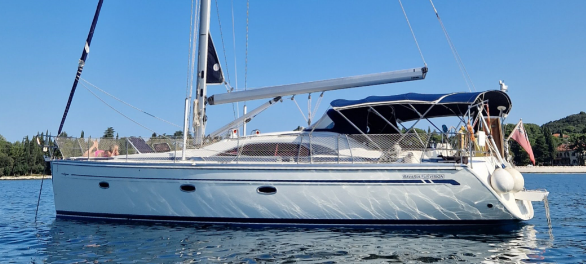
Can you explain why battens are a bad idea? Maybe I am a rubbish sailor, or the boats I sail are carp, but luff flutter has plagued just about every boat I have been on at some point, and the leech line often puts a nasty hook in the luff before the flutter stops. Car forwards or backwards, sheet in/out doesn't always stop it - at least it hasn't for me - so I'm going to give battens a try unless there is a compelling reason to avoid them.

My reasoning for the smaller jib is to go to windward better without a reefed foresail, the code zero is for off-wind ... so I'm more interested in pointing ability than power for the jib.
Both sails are electric so it's button pressing, not grinding winches, so not much "work" to switch sails.
OK, I enjoy sailing upwind and hence efficiency - which our vertical jib battens help with. They are good for speed - but so is a fully battened mainsail, which I know you don’t want.
But the jib battens are also a bit of a pain
(a) fitting and removing the jib - ideally a two person job and have to stop at each batten end and fit / remove the vertical batten, which is a bit of a phaff involving a “batten prodder” to get the Velcro in / out, then tie / untie string (and I tape over knot with self amalgamating tape.) Not a huge issue if have second person and only do at start and end of season.
(b) our expensive North sail has been prone to losing battens out of the top of the pocket (the closed end), no matter how carefully treat the sail. Cue an extra bout of the above phaff to take to the sailmaker.
A high quality 120% jib with a decent foam luff should go well to windward, not needing to be reefed often, but able to work fine part reefed. Much less of an issue than an old style 140-150% jib.

In terms of leech flutter, I am with ChiaraSlave that 99% of cruising sailors don’t sheet their jibs in correctly - usually cars in wrong place and the sheet massively too loose. Get up on the foredeck (harnessed on) and check the sheeting angles and tension. Once correct position winch TIGHT then a bit TIGHTER in a decent wind (with a good sail) - plus backstay on.

PS. Per earlier posts, avoid standard Elvstrom factory fit sails. Need to be sure it is a proper quality sail cloth
 
Last edited:
I'm going to go 120% and keep the battens. ;) ... Better to regret something you have done, than something you haven't ... I want to experience a battened foresail to see how it, and I, cope.

Can you explain why battens are a bad idea? Maybe I am a rubbish sailor, or the boats I sail are carp, but luff flutter has plagued just about every boat I have been on at some point, and the leech line often puts a nasty hook in the luff before the flutter stops. Car forwards or backwards, sheet in/out doesn't always stop it - at least it hasn't for me - so I'm going to give battens a try unless there is a compelling reason to avoid them.

My reasoning for the smaller jib is to go to windward better without a reefed foresail, the code zero is for off-wind ... so I'm more interested in pointing ability than power for the jib.
Both sails are electric so it's button pressing, not grinding winches, so not much "work" to switch sails.
I wouldn't have battens with an overlapping sail. They'll destroy themselves in pretty short order flogging against the rig. Or start taking things off the mast..... Like the steaming light.... It landed in my lap on the helm.

I've been sailing with battened (horizontal) jibs for about 15 years. Only ever non overlappers. The Elan's old overflapping genoas did not have battens. It was an old non overlapping sail that happened to have a batten at the exact height as the steaming light that removed it from the mast. Twice.
With vertical battens they'll swipe anything that they can if they're on an overlapping sail.
 
…..
With vertical battens they'll swipe anything that they can if they're on an overlapping sail.
With care you can avoid the battens hitting the mast. But does require discipline when tacking - through the wind promptly then (in cruising mode) stop just above normal course to winch in bar tight, then bear off and sail. Done crewed and solo hundreds of times. Also if switching engine on don’t go head to wind until jib part furled so battens clear the mast.
 
OK, I enjoy sailing upwind and hence efficiency - which our vertical jib battens help with. They are good for speed - but so is a fully battened mainsail, which I know you don’t want.
But the jib battens are also a bit of a pain
(a) fitting and removing the jib - ideally a two person job and have to stop at each batten end and fit / remove the vertical batten, which is a bit of a phaff involving a “batten prodder” to get the Velcro in / out, then tie / untie string (and I tape over knot with self amalgamating tape. Not a huge issue if have second person and only do at start and end of season.
(b) our expensive North sail has been prone to losing battens out of the top of the pocket (the closed end), no matter how carefully treat the sail. Cue an extra bout of the above phaff to take to the sailmaker.
A high quality 120% jib with a decent foam luff should go well to windward, not needing to be reefed often, but able to work fine part reefed. Much less of an issue than an old style 140-150% jib.
PS. Per earlier posts, avoid standard Elvstrom factory fit sails. Need to be sure it is a proper quality sail cloth.

In terms of leech flutter, I am with ChiaraSlave that 99% of cruising sailors don’t sheet their jibs in correctly - usually cars in wrong place and the sheet massively too loose. Get up on the foredeck (harnessed on) and check the sheeting angles and tension. Once correct position winch TIGHT then a bit TIGHTER in a decent wind (with a good sail) - plus backstay on.

I wouldn't have battens with an overlapping sail. They'll destroy themselves in pretty short order flogging against the rig. Or start taking things off the mast..... Like the steaming light.... It landed in my lap on the helm.

I've been sailing with battened (horizontal) jibs for about 15 years. Only ever non overlappers. The Elan's old overflapping genoas did not have battens. It was an old non overlapping sail that happened to have a batten at the exact height as the steaming light that removed it from the mast. Twice.
With vertical battens they'll swipe anything that they can if they're on an overlapping sail.

Thanks for that, I can see how a thrashing jib (not always avoidable on a cruising boat) could cause problems with battens on an overlapping sail - couple that to @dunedin comment I will drop the jib battens. Thanks.

The cloth is called Pro Radial 394 for the main and 344 for the jib. It is woven polyester supplied by Dimension-Polyant. It is marketted as "high-performance line of sailcloth in the first place, the Pro Radial range has been developed to answer the growing demand for radial sails made of woven Polyester fabrics." - the next step up from it was Hydranet which is quite a bit more expensive. It is definately not the standard cloth supplied with the boat, but I am not a sailcloth expert - so only repeating what I have been told. The sailcloth sample seemed extremely stiff.
 
Certainly worth getting few quotes. Not least because you will get a lot of useful information and possibly options you hadn't thought of from various sailmakers. I have had good discussions with crusader, ullman and sandersons recently. I have no idea on your costs but I bought a no2. jib for my contessa 32 a few weeks back and the quotes varied by 20 percent.
 
Certainly worth getting few quotes. Not least because you will get a lot of useful information and possibly options you hadn't thought of from various sailmakers. I have had good discussions with crusader, ullman and sandersons recently. I have no idea on your costs but I bought a no2. jib for my contessa 32 a few weeks back and the quotes varied by 20 percent.
Another bit of information not yet disclosed ... I am buying with a friend so we are ordering 2 complete sail sets for 2 boats at the same time dependent on a good overall discount. I also need my boat modified (new halyard position on mast and a bowsprit) and it's advantageous to me if it is one company that does everything. We've done the shopping around bit (in Germany) and it's taken my friend a year to get to this point. This thread is the final sanity check before we place an order - at the moment we are happy with the price and spec based on other boats we know of who have bought sails in the last year or so, but the overall price is still a lot of money. My friend is negotiating because he is better at it than me.

This forum is a mine of useful information and will tend to give advice/suggestions that we wouldn't necessarily get from someone trying to sell us something.
 
Vectron is a hybrid, polyester with Vectran fibres to improve stability and lifeprecisionsailloft.com/education/cloth/long-distance-circumnavigation/bainbridge-sailcloth-hsxv-vectran-hybrid/ Hydranet is also a hybrid of polyester and dyneema dimension-polyant.com/product/hydra-net-radial-with-bio-based-dyneema-fibers/

Obviously both are more expensive than the good polyester you have been quoted. as I suggested earlier using this type of cloth gets many of the advantages of a battened furling main without the complexity. I should add a rider that when I bought ny sail, part of the concern about battens was thee potential lack of space in the mast for the furled sail. Vectran is thicker than the polyester of the original and was initially a tight fit in the extrusion. However never a problem when furling.
 
Top