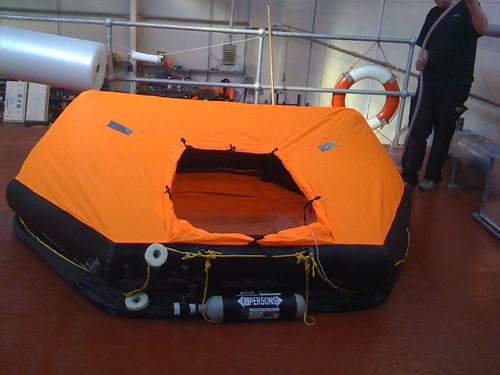
Opening a canister liferaft

I thought the issue especially in the UK was the ambient humidity, service centres open them in a dry atmosphere so there is no risk of condensation of trapped moisture when they get cold. I guess it should be OK if it is left for a few hours in a dry atmosphere before it is packed again.
 
For what it is worth I unpacked an 8-man liferaft which sat on the deck for seven years in the open before I bought the boat.
It was not vac-bagged. The gas bottle was badly rusted. The water and flares were date expired 1993.
The dinghy itself was in very good condition and remained inflated (hand pumped) for a couple of days. I threw out the consumables, took the flares to HMCG and spent an entertaining half day deflating and repacking the beast into its canister.
It has lain in the garage ever since, waiting for some kids who want a bouncy castle.
 
It has lain in the garage ever since, waiting for some kids who want a bouncy castle.

That's exactly what we were going to do with the old raft off Ariam, but then we heard that the local independent lifeboat wanted one to train with, and that seemed a more deserving cause.

Pete
 
Opening up a liferaft is pretty simple albeit hard work repacking it. Don't be put off by the vacuum bag aspect, it isn't under a high vacuum at all, rather the sort that can be made using a domestic cleaner. Anyhow, you don't need a vacuum packer to get it back in the canister. Use a ratchet strap or two round the raft when repacking, put it into the canister before removing the straps and then use the straps to close both halves of the canister again. Most have a couple of bands round the canister to hold things together.
When you have the thing open, take photos to show the stowage of all the bits in the raft, so that you can repack it I. Th same manner. If the gas cylinder is within weights, the it won't need changing (weights are stamped into the cylinder near the shoulders at the valve end). Check the functioning of things like the torch, canopy might and inflator pump before repacking it all. Have fun, you will have to work quite hard to get it all back into the canister!
 
Opening up a liferaft is pretty simple albeit hard work repacking it. Don't be put off by the vacuum bag aspect, it isn't under a high vacuum at all, rather the sort that can be made using a domestic cleaner. Anyhow, you don't need a vacuum packer to get it back in the canister. Use a ratchet strap or two round the raft when repacking, put it into the canister before removing the straps and then use the straps to close both halves of the canister again. Most have a couple of bands round the canister to hold things together.
When you have the thing open, take photos to show the stowage of all the bits in the raft, so that you can repack it I. Th same manner. If the gas cylinder is within weights, the it won't need changing (weights are stamped into the cylinder near the shoulders at the valve end). Check the functioning of things like the torch, canopy might and inflator pump before repacking it all. Have fun, you will have to work quite hard to get it all back into the canister!

Do replace the torch and canopy light with LED types. + spare batteries. This will save some space and weight removing the old torch.
If you do repack it yourself it would then be a good reason to do so again on a much more frequent basis partly because the canister type might not end up so weather proof but also because you can. You can check everything easily except perhaps the gas cylinder and triggeer mechanism. A gas cylinder test shop should be able to help you there. Test and recharge. good luck olewill
 
The vacuum bag on my Plastimo Offshore is a special design to seal around the compressed gas bottle firing mechanism. I would assume that other makes are of a similar design. This allows the deployment line to exit the vacuum bag while maintaining the vacuum and fully protect the liferaft from the elements. I don't imagine it's that complicated a design, just a hole in the bag clamped between flanges on the bottle. I don't have a picture of it sealed around the bottle flanges but I did see this when I peered through the line hole when removing the liferaft this winter.

One issue if your liferaft is very old is that the folds become stiff, brittle, lose resilience and can burst. Folds which are wrong, or in the wrong place, near the gas inlet can get cooled down by the expanding gas as the material which lessens the resilience for a time at that point. My own burst on a fold when inflated because the fold was suspected of being doubled over by accident. The doubling over put strain on the material all the years it just sat there in it's canister. When it was inflated (I watched) at the shop it burst at this point. The fold was right in the firing line of the compressed gas. The liferaft inflated OK, then the top tube started to deflate after it reached full inflation. The picture below is before inflation/service and on the right you just see the frost mist stuck to the tubes. The fold explanation was suggested, it could easily have been a fault in the material or damage at the previous service.

Again, using my Plastimo as an example, the liferaft is folded and then bound together with one wrap of silver 'duck' tape.

6246169302_41f7a2b8b0.jpg
8712684155_b5233be944.jpg
 
Last edited by a moderator:
Fine for the two posters from Greece and western Australia, but unless you have a humidity controlled room do you really want to pack in moisture and leave it sealed up in a plastic bag for a few years?
 
Fine for the two posters from Greece and western Australia, but unless you have a humidity controlled room do you really want to pack in moisture and leave it sealed up in a plastic bag for a few years?

a local service centre near me does not have a humidity controlled room & service hundreds of liferafts each year

Once in France ( Isle de Groix - sorry forget spelling) the customs started visiting boats.
When they got to the large MBO next to us they had the owner place the liferaft on the pontoon & unpack it.
Apparently they noticed that the strapping was not the usual type or one strap looked as though it had been tampered with so if one is unpacking one I suggest one considers how to re bond the cannister before going to France

Re the post re inflating- I wanted to know what my liferaft looked like inflated so the wife took a video camera along to the service centre & filmed the unpacking.
It seems the service centre never inflate with the cylinder , they do it with a separate pump & inflate slowly. so we were a bit disappointed
However, we did get a chance to record the details, contents etc.

Going off thread a bit- my wife's lifejacket needed a new cannister so my son & I decided she should wear it & inflate it to get the "feel"
She simply refused to get in the bath but did set it off in the lounge ( yes fully clothed!!)
We were all surprisde to see it jerk her head forward & hurt her neck. Plus the part that came round the front hit her under the chin & a seam grazed her skin

All a bit concerning but all worth the experience. I can see why the RYA liferaft training is recommended
 
Going off thread a bit- my wife's lifejacket needed a new cannister so my son & I decided she should wear it & inflate it to get the "feel"
She simply refused to get in the bath but did set it off in the lounge ( yes fully clothed!!)
We were all surprisde to see it jerk her head forward & hurt her neck. Plus the part that came round the front hit her under the chin & a seam grazed her skin

What sort was that? I've just done much the same with one of my Crewfits, and actually I was a little surprised at how un-violent the process was and how comfortable the result.

Pete
 
a local service centre near me does not have a humidity controlled room & service hundreds of liferafts each year

Interesting, mine was unpacked and packed in a controlled dry environment, I also made sure I was there for the re pack so I cold see what went in and what it looked like, with pictures for any crew that would sail with us. I wonder if there are any standards/requirements for service centres to comply with?
 
I do not know if vacumn packing removes moisture or if they insert silica gel packs

I don't have any specific knowledge, but since vacuum packing removes the air it seems logical that it would take the moisture with it. Another advantage, alongside the smaller pack size and hermetic sealing against external water.

Pete
 
Top