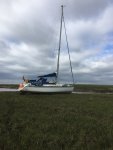
Oops! The Perils of Brown Water Sailing

And that’s the point - no dinghy. When I sailed a ditch crawler years ago we found the traditional wooden dinghy vital as a way to cross deep mud to lay an anchor or get to the pub.

I've made good progress across soft mud by leaning on the transom of a rigid dinghy and pushing it along in front of me. The dinghy takes your weight and stops you sinking in too far.

You can pick up a fair speed like that, almost running in fact.
 
The Medway and Swale.
Some of us, no names, have managed to go aground on the Horse Sands in the Swale and then go aground in exactly the same spot a year later.
The same skipper came a cropper on the little mud bank at the entrance to Faversham Creek and in Sharfleet and.................
None of the boats really need more than 3/4 ft to remain afloat.
 
The Medway and Swale.
Some of us, no names, have managed to go aground on the Horse Sands in the Swale and then go aground in exactly the same spot a year later.
The same skipper came a cropper on the little mud bank at the entrance to Faversham Creek and in Sharfleet and.................
None of the boats really need more than 3/4 ft to remain afloat.
The secret is to make it look like you meant to do it
 
Many years ago, I was with an elderly friend. We put his boat back on the mooring on the west side of Portsmouth Harbour in a strong easterly. As we left the boat, the OB prop hit something and broke the shear pin. The tide was falling fast and we ended up on the mud. No big deal, just a long wait for some water, but we called the club to let them know. Someone there called the Coastguard, who sent GAFIRS to our rescue. By the time they got to us, there was the best part of 100 yards of mud. The guy who came across it took a kayak with him for floatation on the mud. but he was going in up to his knees and sometimes further. He was a big, fit guy, but he was puffing and panting by the time he got to us. He was adamant that we should absolutely not have tried to make it ourselves. In the end, there was a helicopter on passage nearby, and they picked us up and dropped us on shore, but getting us off would have been a problem otherwise, as it was a little Tupperware dinghy, and attempts to pull it over the mud with us in it just made it fold up.

Nasty stuff mud.
 
I've made good progress across soft mud by leaning on the transom of a rigid dinghy and pushing it along in front of me. The dinghy takes your weight and stops you sinking in too far.

You can pick up a fair speed like that, almost running in fact.
We were always much lazier and cleaner - we sat in the dinghy and used it as a sled pushing ourselves along with soild wooden oar handles. Half an inch of water or very liquid mud was best.
 
How to run a kedge out with no dinghy? Blow up a lifejacket and swim. I've also seen a couple of fenders under the armpits used for extra buoyancy.
 
I've made good progress across soft mud by leaning on the transom of a rigid dinghy and pushing it along in front of me. The dinghy takes your weight and stops you sinking in too far.

You can pick up a fair speed like that, almost running in fact.
I think there are bespoke devices used as sleds on the same principle by sea food harvesters. No own experience; would have been seen on TV... wikipedia.org/Mud_sledge
 
Unfortunately the east coast mud has edges
 

Attachments

  • E44832CB-48C1-4848-98A3-45F296EBFB82.jpeg
    E44832CB-48C1-4848-98A3-45F296EBFB82.jpeg
    655.8 KB · Views: 64
One of the things I check when drying out is that the next tide is going to be higher than today's. There was a guy who dried out in the Hardway grid to scrub off his big AWB. He needed a big tide to get on, and he got it. Unfortunately it was the highest spring of that cycle and he was stuck for a month. No harm done, but much piss was taken.
 
Enjoyed the video.

When I first saw this thread's title, I was thinking I'd add the video below, but of course, that's 'Brown-trouser sailing'.

I'm sure it makes Essex mud feel very comforting by comparison.

 
What seems different to me, is I have never known a high tide high enough to cover the grass. Grass up here only grows above the line of the highest tide.

Low atmospheric pressure - even further north - can and does increase the height of tide on occasion.

As for 'grass up here', I'm given to understand that in Shetland, any grass that 'gets above its station' gets blown away to Denmark pdq.....

25250542497_28686d334f_z.jpg


.
 
I had such a moment, up the Helford towards Gweek, open rowing boat with outboard I ran up on the mud at HW, small neap tide. I set the motor astern and the two of us pushing the paddles deep into the mud, got off. Had we not we could have been there 12 or 24 hours, not nice. What could we do? Can't get out and walk. The only solution, and I've tested this, is to 'swim' over the mud. You get pretty mucky, especially if you have a large Labrador trying to rescue you.
I suppose we could have chucked the duckboards over and stood on them to lighten the boat enough.
 
Top