
One MAN engine fails on last day end last trip of our summer holliday’s

BartW

Well-Known Member
Joined
9 Oct 2007
Messages
5,236
Location
Belgium
www.amptec.be
As the title say’s,
A week ago, me and swmbo were on our the last trip of our planned summer holiday’s
Trip was from Cavtat Croatie to Tivat Montenegro

This year we sailed her extremely high hours (>300), and many miles ao delivery trip from SOF to Montenegro, I was very proud and pleased about my 23yo / >3000 hrs Man lumps

I had the brave idea to do the last miles of that trip at full throttle,
Just to check if I still could get full RPM, with all the extra additions (weight) and drag (stabs)

The good news was:
at half load, (fuel and water) I reached 2350 RPM on both engines (normal max is 2300) and 25kn, which is very good I think.

After approx. 5 minutes full throttle, I slowed her down to normal planing cruise speed 20kn 2000RPM,
But from then I noticed a strange and loud vibration and rattling noise from the engine room,
First when I went in the ER I couldn’t see what was going on, then we slowed down to 10kn 1100 rpm, displacement speed, and after close inspection I noticed the noice came from between the pullies on the front of one engine.
At that time there was a very strong Bura (the dangerous N wind in that area),
So I decided to run the P engine on idle, (not stop it), and the rattling and vibration kept on,
And the SB engine at higher RPM, and keep both engines running, in order to be able to maneuver in the marina and in to our berth.
now looking back, I’d probably better stopped that P engine immediately !

I reached the marine, and could maneuver in my berth, still a lot of noise and rattling and vibration, but no unusual smoke !
I believe iirc that the temp op the P engine started raising then, right before I stopped this engine

The following day I had to move berth, and take place in my normal permanent position,
But that P engine didn’t turn normal, produced a lot of smoke, and made again a very strong rattling noise.
I immediately switched off the engine

I had to move and maneuver in the other berth, on one engine, with help from a marinero with a rib.

So what’s going wrong,
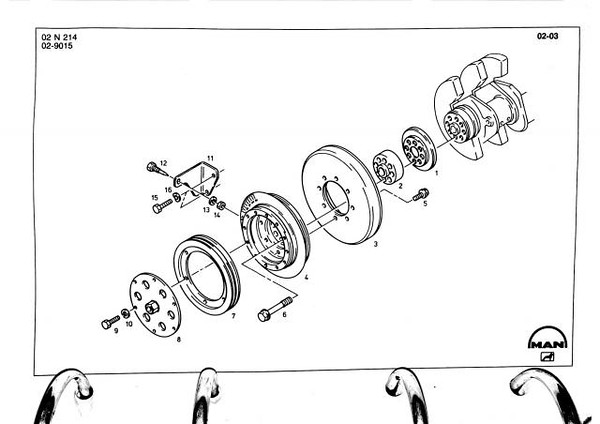
On the drawing below you can see the plate part nr 3 called “vibration damper”,
This plate consists of several layers of steel and rubber, and this is all disassembled, (due to age I guess)
But the separate rings are still there, and where slabbed around….
That was causing the very strong vibration and rattling noice.
The two pully’s with the belts (parts nr 4 and 7) are still in position, and not damaged.


Next week I’ll go back to the boat, and start further diagnoses,
Try to unscrew the pully’s (8 x M16 bolds)
And from then inspect what other damage has been done.
ao the rpm pickup element cable is broken (whas sitting there soemwhere on the front)

The most worrying thing is that the engine didn’t run smooth, and produced lots of grey blue smoke when restarted from cold.
I think I can test the engine when the pullies are off for a minute or so,
One pully is for the alternator, the other is for the cooling water pump.
I know that MAN experience on here is limited, but any advice on my engine repair is welcome

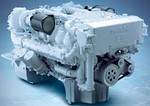
Here is a pic of the front side of a engine
i-SW22xDB-L.jpg


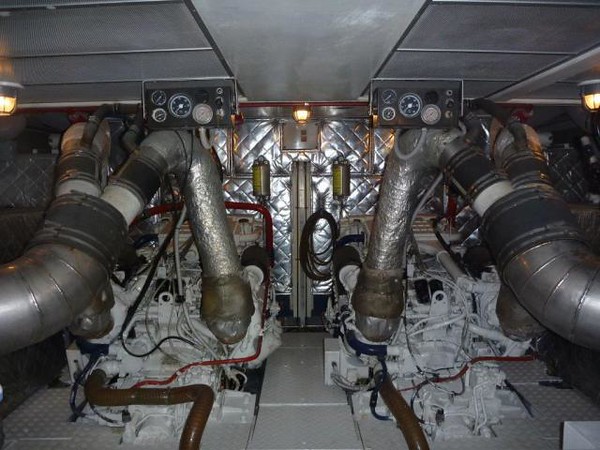
Engine room,
there is only a small gap between the engine and the bulkhead with the fuel tanks
i-R2MbWTd-L.jpg


Here is a plan of the part that broke (part nr3)
i-tZxQKZB-L.jpg
 
Last edited:
Bart,

When you drill down into your maintenance manual you will see that regular inspection of the crank damper is a requirement.

Surprised you have a bonded rubber damper and not the viscous type.

The rubber bonding gradually breaks down due to crank torsional activity, which the MAN/Merc V engines have buckets of due to skinny bearing areas.

You are very lucky, normally crank snaps in thrust area due to torsional activity before damper gives up completely.

When you get new damper check for alignment marks on the metal parts, simply check these marks at service intervals, if they ever cease to line up or the rubber shows signs of bulging time to change it.

Failure was nothing to do with running at WOT.
 
Bad luck BartW. Very sorry to hear that. I hope that only Part #3 has failed/broken - it is easy to replace. But that does not explain the smoke, so it needs further investigation. Do you have a boroscope?

Best wishes for a "lightweight" diagnosis - 3000hrs isn't long enough that you would expect a big failure
 
Bart,

When you drill down into your maintenance manual you will see that regular inspection of the crank damper is a requirement.

Surprised you have a bonded rubber damper and not the viscous type.

The rubber bonding gradually breaks down due to crank torsional activity, which the MAN/Merc V engines have buckets of due to skinny bearing areas.

You are very lucky, normally crank snaps in thrust area due to torsional activity before damper gives up completely.

When you get new damper check for alignment marks on the metal parts, simply check these marks at service intervals, if they ever cease to line up or the rubber shows signs of bulging time to change it.

Failure was nothing to do with running at WOT.


None too happy with the smoke and rough running.... after damper failure. Hope it not a web fracture.
 
Indeed sorry to hear of the problem. As others have said, hopefully there is only limited damage.

I hope there is some consolation from the fact that at least this didn't mess up your holiday plans.
 
None too happy with the smoke and rough running.... after damper failure. Hope it not a web fracture.
That's my concern too. My concern is that the damper has been pretty mashed for quite a while, so that while it wasn't yet to a pile of dust in the bilge, it hasn't been doing any damping for quite a while. The crank has therefore been resonating and suffering fatigue, all the more than in other engines due to above mentioned MAN skinniness. The 5minutes at WOT might have been 5 mins of too-much crankshaft harmonic/torsional dancing and so was the straw that broke the camel's back. Alas the camel's back here is potentially a crank web. I hope this is too pessimistic and that none of it is true, but my worry is that a mere broken damper (part #3) on its own wont make any change exhaust smoke at all. Fingers and everything crossed BartW
 
Bart,

When you drill down into your maintenance manual you will see that regular inspection of the crank damper is a requirement.

Surprised you have a bonded rubber damper and not the viscous type.

The rubber bonding gradually breaks down due to crank torsional activity, which the MAN/Merc V engines have buckets of due to skinny bearing areas.

You are very lucky, normally crank snaps in thrust area due to torsional activity before damper gives up completely.

When you get new damper check for alignment marks on the metal parts, simply check these marks at service intervals, if they ever cease to line up or the rubber shows signs of bulging time to change it.

Failure was nothing to do with running at WOT.

thanks a lot for posting your comments,
I have to admid that I don't have a full service manual,
i have a very limited basic user manual,
we just replaced the filters, the oil and impellors every winter,
I was wondering about the renewal of ao the belts, I just do visual inspection, and have spares onboard.
have ordered the full service manual today.

I 'll keep you updated about my findings,
thanks again for comments and advice
 
Could the smoke at start up be due to ththe engine running at idle for a long time, and be over fuelled? Latestarter is usually pretty accurate with his summaries.
 
Do you have a boroscope?

no I don't but the right moment to buy one
looking online its not a expensive tool,
any sugestions on what to order ?

do you asc about the borescope just to have better vieuw on that hidden side of the engine,
or perhaps investigate potential Web fracture,
or do your have other vieuws in mind ?

indeed, now that some of you on here confirm, and specifie potential damage,
I'm also very worried that the situation is no good.
thanks for the advice !
 
Sorry to hear this news Bart. I hope it turns out to be a simple repair!


I hope there is some consolation from the fact that at least this didn't mess up your holiday plans.

yes so far I'm looking at the bright side, we had a very long and very good season on the boat,
many miles and much fun with family and friends...

this was my big fear, at the beginning of this season,
that something like this would happen during my delivery trip, or during some of the bookings, which we and some of our friends were really looking forward to
being stucked somewhere in the south of Italy was my worse nightmare in may-june

I was very exited that this challanging season passed without any serious issue.
That was also the reason that I postponed this test until the last day of the last booking,

now I have a long winter for the repair,keep fingers crossed !

krgds
 
Last edited:
Could the smoke at start up be due to ththe engine running at idle for a long time, and be over fuelled? Latestarter is usually pretty accurate with his summaries.

not sure Rafiki, engines are stopped very often after running for a long time at idle, after maneuvring, ar while the crew is doing the ropes, ...
sugestions of the cause posted above are really worrying me
 
not sure Rafiki, engines are stopped very often after running for a long time at idle, after maneuvring, ar while the crew is doing the ropes, ...
sugestions of the cause posted above are really worrying me

Sorry to have opened my big mouth and worried you. Should have shown a little more tact, but in my line of work you tend to get a little "clinical" about such things.
No point getting het up yet, it may be just the damper and you looking at things a bit deeper than normal.

Cold comfort, but I have come across many web fractures where the motor has suffered virtually nil collateral damage. In fact I had a DAF 960 in for rebuild a couple of months ago. Web fracture, driver noted odd sensation running through bus at start of his shift and reported it at the end of the shift.
Engineers were alarmed to see crank pulley moving backwards and forwards a few milimeters when the engine was being cranked and sent the motor to us.
Broken web was not oil carrying and motor ran all day without further damage or abnormal temps or pressures. Only real damage was crank and the shells riding the fillets. Motor was fully overhauled at customer request, but a new crank and shells would have had it up again nice as ninepence.

Bus company engineer was amazed when we reported a broken crank. He was expecting a thrust bearing that had been spat out and the expense of a block surcharge.
 
Last edited:
no I don't but the right moment to buy one
looking online its not a expensive tool,
any sugestions on what to order ?

do you asc about the borescope just to have better vieuw on that hidden side of the engine,
or perhaps investigate potential Web fracture,
or do your have other vieuws in mind ?

indeed, now that some of you on here confirm, and specifie potential damage,
I'm also very worried that the situation is no good.
thanks for the advice !
Yes they are surprisingly cheap. I suggest google Sealey Boroscope. I bought the £100 one with 8.5mm dia probe. It records onto SD card as well as showing the picture on the screen in real time. The probe has LED light. It's a very good device for the money. For much more money @£400 they do one with 4.5mm probe but I think all the glow plug/injector holes on big engines like yours will accept 8.5mm dia

I would want to look with boroscope at the crankshaft by opening a plate on the side of the sump. Alternatively put the boroscope into the injector/glow plug hole of the cylinder furthest away from the flywheel and turn the engine with spanner on flywheel ( or starter motor maybe). If that cylinder moves ok in a full up/down cycle then the crankshaft must be ok

Fingers seriously crossed here. I hope I am being far too pessimistic and that it is something less serious. It's hard to diagnose from a keyboard anyway. Unfortunately crankshaft dampers are important parts of an engine (to stop the torsional harmonic dancing) and if yours has been bad for a while then I fear the consequences. Crankshaft work is major surgery in a boat, as you know, though if anyone can do it you can!). Fingers very much crossed for you Bart
 
If the crank was broken, then surely the engine would not start, let alone smoke?

I ran an engine for 10 miles once with a broken crank. Unknown to me it had sheared across the web (?). I thought I had a rope/something around the prop but as we were still making way I just kept going. Slowly.
 
If the crank was broken, then surely the engine would not start, let alone smoke?
Sure it could start. The break could be a long way along the crank from the flywheel (starter motor) end. It would run lumpier of course because the stationary cylinders would not fire when their turn came. The injectors would still squirt fuel into the dead cylinders, and the governor would squirt more fuel into the live cylinders because they'd be working harder to hit the rpm demanded of the governor, hence potential smokiness

This is why, unfortunately, the combination of busted dampener and smoky running and WOT blast for 5 minutes leads inevitiably to a worry of busted crank. It pains me to say it but that's what you gotta suspect on the info available. Dampeners are very important things
 
Last edited:
I suggested web fracture because the broken ends snag together and the engine continues running. If that particular web is not oil carrying, then there is usually no loss of oil pressure until crank support fails.
You got flywheel at one end and timing at the other......usually, unless deutz designed or cummins b series in my particular niche.

Crank phasing goes out of whack on rear cylinders behind the break and you get smoke and vibration, sometimes due to bent valves if a full 360 out, but often just a few degrees, enough to cause smoke due to rear cylinders running late.

I would have said piston if not for the damper issue.
 
Last edited:
Top