Oh the weather this weekend!

Seven Spades

Well-Known Member
Joined
30 Aug 2003
Messages
4,938
Location
Surrey
Visit site
I was so looking forward to the weekend as I could not go out last weekend.

Anyone know the long term forecast i.e. the next 4 weeks?
 
Last edited:
I don't think that 4 week forecasts are worth much. I'm suspicious of anything much over about four days - perhaps 7 days for a bit of a clue... One may be able to ascertain a general trend for a longer period but on a day by day basis I'd forget it.
 
I was so looking forward to the weekend as I could not go out last weekend.

Anyone know the long term forecast i.e. the next 4 weeks?

the weather never does what you want it to do when you want it to do it ;)

i think the forecast for this weekend has changed a few times this week, on that note i wouldn't rely too heavily on any forecast more than a couple days, i doubt we will get out this weekend :( but looks to blow through by sat night.
 
Fed up watching the garbage weather forecasts for our forthcoming 2 weeks cruise on the West Coast, or Ireland.

Flights booked to Florida instead. Would have much preferred 2 weeks sailing, but reluctantly not prepared to risk two precious weeks of my annual leave stuck in port/anchor or in the rain. Really disappointing.

So far, this season has been terrible weather wise. Seems like there is one very windy northerly after the other, plus numerous intense showers and it seems a lot colder than it should be.
 
the weather never does what you want it to do when you want it to do it ;)

i think the forecast for this weekend has changed a few times this week, on that note i wouldn't rely too heavily on any forecast more than a couple days, i doubt we will get out this weekend :( but looks to blow through by sat night.

I always start watching the forecast at 14 days on the whole of Europe scale.
Ecah day I count down the forecast as my sailing date gets closer.
If the overall pattern is staying similar each day, I begin to develop confidence on the accuracy of the forecasts.

Times like this week when we have Atlantic high and European low competing with each other the forecast does indeed change every day. The forecast is good for about six hours.
 
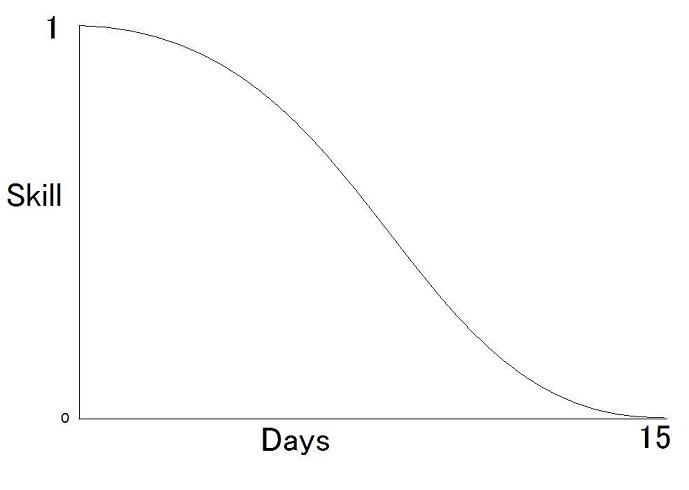
This is one of the diagrams on my website. Like all good graphs it is indicative rather than definitive. For deterministic prediction, the absolute limit is probably around 10-14 days. We are not there yet.

Skill-graph.jpg
.

When cruising, we try to plan our sailing on about a 5-7 day basis. We look at GRIB output every day, GFS, ICON, ECMWF, take your pick. We look for when forecasts are fairly consistent from one day to the next. When, say, day 6 today, is similar to day 7 yesterday and to day 8 on the previous day, then we are fairly sure and plan or think ahead with some confidence. We always have in the back of our minds that weather is never precise. A F5 forecast will probably mean some F4 and some F6. Hence my rule of thumb, 6 ever, 7 never.” If 6 is forecast, a 7 is likely and possibly 8. We can cope if the directions are OK. If a 7 is forecast, an 8 is quite possible and perhaps, even, a 9. That we would prefer to avoid. This is not a council of despair. It is hard reality.

Some people like to use Windy.com, Ventusky, Predicteind, MeteoConsult, XyGrib etc to compare forecasts from different models or sources but that is a waste of time. Effectively, you are looking st a small ensemble. You could be looking at a group of forecasts as equally right or wrong even though they are all similar. You could be looking at different forecasts with no indication which is best on that day. The only value to us in ensembles is when used to get probabilities - FNMOC and NOAA provide useful data for different wind and sea thresholds. We do look at different models, Windy.com is the most convenient, we think, but only for interest rather than trying to double guess.
 
Last edited:
We look at GRIB output every day, GFS, ICON, ECMWF, take your pick. We look for when forecasts are fairly consistent from one day to the next. When, say, day 6 today, is similar to day 7 yesterday and to day 8 on the previous day, then we are fairly sure and plan or think ahead with some confidence.

What about the GEFS SPAG? I use that hoping that if the contours line up well then good chance it won't be far off, and even if the timings are out a bit then at least it should give a good hint of where the lows will track.

Think that's wishful thinking or possibly useful? Near impossible for us mere mortals lacking in supercomputers to check if our online seaweed actually works or we just see what we want to see. :)


https://mag.ncep.noaa.gov/model-gui...up=Model Guidance&model=GEFS-SPAG&area=NAMER#
500 Millibar 522 and 564 height Image (500_522_564_ht):This product contains one field:


522 and 564 decameter isopleths on 500 millibar. Spaghetti plots help to determine the uncertainty in forecasting positions and intensities of weather systems. High confidence in the forecast results from contours being in good agreement. Low confidence in the forecast results from contours being chaotic.

http://prettygoats.com/481-2/
 
What about the GEFS SPAG? I use that hoping that if the contours line up well then good chance it won't be far off, and even if the timings are out a bit then at least it should give a good hint of where the lows will track.

Think that's wishful thinking or possibly useful? Near impossible for us mere mortals lacking in supercomputers to check if our online seaweed actually works or we just see what we want to see. :)


https://mag.ncep.noaa.gov/model-gui...up=Model Guidance&model=GEFS-SPAG&area=NAMER#


http://prettygoats.com/481-2/

I do not see how SPAG can really help. If I was interested in probabilities, I would use https://ocean.weather.gov/prob_guidance.php?model=naefs&basin=atl&cycle=00&plot=15&loop=0#top or https://www.fnmoc.navy.mil/wxmap_cgi/index.html#ensemble.

In fact, I use neither. My “6 ever 7 never” will do for me. Watching a time sequence of forecasts is quite good enough. You can over-complicate. On a long ocean passage use climatological routing. When Stan Honey was not racing mega yachts and was cruising a conventional 40 foot yacht, he left harbour with a window to get clear of land and then took what came. You can forget routing and probabilities. KISS.
 

Use those as well :cool:

The SPAG seemed interesting from - "High confidence in the forecast results from contours being in good agreement. Low confidence in the forecast results from contours being chaotic."

Though the probabilistic forescast I link to are GEFS - https://ocean.weather.gov/prob_guidance.php?model=gefs&basin=atl&cycle=00&plot=15&loop=0

So how do they calc the probabilities? Isn't it similar to the SPAG but looking at the mean?

LaQst1i.png


NAEFS & GEFS probabilities look very similar even 384h ahead.
 
Use those as well :cool:

The SPAG seemed interesting from - "High confidence in the forecast results from contours being in good agreement. Low confidence in the forecast results from contours being chaotic."

Though the probabilistic forescast I link to are GEFS - https://ocean.weather.gov/prob_guidance.php?model=gefs&basin=atl&cycle=00&plot=15&loop=0

So how do they calc the probabilities? Isn't it similar to the SPAG but looking at the mean?

LaQst1i.png


NAEFS & GEFS probabilities look very similar even 384h ahead.

I think that you are trying to over-complicate and trying to derive more from the GFS output than is useful. The GEFS is simply the GFS run 20 times with slightly different analyses that are consistent with the actual data. The probabilities are based on those 20 values; not really a big enough population. The FNMOC and the NOAA OPC are, as far as I know, just different presentations of the same data. Possibly the FNMOC use the US Navy model but, in the back of my mind, I think not.

From my perspective, the kind of exercise that you are trying to do is interesting in an academic sense. I doubt that you will make better decisions than just using the GFS, ICON, ECMWF data for the next 24 to 48 hours. Watching Windy.com, they are very similar. Bear in mind the inherent variability of the westher. After that, use one model. Look for consistency between consecutive model runs. Be careful or do not plan too far ahead if there is not consistency.
 
I think that you are trying to over-complicate and trying to derive more from the GFS output than is useful.

Disagree, a bit anyway. Depends what you think is useful. I find the 500mB really handy as a quick glance to see what the next weekish might bring & roughly where the depressions will likely track, the GEFS SPAG gives at least an idea of probability. Often a week out the SPAG will have contours very closely spaced, and going from the US NWS site >
Spaghetti plots help to determine the uncertainty in forecasting positions and intensities of weather systems. High confidence in the forecast results from contours being in good agreement. Low confidence in the forecast results from contours being chaotic.
which suggests a week out with close contours is worth paying attention to as a fair bet of what might happen though just as a rough guide rather than something to base any firm plans on, sometimes a week out contours will be wildly off then probably much less likely.

Also a little while ago the SPAG hinted at a low forming off Morocco which none of the GFS/ECMWF gribs caught on to until a few days later, if you were looking at exiting the Med that most definitely would have been a very useful early heads up that something might be on the way.

Just another source of data, an IMHO can be handy though a week out best taken with plenty caution.
 
Disagree, a bit anyway. Depends what you think is useful. I find the 500mB really handy as a quick glance to see what the next weekish might bring & roughly where the depressions will likely track, the GEFS SPAG gives at least an idea of probability. Often a week out the SPAG will have contours very closely spaced, and going from the US NWS site >
which suggests a week out with close contours is worth paying attention to as a fair bet of what might happen though just as a rough guide rather than something to base any firm plans on, sometimes a week out contours will be wildly off then probably much less likely.

Also a little while ago the SPAG hinted at a low forming off Morocco which none of the GFS/ECMWF gribs caught on to until a few days later, if you were looking at exiting the Med that most definitely would have been a very useful early heads up that something might be on the way.

Just another source of data, an IMHO can be handy though a week out best taken with plenty caution.

Surely, SPAG is just another presentation of the GFS ensemble. You may be able to glean something from the presentation. I do not think that I can and am sure that the majority of sailors cannot either. There is little point in hinting st an outcome. For immediate use, there is barely any discernible difference between models. GFS, ICON, ECMWF. When it comes to planning ahead, I look for certainty, or nearly so. Is a model giving me a clear steer on the next few days? I am not interested in models suggesting that something might happen.

I still think that you are trying to extract meaningful or useful information from an inevitably imprecise system. Maybe the difference between us is that I have had to decide what to say as guidance to other forecasters in the U.K. and to the general public. You, I guess, are trying to derive information of some meaning or value to you personally.
 
Top