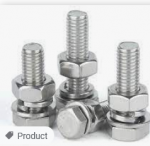
Nylocs or not?

I was rude. Sorry.

The Nylock was not the reason for galling. I have studied and researched the subject in my day job, and the reasons for galling are as I stated. The reason for the galling in your experience was almost certainly a combination of tightening too quickly under load (stainless heats up FAST when tightened under load) AND using the bolt to draw the surfaces together. Drawing surfaces together by tightening stainless bolts is a big no-no, and is the reason rigging turnbuckles never have stainless female threads. The bolt did not gall because it was a Nylock. The Nylock has no meaningful bearing on the thread load, which is the primary cause. Were the threads lubed before assembly? Google stainless galling.

No reason you can't use thread locker. I'm more likely to use double nuts; they're less bothersome if working alone.
 
Nut plus lock nut. Sometimes one is thinner than the other.

Richard

I know that but what is the objective of the double nuts, in the context to this application. If you need double nuts, then do away with the double nuts and use a nyloc. I don't understand what's being achieved with double nutting, if it is for vibration then double nuts are a shit solution compared to Nylocs, if no vibration, then double nutting is not needed.
 
Double nuts are often easier and are much more common on boats. Just as secure.

As a vibration solution for bolting it is the worst solution you can apply. Do your own research, plenty of information available to show that. No one who takes reliable fastening seriously would use double nuts.
 
I always cut the bolt to length. Long, exposed thread is not good.
Depends how it is cut to length.. Monday, while waiting for the surveyor, I thought I would remove a couple of cracked rope clutches. Seems the 'workers' at Jeanneau cut the excess off with bolt cutters... leaving distorted thread ends. Going to need another pair of hands or a dremel to get them off, as the nuts are in the aft cabin, out of reach of the heads on deck.
 
Drawing surfaces together by tightening stainless bolts is a big no-no, and is the reason rigging turnbuckles never have stainless female threads.
I'm not sure I understand how a stainless steel turnbuckle would work if if they had no female threads. A nut is a female thread and turnbuckles have nuts to lock them once adjusted and the threaded part of the sleeve is a female thread. Could you expand on your theory please?
 
I'm not sure I understand how a stainless steel turnbuckle would work if if they had no female threads. A nut is a female thread and turnbuckles have nuts to lock them once adjusted and the threaded part of the sleeve is a female thread. Could you expand on your theory please?

The female part is always bronze. I may be plated or it may be a insert. Bonze vs. stainless is not prone to galling.
For example: turnbuckle with bronze insert
 
I'm not sure I understand how a stainless steel turnbuckle would work if if they had no female threads. A nut is a female thread and turnbuckles have nuts to lock them once adjusted and the threaded part of the sleeve is a female thread. Could you expand on your theory please?
I suspect he is talking about winding stainless threads up while under load, causing heat and gauling. Since most boats have stainless turnbuckles, I am slightly puzzled by his comment.
 

Thas an advert for a rigging turnbuckle.

I understand the science. As a solution for vibration, double nuts are a poor choice, you stated "just as secure", as what? A nyloc, absolutely not. The vibration testing is all on line and demonstrates how shit double nuts are compared to the many other solutions. If there is no vibration, double nuts are pointless and a waste of the OPs time (and money).
 
As a vibration solution for bolting it is the worst solution you can apply. Do your own research, plenty of information available to show that. No one who takes reliable fastening seriously would use double nuts.

Well, that is just not true. You have some bad information and perhaps you are using them wrong (see double nut science link). Strange that good cars don't use Nylocs on every fastener, but they don't. Double nuts are the standard on heavy (expensive) refinery equiment. It's not about money.

BTW, most people use double nuts backwards and don't tighten them properly. Just sayin'.
 
I suspect he is talking about winding stainless threads up while under load, causing heat and gauling. Since most boats have stainless turnbuckles, I am slightly puzzled by his comment.
No, they do not. Take a look and you will find either plated bronze or stainless with broze thread inserts. In fact, look for an all-stainless standing rigging turnbuckle.
plated turnbuckle
 
Thas an advert for a rigging turnbuckle.

I understand the science. As a solution for vibration, double nuts are a poor choice, you stated "just as secure", as what? A nyloc, absolutely not. The vibration testing is all on line and demonstrates how shit double nuts are compared to the many other solutions. If there is no vibration, double nuts are pointless and a waste of the OPs time (and money).

Corrected. double nut science

Bt the way, common observation of machines tells a different story. I take your profanity as a pitch in the dirt. We'll just have to disagree.
 
Well, that is just not true. You have some bad information and perhaps you are using them wrong (see double nut science link). Strange that good cars don't use Nylocs on every fastener, but they don't. Double nuts are the standard on heavy (expensive) refinery equiment. It's not about money.

BTW, most people use double nuts backwards and don't tighten them properly. Just sayin'.

No, not bad information, a receiver of dedicated studies into reliable securing for the oil and gas injury in order to stop failed joints and release of hazardous materials.

DIN testing for vibration, its an advert for Nordlocks which hold up a lot of equipment
 
Top