Nuts are off........Seacock Woes!!!!

thesaintlyone

Well-Known Member
Joined
12 Sep 2015
Messages
902
Visit site
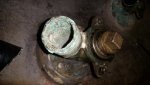
So finally got all four nuts off of the Head Outlet Blakes Seacock which is being a bit crap to free up, probably due to well years of crap!!! :)

30137818520_6425e6258a_k.jpg

The Main Problem is the outside flange which I know on blakes is not connected to the internal but is rather a nut retainer. Which as I mentioned in another post was damaged see the picture below.
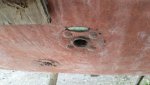
29529799023_4decd03e69_k.jpg

I spent today seeing how much of it was brittle and there wasn't a great deal of stength in the plate so I decided to remove as much of the backing plate as I could til i now only have the exposed heads in place.
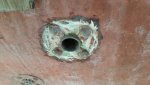
30137817400_cf442c0b82_k.jpg

So hear lies the problem as I understand from a former Longbow owner these nuts when originally fitted were put into wet epoxy or something when the seacocks were fitted into the holes so no ammount of tapping is going to just pop them out as they are embedded.


So I need to remove the embedded nuts???
Still free up the stuck Cone Which is not budging???
Tidy it all up???
Add a new backing plate and Bolts???

Or potentially replace the whole thing???


Now I know some of you suggested leaving the broken plate but I would rather know its all been sorted and replaced properly rather than relying on the brittle plate.

Thankfully this is the only seacock that has presented any problems and the other blakes are fine and I shall just simply replace the gate valves.
 
The bolts are bronze carriage bolts like this

https://www.bing.com/images/search?...421a582b6f9aab123d83611bc38d4ed2o0&ajaxhist=0

Note the square beneath the head which engages in a corresponding square hole in the exterior plate, ie the one you have chiselled off.

All you need to do now is to drive the old bolts out through the hull from the inside.

Regarding "embedded nuts", none of my Blakes seacocks had anything like that. What would be the point of it, anyway? Just extra work and extra cost for no good reason. In any case, the square on the bolt prevents it turning (that's why it's there) so how could it have been screwed into a nut?
 
Last edited by a moderator:
Really don't know why you bothered to try and take the body out of the boat. If the nuts and bolts are sound, that is they show no signs of dezincification (which is unlikely), just hammer the cones out from the outside, keeping the keep plates on so the cone does not fly around in the boat. Then lap it in and regrease it. That little chip off the outside plate really is of no consequence.
 
Really don't know why you bothered to try and take the body out of the boat. If the nuts and bolts are sound, that is they show no signs of dezincification (which is unlikely), just hammer the cones out from the outside, keeping the keep plates on so the cone does not fly around in the boat. Then lap it in and regrease it. That little chip off the outside plate really is of no consequence.

Agree - I freed mine off by inserting a short length of broom-handle, which fit perfectly, then smacking it middling-hard with a club hammer. However, the OP has now mullered the external plate, so for anything other than a bodge he now has to at least knock the bolts out in order to fit a new one.

Pete
 
Agree - I freed mine off by inserting a short length of broom-handle, which fit perfectly, then smacking it middling-hard with a club hammer. However, the OP has now mullered the external plate, so for anything other than a bodge he now has to at least knock the bolts out in order to fit a new one.

Pete


Mostly Peace of Mind......the plate was brittle for some reason and I don't know why. I would rather go to the expense of fitting a whole new one rather than find out later that there is a failure somewhere that could lead to something more catastropic. If the nuts do simply pop out then replacing them and the plate will be no bother maybe some expense only. A new backing plate is £18. The plate is not part of the seacock itself and is there simply as something to hold the bolts.

https://www.seaware.co.uk/strainer-bolts-for-3-4-blakes-seacock.html £43 including bolts.

TBH if this is the biggest problem I have with the seacocks I will be happy expected alot more.
 
Should add I didn't do this because the seacock was stuck but because the plate was brittle. Which concerned me. had two stuck ones on the jouster and they eventually freed up with a heat gun and club hammer.
 
Unless you can get the bolts out in one piece then you are going to need replacement for them as well. No chance of a failure from that plate even if it is brittle. The bolts and nuts hold the valve into the hull and they are not going to fail unless they are dezincified, and even then unlikely. The plate only holds the square so you can tighten the nut. It then digs into the GRP and does not move as you have found out.
 
Have you actually tried to drift the bolts through? That's your first step, as parsifal wrote.

If they really are stuck in epoxy, the stuff softens considerably when heated. Get someone to play a pencil-type blow torch on the heads, keeping the heat as localised as possible. Then welly the bolts through with a suitable drift. If you screw the nuts half-on, you might not even damage the threads. Don't go giddy with the heating: GRP doesn't like to get too hot.

As said, you'd have been better freeing the cone before taking the plate off. The perfect 'special tool' for holding them still while you clout 'em is...a hull.
 
Have you actually tried to drift the bolts through? That's your first step, as parsifal wrote.

If they really are stuck in epoxy, the stuff softens considerably when heated. Get someone to play a pencil-type blow torch on the heads, keeping the heat as localised as possible. Then welly the bolts through with a suitable drift. If you screw the nuts half-on, you might not even damage the threads. Don't go giddy with the heating: GRP doesn't like to get too hot.

As said, you'd have been better freeing the cone before taking the plate off. The perfect 'special tool' for holding them still while you clout 'em is...a hull.

What he said for "releasing" the epoxy... When drifting out use as heavy a hammer as you can control
 
I'll be very surprised if Westerly epoxied the bolts in, back in the 70's. As you have removed the plate (a sensible move IMO) can you not get a pair of mole grips on the bolts and unscrew them ?
 
i second that use of a local heat source, e.g. a small gas soldering gun or nick one from the kitchen. It will help unstick any sealant, and expansion should break any strong adhesion between the bolts and the body of the valve.

Keep the GRP cool with a wet towel and consider, when you have the unit freed and removed,.the use of a backing plate.
 
Before you commence destroying the existing bolts, check the price of new ones. Assuming the correct grade was used they are phosphor bronze, which are totally dezincification resistant. When I last checked they were £50 for the four but someone reported recently that they are now £70.
 
I'll be very surprised if Westerly epoxied the bolts in, back in the 70's. As you have removed the plate (a sensible move IMO) can you not get a pair of mole grips on the bolts and unscrew them ?

Am considering that approach as I exposed the nut heads. I think the other owner meant that the bolts were put in when epoxy was still wet. Tho TBH it could just be sealant holding them
 
Am considering that approach as I exposed the nut heads. I think the other owner meant that the bolts were put in when epoxy was still wet. Tho TBH it could just be sealant holding them

Might be difficult as the Blakes bolts are coach bolt style (domed head with a square immediately under). Be difficult to get a mole to grip on those
 
It's really quite confusing when the OP persists in calling bolts "nuts".
As others have said, he would have been better leaving well alone, knocking out the cone, cleaning, lapping, greasing and refitting.
However, having done what he has done, there is no alternative to knocking out the bolts with a drift and a big hammer. It's no use tapping with a light one, you just rivet the end of the bolts.
 
...there is no alternative to knocking out the bolts with a drift and a big hammer. It's no use tapping with a light one, you just rivet the end of the bolts.

Yes to a heavy hammer and drift. As I mentioned above the bolt threads can be protected by leaving a nut half-on, until the bolt becomes free. Or, better still, two nuts locked with the top one half-on. At the prices Vyv mentioned, it's well worth it.

To clarify: by 'nut' I mean a hexagon-shaped thing with a hole in the middle ;)
 
I did this on a '72 Centaur earlier this year, the outer plate was on the inlet strainer was rotten and so was one of the bolts it sheared in half when spannering off the nut on the inside. I think they were put in and bedded on sealant and it was a job and a half to shift them. I got the 4 bolts out by putting the nuts back on the ends of the threads then drifting them flat with the inner plate, a 6'' nail with the point cut off then used to continue drifting it out of the hole. I examined both Blakes valves closely and removed and renewed them.
 
Top