Not your average Anchor question

zoidberg

Well-Known Member
Joined
12 Nov 2016
Messages
6,962
Visit site
It seems our nuclear submarines ( and probably all the preceding steam-driven ones ;) ) have at least one anchor fitted.... together with an anchor rode.

That raises a number of questions.

Not least about the type and weight/size preferred, and whether 'all chain' or 'short chain and long dyneema'. One can speculate about the circumstances in which one might wish to anchor a T-boat for a while - there are some novels about that idea - and I'm certain there are among us a few who could give us chapter and verse, but I suspect they're all in 'couldn't possibly comment' mode.

Submariners are, in my limited experience of the breed, 'as tight as a crab's a**e at 20 fathoms - and that's watertight!'

Still, one wonders if they store and hoist an anchoring ball when anchored on the surface, and whether they have a special 'no-noise' chain that doesn't rattle and rumble on the seabed.
 
We have an old (1970s I think) diesel submarine called Oeron class, on our dock available for inspection. (attached to the museum) I don't recall any anchor on deck but there is a steel cable attached at the bow running in a slot to stern. It is suggested available for being towed. ol'will
 
We have an old (1970s I think) diesel submarine called Oeron class, on our dock available for inspection. (attached to the museum) I don't recall any anchor on deck but there is a steel cable attached at the bow running in a slot to stern. It is suggested available for being towed. ol'will

I remember them moored on the way out of Port Solent when they were scrapping them in the 90s.
 
Surely they can look around for a nice sandy/muddy bit and "park" rather than anchor? Maybe deploy a kedge off the bow if staying longer than just lunch
 
It seems our nuclear submarines ( and probably all the preceding steam-driven ones ;) ) have at least one anchor fitted.... together with an anchor rode.

That raises a number of questions.

Not least about the type and weight/size preferred, and whether 'all chain' or 'short chain and long dyneema'. One can speculate about the circumstances in which one might wish to anchor a T-boat for a while - there are some novels about that idea - and I'm certain there are among us a few who could give us chapter and verse, but I suspect they're all in 'couldn't possibly comment' mode.

Submariners are, in my limited experience of the breed, 'as tight as a crab's a**e at 20 fathoms - and that's watertight!'

Still, one wonders if they store and hoist an anchoring ball when anchored on the surface, and whether they have a special 'no-noise' chain that doesn't rattle and rumble on the seabed.
Use Google - it has an answer to some of the questions

We have an old (1970s I think) diesel submarine called Oeron class, on our dock available for inspection. (attached to the museum) I don't recall any anchor on deck but there is a steel cable attached at the bow running in a slot to stern. It is suggested available for being towed. ol'will

The Oberon at Freemantle has its anchor, nothing special, and some rode deployed and lying alongside the vessel sitting on the hard. Its a conventional stockless anchor (not a mushroom in sight). It seems we have a surfeit of Oberon, one in Freemantle, one in Sydney and one in Holbrook (roughly half way between Sydney and Melbourne (and well inland).

Maybe they were prescient - and they are a fall back when the AUKUS deals falls flat.

Jonathan
 
Last edited:
When I were a lad living in Dover we used to regularly get visits from RN vessels and they would usually have open days where we could go aboard and get shown round. One time there were three submarines, one alongside the pier, and two at anchor in the harbour. There were queues on the pier but my grandad sussed a launch that was taking people out to one of the anchored subs and we got on that. About eight of us got a guided tour from one of the crew. I can't remember the name of the sub or the date, but the crewman told me he got an extra ten bob a day for being on submarines so that was probably about 1970?
 
When I were a lad living in Dover we used to regularly get visits from RN vessels and they would usually have open days where we could go aboard and get shown round. One time there were three submarines, one alongside the pier, and two at anchor in the harbour. There were queues on the pier but my grandad sussed a launch that was taking people out to one of the anchored subs and we got on that. About eight of us got a guided tour from one of the crew. I can't remember the name of the sub or the date, but the crewman told me he got an extra ten bob a day for being on submarines so that was probably about 1970?
That's probably about right, when I qualified in 1974 my submarine pay was £1.49 per day. Luxury!
 
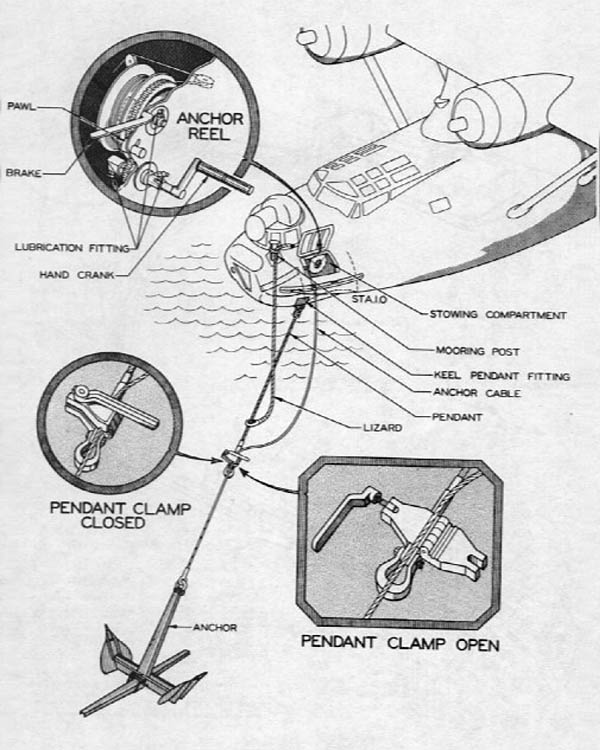
pby-catalina-flying-boat-anchor.jpg

Planes too. LOTS of windage. One could imagine flying like a kite, but I guess the gear probably isnt strong enough for that.

I'd guess the "pendant" shown corresponds to a "snubber" but I dunno if its nylon. The rode is probably SWR

Not sure what the "lizard" line does, but that seems likely to be a trad sailing term rather than flying boat specific, so someone will know.

Seaplanes too, with, unsurprisingly, a bridle, catamaran stylee

https://i.sstatic.net/Q6qDB.png

That looks to be quite an unusual anchor, and, if the drawing is accurate, quite like a locally-made-from-rebar (I assume) thing I see in use on the oyster farms around here
 
Last edited:
pby-catalina-flying-boat-anchor.jpg

Planes too. I'd guess the "pendant" shown corresponds to a "snubber" but I dunno if its nylon. The rode is probably SWR

Not sure what the "lizard" line does, but that seems likely to be a trad sailing term rather than flying boat specific, so someone will know
I think the aircraft is a Catalina and the anchor a Northhill, both American. The anchor folds and is still held in high regard. A further developments almost recent) for seaplanes or flying boats was the Flook.

.

Depending on the year I suspect Shorts would have used a CQR or Admiralty Pattern fisherman's.

Neither anchor has any similarity to a mushroom.

It all proves interest in anchor design lives on.....even if the designs die (or in modern PC parlance...."Pass"

Jonathan
 
Last edited:
I understand that the CQR was designed specifically for flying boats. It was evaluated at the Seaplane Experimental Station at Felixstowe. From the designer's article in YM, 1934:
The new anchor was designed primarily for possible use in seaplanes, where reduction in weight is so important that it overrides many other considerations which may affect the yachts-man. The cost of construction, for instance, is
considerably greater than that of any other anchor of the same weight. It must be
remembered however, that this anchor should be as good as one of the traditional type weighing twice as much. This saving of weight in short-handed yachts may be worth much. Whether the new type will prove easy to handle and stow is a question which I hope to be able to answer at the end of the coming season, for I propose to substitute a 60 lb. specimen for my present very excellent 120 lb. Nicholson in my 19 ton cutter Frolic.
One thing is certain, however, the new anchor has no stock to foul the jib sheets when coming about, so that one continuously acting source of blasphemy will be removed.
 
All submarine related anchor questions should be posted in the Motorboat sub forum
Why?

Submarines have a 'Sail' or so I have been led to believe.

Jonathan


Sail (submarine)​


From Wikipedia, the free encyclopedia

Sail of the French nuclear submarine Casabiancashowing the diving planes, camouflaged masts, periscope, electronic warfare masts, door and windows.
In naval parlance, the sail (American usage) or fin(British/Commonwealth usage) (also known as a fairwater) of a submarine is the tower-like structure found on the dorsal(topside) surface of submarines. Submarine sails once housed the conning tower (command and communications data center), and continue to house the periscope(s), radar and communications masts (antenna).<a href="Sail (submarine) - Wikipedia"><span>[</span>1<span>]</span></a> When above the water's surface, the sail serves as an observation platform. It also provides an entrance and exit point on the submarine that has enough freeboard to prevent the submarine being swamped. Under water, the sail acts as a vertical stabilizer. In some submarines, the sail also supports diving planes (or fairwater planes), which are control surfaces used for depth control while underwater.<a href="Sail (submarine) - Wikipedia"><span>[</span>1<span>]</span></a><a href="Sail (submarine) - Wikipedia"><span>[</span>2<span>]</span></a>
 
Why?

Submarines have a 'Sail' or so I have been led to believe.

Jonathan


Sail (submarine)​


From Wikipedia, the free encyclopedia

Sail of the French nuclear submarine Casabiancashowing the diving planes, camouflaged masts, periscope, electronic warfare masts, door and windows.
In naval parlance, the sail (American usage) or fin(British/Commonwealth usage) (also known as a fairwater) of a submarine is the tower-like structure found on the dorsal(topside) surface of submarines. Submarine sails once housed the conning tower (command and communications data center), and continue to house the periscope(s), radar and communications masts (antenna).<a href="Sail (submarine) - Wikipedia"><span>[</span>1<span>]</span></a> When above the water's surface, the sail serves as an observation platform. It also provides an entrance and exit point on the submarine that has enough freeboard to prevent the submarine being swamped. Under water, the sail acts as a vertical stabilizer. In some submarines, the sail also supports diving planes (or fairwater planes), which are control surfaces used for depth control while underwater.<a href="Sail (submarine) - Wikipedia"><span>[</span>1<span>]</span></a><a href="Sail (submarine) - Wikipedia"><span>[</span>2<span>]</span></a>
From your post...
sail (American usage) or fin(British/Commonwealth
and I believe (and had to look this up)...Australia is still in the Commonwealth
 
From your post...
sail (American usage) or fin(British/Commonwealth
and I believe (and had to look this up)...Australia is still in the Commonwealth
I'm disappointed that you did not know and had to look it up. :)

But, again I believe, our submarine fleet will be made up, for a couple of decades, of second hand American (sail) boats and we are gearing up as preliminary to our 'own' subs to host boats with a 'sail' not a 'fin'. We had a visiting 'sail' boat recently. Contemporaneously we will be building our own subs under the guidance of poms used to fins - but that is well beyond my lifespan - so for the foreseeable future our boats will have a sail, only one each, not a fin.

Interesting that the quote to explain and support the use of the word 'Sail' in the context of a submarine is a picture of a French boat.

Under normal circumstances I would take a note to refresh this thread in 30 years time..... :)

No wonder it is said that Yanks and Brits are separated by a common language.


In any event I understood there was an unwritten precedent that being multicultural on YBW we would not criticise member's linguistic mistakes and foibles, like colour/color, mistaking 'there' for 'their' and....sail for fin. :)

Jonathan
 
I'm disappointed that you did not know and had to look it up. :)

But, again I believe, our submarine fleet will be made up, for a couple of decades, of second hand American (sail) boats and we are gearing up as preliminary to our 'own' subs to host boats with a 'sail' not a 'fin'. We had a visiting 'sail' boat recently. Contemporaneously we will be building our own subs under the guidance of poms used to fins - but that is well beyond my lifespan - so for the foreseeable future our boats will have a sail, only one each, not a fin.

Interesting that the quote to explain and support the use of the word 'Sail' in the context of a submarine is a picture of a French boat.

Under normal circumstances I would take a note to refresh this thread in 30 years time..... :)

No wonder it is said that Yanks and Brits are separated by a common language.


In any event I understood there was an unwritten precedent that being multicultural on YBW we would not criticise member's linguistic mistakes and foibles, like colour/color, mistaking 'there' for 'their' and....sail for fin. :)

Jonathan
I used to live in Sydney during the early eighties.....and as I recall they weren’t too fond of the Poms back then 😳
 
Top