NMEA 2k voltage

Using a substantial backbone cable for your NMEA network is good advice. The connected instruments are important for safety. However, superior backbone cables are expensive.

Duplex tinned ordinary power cable is cheaper, so it makes sense to supply power to the NMEA backbone where the voltage drop at the ends will be similar. Of course, you can do both, belt and braces.
 
Theoretically yes I’m with you.

In the real world installation has a cost and complexity is not a good thing. The whole point of a backbone is reducing cabling and complexity, otherwise each device would have its own power cables. More connections, cables, cable runs, fuses, switches all add to potential failure points.

I don’t think better backbone cables are that much more expensive. Doing it again I’d even consider buying bare cable and connectors for the backbone rather than pre-made cables.
 
Supplying power to the electrical center of an NMEA backbone, rather than at the end does not add to the complexity, or the number of components needed. It may add to the length of the power cable, but this is not expensive or complex.

NEMA 2000 backbone cables with larger wire sizes are substantially more expensive than those offering thinner alternatives. For example, look up the price of Maritron mini or micron bulk cable with 0.65 mm2 power wire versus their Mid bulk cable with 1.29 mm2 power wires.

The thicker backbone wire will reduce the voltage drop, but it is more expensive.

The cheaper alternative is to supply power to the electrical centre of the backbone minimising the voltage drop at the ends. This reduces the requirement for more substantial NMEA wire sizes. However, given the importance of preserving the reliability of these systems some overkill with a substantial NEMA backbone combined with a central power supply is worth considering.
 
Last edited:
1766216940163.png

My boat has a 28,8m backbone which is Raymarine standard SeatalkNG (NMEA2000) - wire size 0,75 mm2 .... it has a total of 27 LEN which is a 1,35A load. The power supply is in the middle of the loads, so approx 0,7A flows in both directions, increasing the wire length before a critical voltage drop is seen.

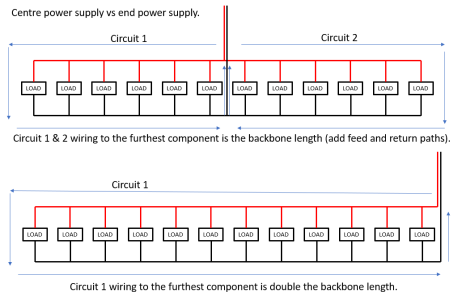
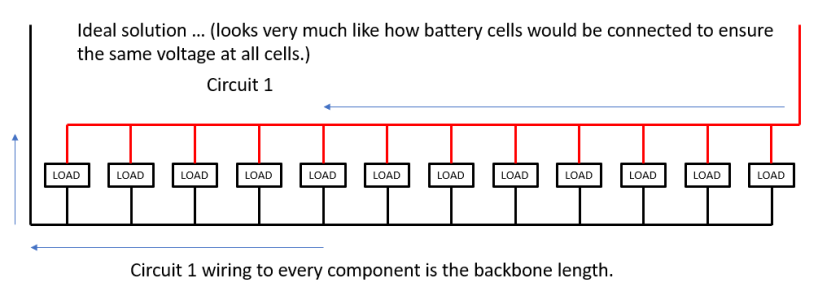
Putting the power at one end means the path to the furthest component, and the voltage drop in the wires, is double the backbone length.

In my case, power at the end would mean a total wire length to the furthest component of 57,6m.

1766219422265.png

1766219926009.png
 
This morning I made myself a voltage reading cable for N2k using half a drop cable and some crimps as well as a t connector.
Plugged in to several locations and the voltage was surprisingly (well, perhaps not surprising that science works…) close to what the software had said.
I then moved the N2k power to the other end at the helm and again all voltages match the predictions so first problem solved. Now to decide how badly I need that extra switch. Thankfully I had 6mm cable to the helm so no issues with power or voltage drop with the current setup.
 
You should not have a problem if the network power supply is getting 13.6v and the number of devices and length of backbone and branches are within spec. Voltage drop over the in-spec network is taken into account.

HOWEVER, if you are a 12v boat, you may not always be getting 13.6v to the power supply. Worse, voltage dips and spikes will be getting into your network. In that case, a stabilised DC-DC power supply may be beneficial.

We are a 24v boat so we have that in any case (an isolated 24-12 Victron dropper), and have never had any issue with voltage anywhere, even when we had 23 metres of backbone cable up the mast.
 
Supplying power to the electrical center of an NMEA backbone, rather than at the end does not add to the complexity, or the number of components needed. It may add to the length of the power cable, but this is not expensive or complex.

NEMA 2000 backbone cables with larger wire sizes are substantially more expensive than those offering thinner alternatives. For example, look up the price of Maritron mini or micron bulk cable with 0.65 mm2 power wire versus their Mid bulk cable with 1.29 mm2 power wires.

The thicker backbone wire will reduce the voltage drop, but it is more expensive.

The cheaper alternative is to supply power to the electrical centre of the backbone minimising the voltage drop at the ends. This reduces the requirement for more substantial NMEA wire sizes. However, given the importance of preserving the reliability of these systems some overkill with a substantial NEMA backbone combined with a central power supply is worth considering.
Mid-size backbone cable is not only more expensive, it's much bulkier and harder to pull. Absolutely unnecessary on a small boat like the OP's.

He simply needs to feed the backbone in the middle (as you suggested), and make sure he gets consistent 13.6v at the power supply. Every N2K network needs a stabilised power supply, in my opinion, and should never be connected directly to 12v boat system with heavy consumers on it, producing voltage drops and spikes which can cause a host of problems.
 
feed the backbone in the middle (as you suggested)
The middle in this instance couldn’t be further from the electrical panel and would require all kinds of work to get power there. It’s unnecessary to do so as moving to the other end solved the issue.
it's much bulkier and harder to pull
It isn’t that much bulkier, the cores are slightly thicker but not by much. If it’s that or pulling three cables I’d prefer one slightly bigger cable for a proper backbone. Micro cable is under sized for a modern network, I suspect it was designed when the components were fewer and more basic. The latest “instruments” are actually 5” plotter screens in many cases and even my old Triton 2 are full digital backlit screens. Much more power consumption than older stuff. If I wanted to put a couple of instrument displays down below I’d have to split the network to provide decent voltage.
 
The middle in this instance couldn’t be further from the electrical panel and would require all kinds of work to get power there. It’s unnecessary to do so as moving to the other end solved the issue.

It isn’t that much bulkier, the cores are slightly thicker but not by much. If it’s that or pulling three cables I’d prefer one slightly bigger cable for a proper backbone. Micro cable is under sized for a modern network, I suspect it was designed when the components were fewer and more basic. The latest “instruments” are actually 5” plotter screens in many cases and even my old Triton 2 are full digital backlit screens. Much more power consumption than older stuff. If I wanted to put a couple of instrument displays down below I’d have to split the network to provide decent voltage.
That's not true. My system uses all Garmin cables and the backbone runs from behind the lower helm to the battery compartment, which as as low down in the boat as possible. It then goes up to the flybridge and finally to the overhead display at the lower helm. The network consists of:

12" MFD
9" MFD
2 x GMI 12s
1 x GHC 20
1 x GHC 50
1 x Garmin reactor 40
1 x black box VHF
1 x AIS transceiver
1 x analogue to N2K trim tab converter
Victron Cerbo
Acitsense EMU1
Actisense NGT1

The network is powered with a single insertion point. My boat is primarily 24V, the network is powered by a Victron DC-DC converter, giving a stable 12.5V supply.
 
Mid-size backbone cable is not only more expensive, it's much bulkier and harder to pull. Absolutely unnecessary on a small boat like the OP's.

He simply needs to feed the backbone in the middle (as you suggested), and make sure he gets consistent 13.6v at the power supply. Every N2K network needs a stabilised power supply, in my opinion, and should never be connected directly to 12v boat system with heavy consumers on it, producing voltage drops and spikes which can cause a host of problems.
"In the middle" means the electrical middle, not 5m from each end of a 10m backbone, yes ?

There is no need for a consistent 13.6V, 12V is perfectly OK. The voltage range of the network is 9V to 16V. Mine is powered by a Victron 24V to 12V converter, giving a stable 12.5V, but only because the boat is 24V.
 
It isn’t that much bulkier, the cores are slightly thicker but not by much. If it’s that or pulling three cables I’d prefer one slightly bigger cable for a proper backbone. Micro cable is under sized for a modern network, I suspect it was designed when the components were fewer and more basic. The latest “instruments” are actually 5” plotter screens in many cases and even my old Triton 2 are full digital backlit screens. Much more power consumption than older stuff. If I wanted to put a couple of instrument displays down below I’d have to split the network to provide decent voltage.
If you are able to pull the thicker cable in your boat, then by all means, go for it. Of course thicker conductors are better. And there is no other downside other than cost.

On my network I have: 8x Tritons, a Maretron DSM250, 2x B&G Zeus plotters, an H5000 sailing computer, a depth sounder, an autopilot computer, an AIS set, 2x Maretron fuel flow meters, a Maretron temperature module, a Maretron engine monitor module, two compasses (a Precision 9 and a Furuno sat compass), and probably something else I forgot. In former days, I had a WSO100 23 metres up at the top of the mast, where I formerly terminated the network.

As originally constructed, I split the network into two parts with two separate power supplies, each powered by a Victron stabilised power supply. When I started having network errors, I eliminated the split.

I've never had voltage problems, despite Micro cabling. I seriously doubt you would have voltage problems if you were getting reliable 13.6v on your power supply.
 
But I was talking about my network and my boat so I’m not sure what you think was untrue.
"Micro cable is under sized for a modern network"

Mine is a modern network, with lots of equipment, it works perfectly OK. I've fitted countless N2K networks, never had to use anything other than micro cable.

Yours works now you've installed it better/properly.
 
What I meant was that micro is too small to create larger more complicated networks so it’s unlikely you’d reach the backbone length the spec suggests if also having lots of modern stuff. Had the spec been written today they may well have increased the core sizes. Your network is relatively short by the sound of it so of course works well. Add to that it being relatively convenient to put the power feed where you want to and you’re grand.
A more complex boat with worse access and it quickly seems more sensible to just have larger conductors to reduce voltage drop. The Garmin cables have tiny power wires inside, and placing a few bright screens 10s of metres apart drops the voltage a lot. While 9V may be within spec it’s not desirable at all, and the warning alarms on mine were 10.5V.
 
I've never had voltage problems, despite Micro cabling. I seriously doubt you would have voltage problems if you were getting reliable 13.6v on your power supply.
We definitely get good stable voltage from the LFP house bank, no problems there. The software tool and my multimeter confirmed that 11.5V is correct at the end when most kit is idle, add in some load and that drops further.
 
"In the middle" means the electrical middle, not 5m from each end of a 10m backbone, yes ?

There is no need for a consistent 13.6V, 12V is perfectly OK. The voltage range of the network is 9V to 16V. Mine is powered by a Victron 24V to 12V converter, giving a stable 12.5V, but only because the boat is 24V.
You are of course correct on all points.

The main point with power supply is its (a) stability, and (b) isolation from spikes and voltage drops below the specs. I suppose it will be fine with 12v -- certainly the N2K specs say that -- but my history with amateur radio tells me it's always safer and better to have stable power at the higher end of the specified voltage range.

The N2K specification calls for all certified devices to tolerate power supply voltages from 9V to 16V. Many of them are 5V internally and so have their own internal droppers, which will stabilise the power at the device level. But I still think that it's very bad design to feed an N2K network with unstabilised power from a yacht power system with large consumers on it, which might have spikes to 60v or sags down below 9V.

On my previous boat, much smaller and simpler than this one, and 12v unlike this 24v one, so more like the OP's, I experienced a revolutionary improvement in electronics performance by installing a stabilised, isolated power supply. It was not an N2K network (this was decades ago), but still. In my experience autopilots are particularly sensitive to unclean power (how many of us have to hand steer when transmitting on HF?), but not only. And don't forget that not all N2K certified devices perform according to spec.
 
autopilots are particularly sensitive to unclean power
Ours has its own direct feed to the battery (well, main switch which is close enough) with 6mm cable so never had a problem. Modern LFP batteries have very stable voltage so I don't think it's such an issue as it used to be anyway.
 
Top