NMEA 2k voltage

Using a substantial backbone cable for your NMEA network is good advice. The connected instruments are important for safety. However, superior backbone cables are expensive.

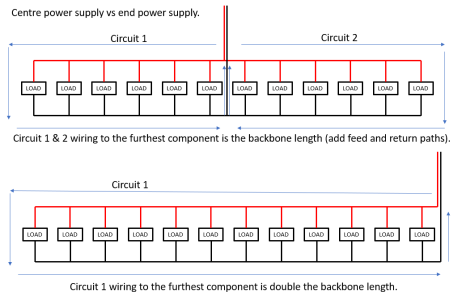
Duplex tinned ordinary power cable is cheaper, so it makes sense to supply power to the NMEA backbone where the voltage drop at the ends will be similar. Of course, you can do both, belt and braces.
 
Theoretically yes I’m with you.

In the real world installation has a cost and complexity is not a good thing. The whole point of a backbone is reducing cabling and complexity, otherwise each device would have its own power cables. More connections, cables, cable runs, fuses, switches all add to potential failure points.

I don’t think better backbone cables are that much more expensive. Doing it again I’d even consider buying bare cable and connectors for the backbone rather than pre-made cables.
 
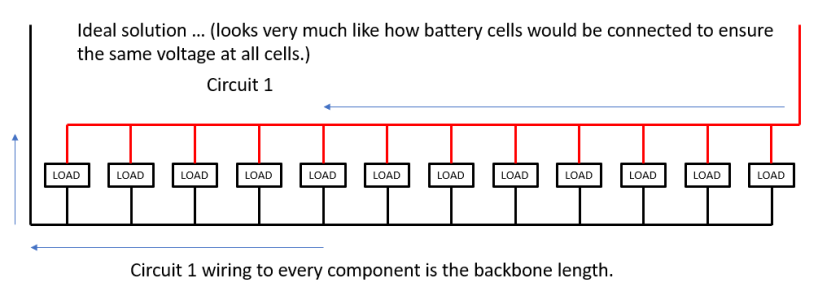
Supplying power to the electrical center of an NMEA backbone, rather than at the end does not add to the complexity, or the number of components needed. It may add to the length of the power cable, but this is not expensive or complex.

NEMA 2000 backbone cables with larger wire sizes are substantially more expensive than those offering thinner alternatives. For example, look up the price of Maritron mini or micron bulk cable with 0.65 mm2 power wire versus their Mid bulk cable with 1.29 mm2 power wires.

The thicker backbone wire will reduce the voltage drop, but it is more expensive.

The cheaper alternative is to supply power to the electrical centre of the backbone minimising the voltage drop at the ends. This reduces the requirement for more substantial NMEA wire sizes. However, given the importance of preserving the reliability of these systems some overkill with a substantial NEMA backbone combined with a central power supply is worth considering.
 
Last edited:
Top