New to sailing & need some help with my boom!

elv_1986

Well-Known Member
Joined
26 Oct 2005
Messages
90
Location
Milford Haven, Pembrokeshire
Visit site
I am new to sailing and am taking a huge learning curve with my first proper 17ft yacht. With it I have a lovely aluminium mast & boom. On the boom where it attaches to the main mast is a fitting with "tuphfitting" written on it. I think it is supposed to allow me to roll the boom to roll up my sail, but i'm not sure now it works. Can anyone help me with how this should work?

Thanks,
Louis
 
hi and welcome to ye Forum.

If you could post a pic or two, it would help with specific advice.


Mainsails are reduced in size principally by three methods
:
1 you roll them up into the inside of the mast or the boom. Unlikely in your boat.

2 you take in 'slabs' of sail, for which you needs lots of cringles (round steel things) at the tack end and clew end of the mainsail, and loads of extra bits of rope. You would be able to see these clearly.

3 roller reefing. This is where the boom is attached to the mast at the gooseneck, by an articulated fixing like a spindle. Either at the for'd side of the mast, or on the boom itself, is a socket which takes a winch handle.

To reduce by roller reefing while at sea, you need
1 to make sure the topping lift is attached and bearing the weight of the boom. You may have to disconnect the vang also; sometimes there is a horseshoe shaped fitting which you can use instead.

2 you are heading pretty nearly dead to wind (if you are off the wind, the sail will not roll easily)

3 crewman 1 eases the main halyard gently, as No2 turns the roller reefing handle, and No 3 pulls out the clew of the sail to prevent creases becoming locked into the sail

4 make the halyard fast, and tighten the roller device to produce a flat sail (generally best for stronger winds). Some sails and booms need a 'sausage' of cloth place next to the boom to make certain that the 'belly' is wrapped properly.

It all sounds complicated, but is can be done quickly with team work and practice. Just make sure that the roller reefing gear is fully mobile before starting - and don't leave the winch handle in the gear, as they tend to sink rather quickly.

Perhaps practice when ashore or tied up before you try in in anger while sailing ?

Best of luck - and never be reluctant to reef; it quickly changes a hairy situation into one where you have control and can enjoy the sailing.
 
Last edited:
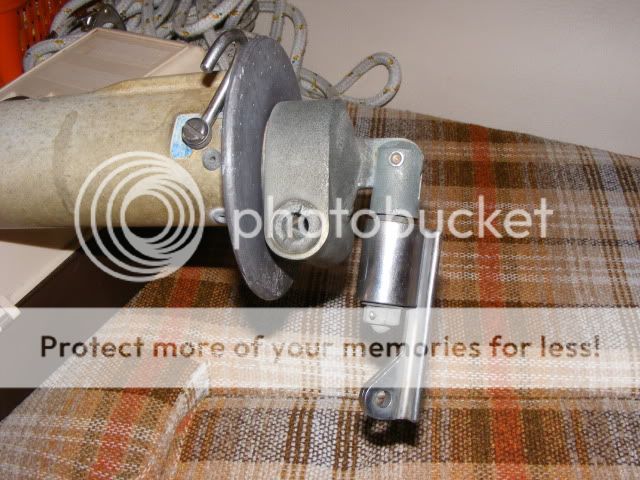
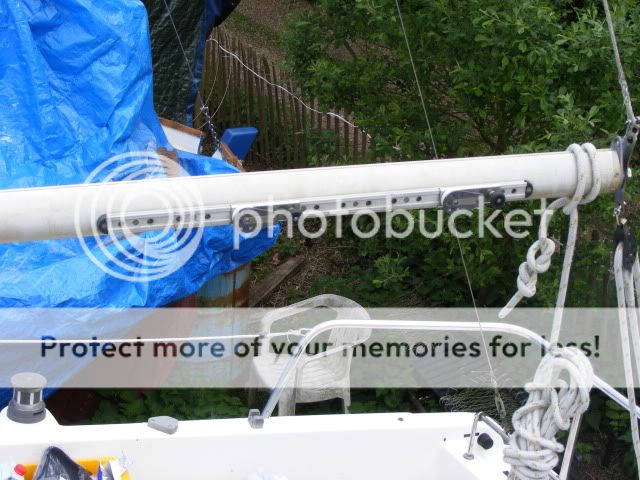
Hi, thanks for the welcome and the information. I think what I have may be roller reefing. I have just taken a few pictures, they are not great as it is dark outside, I cant see a socket for a handle though?

144_0324.jpg

144_0325.jpg

144_0326.jpg

144_0327.jpg
 
It's roller reefing. The hole for the handle is the big hole near the botton of the silvery bit in the middle of the first photo. If you examine carefully you should also find an oiling hole at the top. If you are short of a handle I believe Barton make one.
 
thats great thanks, very helpful! I havent found a handle yet, so I may have to get one from Barton. I have located the oiling hole, and will give it an oil tomorrow to make sure its all free.
thankyou very much for the help, next job is to try and rig it all up! :D
 
The presence of that cleat in the picture implies that someone has not been using the roller boom. That would get rolled into the sail which would not be desirable. It is quite common for people to convert from roller to slab reefing as roller reefing can do horrible things to the shape of the reefed sail. Perhaps that cleat is part of another setup?

If you decide to use the roller boom, you need a boom free of obstructions; a special fitting that looks like a claw (can't remember the name) for you kicking strap boom attachment; and you must remove any sail battens when taking a deep reef. To reduce the sail distortion you can chuck a few spare sail battens into the middle of the boom as you roll the sail to take some of the bag. Remembering they were there when shaking out the reef was something I singularly failed to do, the batten overboard rate was fairly high.

...17ft is she a Cherub?
 
Indeed. Don't try to roll up the main with that cleat on the boom. :eek:

Your boat has been converted to slab reefing, as has mine and probably the majority of others that originally started with roller reefing. You will find you have cringles on the sail. These are pairs of metal eyes at the same height on the leading and trailing edges of the sail and are used to pull down "slabs" of the main to reduce it's area.
 
Last edited:
Now its all starting to make sense! I havent had a good inspection of the sail tonight to see if I have the metal eyes because its dark, but I am fairly sure I remember seeing some yesterday when hanging them up (the sails were wet when I took delivery). If she has been converted to slab reefing, which it looks likely, I shall not use the roller reefing as it sounds a lot easier!
If I pull down a few slabs of sail, how do I secure them to keep the sail down?

The boat is a 17ft Newbridge Topaz, bilge keeler. Lovely little boat with a small cabin, perfect for my sailing area (Cleddau Estuary) as I can dry her out easily! She hasnt been used for a few years so I am checking the rigging over. The forstay is currently rope, I am changing that for stainless steel wire. Sail are in great condition they were just wet in the bag.
 
This Sailnet article is a reasonable primer on reefing although it refers to reef hooks for the luff cringles which you don't appear to have. Silkie didn't have these either but they make the job a lot easier, cost only a few quid and will probably be relatively easy to fit.
 
Last edited:
Looks very similar to the roller reefing fitting that I have:-

DSCF0423.jpg


I dont use it as I have converted to slab reefing. You can see one of the home made hooks in the above picture.

I have fitted a slab reefing kit (track and blocks ) to the boom also:-

DSCF0474.jpg


The roller reefing handle is made by Barton:-

reefinghandle.jpg
 
The bits of string hanging from the sail are used to tie the "slabs" of the reefed sail to the boom.

The "cringles" are visible on the reinforced bits of the sail, two cringles per reef, one at the mast edge of the sail, the other at the trailing edge.

The cringle at the mast usually hooks onto some sort of hook or horn so that you can keep the sail tensioned vertically, the other cringle is used with some rope arrangement to keep the bottom edge of the sail tensioned horizontally.

Hope this helps.


090.jpg
 
Indeed. Don't try to roll up the main with that cleat on the boom. :eek:

Your boat has been converted to slab reefing, as has mine and probably the majority of others that originally started with roller reefing. You will find you have cringles on the sail. These are pairs of metal eyes at the same height on the leading and trailing edges of the sail and are used to pull down "slabs" of the main to reduce it's area.

Perhaps that should be re-worded to read "Dont try to sail roller-reefed with that cleat on the boom"
I have had no problems using the roller reefing as a method of flaking at the end of the day despite two similar cleats on my boom.
I would have little concern over using the roller reefing to reef deeper than the two slab reefs on my main either if necessary. Because the luff of the sail, the bunt of the slab reefs plus the bulk of the boltrope keeps the cloth loose on top of the cleats.
 
Thank you very much for all of your help, I have put the mast up today, raised the sails and measured up for a wire forestay. I also found the handle for the roller reefing inside the boat, allbeit a bit rusty! It is evident that the boat has not been under sail for a few years as I am having to replace shackles and a few pulleys. I am also changing all the rope onboard just incase!
 
hey, that sounds like good progress ! Well done. When do we see the piccies ?


BTW, there's only one 'rope' on a boat, and that's attached to the bell.

There are, however (a pednat writes ;)

sheets, guys, halyards, lines, buntlines, cords, cordage, hawsers, lashings, whippings, twines, shrouds, stays, jackstays, falls, cables, yarn, spunyarn, junk, clews, tacks, warps, roundings, rodes, lanyards, messengers, points, pendants, stoppers, nippers, seizings, strops, slings, spans, tackles, braces....


Oh yes, if anyone else is feeling picky, I know that on a ship ( a real ship) you can have a footrope, and a horse, also:)
 
sorry, I will replace all the sheets the just incase :) I come from a motor boat background where there only called ropes :)

The only thing I am lacking is the string on the sails to slab reef, I will experiment when she is out on the water, I may change her back to roller reefing. Todays jobs are to remove some old rusty snapped fittings and replace with shiny new stainless ones and possibly start some cleaning as she is filthy from being left in someones garden!

I will get some pics for you all to see once I have the new forstay in place (the mast is down at the moment) which should (*fingers crossed) be monday! :) :D :)
 
Newbridge Topaz in Canada

Hi there. I found your pictures from several years ago! I have just found one of these boats in Canada and am in the early stages of doing a complete refurb! Do you happen to have any information on the boat? Date? Sail dimensions?, etc? Thanks for any help you can provide!

Lee
 
Your boom looks a touch high!! Rather than have permanent reefing ties use a sail tie or two to gather the sail folds when reefed,they are only needed to tension the loose folds for better visibility when sailing reefed. As VicS has mentioned you'll need a couple of reefing hooks at the mast end of the boom which can be made from a stainless shackle for each side. The luff cringle is hooked onto the hook first and the tension taken up on the clew reefing cringle of the mainsail as tight as possible and jammed off into a clamcleat(with a 'bridge')or the existing cleat on the side of the boom. Reefing is easier done before setting out in a breezy day, and will provide a safer exhilarating sail, but you should perhaps practice reefing afloat in case you get caught out in rough weather another time.


If you read down the current threads here you will see one referred to about 'heaving-to', that is backing the jib on the 'wrong' side and pushing the tiller over to the leeward side and keeping it there; this will cause the mainsail to depower and allow you to put the reef in; the boat will drift slowly sideways at about 1 kt;that is 'hove-to'; when reefed release the jib, sheet in both main and jib, and carry on sailing as before.


ianat182
 
Last edited:
Top