New gas regulator. Which one?

Zing

Well-Known Member
Joined
7 Feb 2014
Messages
8,226
Visit site
My gas regulator is a bit old now. Don't ask how old... I think it's overdue for a change, so I researched a bit to find out what I need. The fitting is a standard POL for propane and the cooker is a UK spec Force 10. It turns out that in the intervening years since installation that new standards have emerged and I ought to (I think) change the regulator for a Marine spec reg. These are only available in 30 mbar, but my cooker is made for 37 mbar and the old regulator is set at that value.

So if I get the new marine regulator, will it work OK with the lower pressure supply? I realise I probably can get new orifices or burners for the cooker, but what a pain! Also I could just get a standard 37 mbar regulator (non marine) and be done with it.

Any advice for me?
 
We have just had our gas system checked and refurbished by a very nice young man. He condemned our old regulator, bought at a chandlers abroad a year ago, and replaced it with a new marine one. I don't have the details but according to him it is usable by camping gas or propane with an adaptor. I don't remember exactly what he said, but apparently the camping gas pressure has been increased recently to match that of propane. This sounds odd to me if we are talking about the pressure above a liquid, but never mind. It certainly looks as if we all ought to change to a marine regulator, though it looks a if the matter of changing cylinders will be trickier and need a tool.
 
We have just had our gas system checked and refurbished by a very nice young man. He condemned our old regulator, bought at a chandlers abroad a year ago, and replaced it with a new marine one. I don't have the details but according to him it is usable by camping gas or propane with an adaptor. I don't remember exactly what he said, but apparently the camping gas pressure has been increased recently to match that of propane. This sounds odd to me if we are talking about the pressure above a liquid, but never mind. It certainly looks as if we all ought to change to a marine regulator, though it looks a if the matter of changing cylinders will be trickier and need a tool.

Yes, I believe butane pressure has gone up from 28Mbar to 30 and propane reduced from 37Mbar to 30. They are now the same. EU standardisation I think. And, no please don't move this thread to the Brexit forum.
 
this what i have i propane cylinder & 1 camping gaz with a change-over cock mounted in the gas box
https://www.bes.co.uk/manual-changeover-valve
sadly i cant accommodate 2 x propane

https://www.bes.co.uk/propane-low-pressure-regulator-1-5-kg-hr-15163
https://www.bes.co.uk/camping-gaz-low-pressure-regulator-1-kg-hr-8809

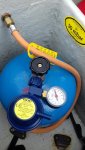
I found this one on that site. With a gauge, which should be useful, though I wonder if it only works when virtually empty?

https://www.bes.co.uk/propane-low-pressure-regulator-15-kg-hr-23143#product-details-tab
 
I recently fitted a Gasboat marine regulator from W Haywards IIRC. I imagine if you run an older propane cooker at the new lower pressure it will be less efficient. However, some cookers can be adjusted between 28 and 37 mbar.
 
My gas regulator is a bit old now. Don't ask how old... I think it's overdue for a change, so I researched a bit to find out what I need. The fitting is a standard POL for propane and the cooker is a UK spec Force 10. It turns out that in the intervening years since installation that new standards have emerged and I ought to (I think) change the regulator for a Marine spec reg. These are only available in 30 mbar, but my cooker is made for 37 mbar and the old regulator is set at that value.

So if I get the new marine regulator, will it work OK with the lower pressure supply? I realise I probably can get new orifices or burners for the cooker, but what a pain! Also I could just get a standard 37 mbar regulator (non marine) and be done with it.

Any advice for me?

We have just had our gas system checked and refurbished by a very nice young man. He condemned our old regulator, bought at a chandlers abroad a year ago, and replaced it with a new marine one. I don't have the details but according to him it is usable by camping gas or propane with an adaptor. I don't remember exactly what he said, but apparently the camping gas pressure has been increased recently to match that of propane. This sounds odd to me if we are talking about the pressure above a liquid, but never mind. It certainly looks as if we all ought to change to a marine regulator, though it looks a if the matter of changing cylinders will be trickier and need a tool.

We are not talking about the bottle pressure ! It is the regulated low pressure, ie that of the gas supplied to the appliances , which has been standardised to 30 mbar

The practical benefit is interchangeability between propane , butane and Camping Gas which if the system is correctly designed should be accomplished merely by using the correct bottle connector. However the performance of a cooker designed for propane at 37mbar will be diminished if operated at 30 mbar but perhaps not sufficiently to be of great concern.

This page illustrates the range of adapters/ bottle connectors available: http://www.whayward.com/Details.cfm?ProdID=631

On the back of the arrival of the 30mbar "dual fuel" regulators come the Annexe M "marine" regulators which have additional safety features including an over pressure relief valve and corrosion resistant construction.

In time, no doubt, insurance companies will insist on marine regulators being used as surveyors' reports draw their attention to them.
 
So far I haven't heard a convincing explanation of the use of 30 mbar for both gases. There really isn't a machanism for any "new design" appliances to counter the imbalance of changing gases without changing pressures - so an old cooker will behave the same as a new one. After all, a fixed jet is just that - fixed!

I guess it's worth going to the annexe M (marine) 3- mbar regulator, but there was a spate of them leaking straight from the box reported here so I'd suggest a thorough leak check on installation. As others have hinted at, you may find an advantage in selecting a bulkhead mounted version so that changing the pigtail hoses will allow you not only to switch between butane and propane, but also adapt to local bottle supplies when abroad.

Rob.
 
So far I haven't heard a convincing explanation of the use of 30 mbar for both gases. There really isn't a machanism for any "new design" appliances to counter the imbalance of changing gases without changing pressures - so an old cooker will behave the same as a new one. After all, a fixed jet is just that - fixed!

I guess it's worth going to the annexe M (marine) 3- mbar regulator, but there was a spate of them leaking straight from the box reported here so I'd suggest a thorough leak check on installation. As others have hinted at, you may find an advantage in selecting a bulkhead mounted version so that changing the pigtail hoses will allow you not only to switch between butane and propane, but also adapt to local bottle supplies when abroad.

Rob.

I can't unfortunately fit a bulkhead regulator in my locker. I can see it being preferable though.

It seems that one of the main changes of the new rules is to have a valve with a pressure release valve in it. That sounds like a good thing, but it seems that the non-marine 37Mbar valves don't have them in small sizes, so I probably will have to get a larger one if I want this valve.

The deciding issue really is if my cooker will work OK or not.

A further thought. I don't think a gauge is any good as I previously thought as the pressure in a propane tank is there to hold the gas as a liquid and until it is nearly all gas then it won't change much I expect, so I don't really see much point in getting one, especially as it is a pain to open up my gas locker to check levels.
 
We are not talking about the bottle pressure ! It is the regulated low pressure, ie that of the gas supplied to the appliances , which has been standardised to 30 mbar

The practical benefit is interchangeability between propane , butane and Camping Gas which if the system is correctly designed should be accomplished merely by using the correct bottle connector. However the performance of a cooker designed for propane at 37mbar will be diminished if operated at 30 mbar but perhaps not sufficiently to be of great concern.

This page illustrates the range of adapters/ bottle connectors available: http://www.whayward.com/Details.cfm?ProdID=631

On the back of the arrival of the 30mbar "dual fuel" regulators come the Annexe M "marine" regulators which have additional safety features including an over pressure relief valve and corrosion resistant construction.

In time, no doubt, insurance companies will insist on marine regulators being used as surveyors' reports draw their attention to them.

:sleeping:
 
I can't unfortunately fit a bulkhead regulator in my locker. I can see it being preferable though.

It seems that one of the main changes of the new rules is to have a valve with a pressure release valve in it. That sounds like a good thing, but it seems that the non-marine 37Mbar valves don't have them in small sizes, so I probably will have to get a larger one if I want this valve.

The deciding issue really is if my cooker will work OK or not.

A further thought. I don't think a gauge is any good as I previously thought as the pressure in a propane tank is there to hold the gas as a liquid and until it is nearly all gas then it won't change much I expect, so I don't really see much point in getting one, especially as it is a pain to open up my gas locker to check levels.

Not so much whether you cooker will work or not probably more a question of how well it will work. I imagine it will be like not opening the control valve more than a 3/4 of fully open. It'll just take longer to boil the kettle etc.

I am inclined to agree with you about the pressure gauge. The reading will be constant, varying only with temperature, until all the liquid has been consumed . I suppose when you open the gas locker to turn the gas on every time it is to be used you will have the opportunity to check it and have some warning that you will need to change to a full bottle before long.

However in addition to giving you a little warning of a low gas level they can be used as a method of leak detection although a poor one, and not infallible, compared with a bubble leak detector
 
I've just replaced my elderly Calor Butane regulator, originally purchased from Socal, with an apparently similar one from the local chandler. I was concerned to read on the fitting instructions that this device is not suitable for caravans or motor caravans, but with no explanation. Boats are not mentioned.
I've now checked on the Socal site for this regulator and they include boats on this "not suitable for" list.
Are marine regulators now more or less mandatory, have I wasted my money?
 
I've just replaced my elderly Calor Butane regulator, originally purchased from Socal, with an apparently similar one from the local chandler. I was concerned to read on the fitting instructions that this device is not suitable for caravans or motor caravans, but with no explanation. Boats are not mentioned.
I've now checked on the Socal site for this regulator and they include boats on this "not suitable for" list.
Are marine regulators now more or less mandatory, have I wasted my money?

I am not going to claim that I have all the Is dotted and Ts crossed correctly on this despite having read up on it earlier today but:

ITYWF that the standards to which caravans and motor caravans have to comply these days require them to have a 30mbar gas system suitable for butane or propane, at least in the EU. A standard 29 mbar butane regulator will presumably not therefore comply with the current requirements for caravans and motor caravans.

Marine regulators are 30mbar with additional safety features . Socal are protecting their backsides to some extent by saying that the standard butane regulator is not suitable for boats. It remains your choice AFAIK regarding your boat but it may be different for commercial / charter boats, I dont know.
 
Thanks for response VicS. I expect that you're not far off the mark. My regulators are 29 mbar, I'll stick with the one I bought.
For this basic type of regulator, sold for 4.5 Kg butane bottles, caravans, motor homes and boats must represent a large portion of the potential market, the larger bottles seem to have a different fitting.
 
I found this one on that site. With a gauge, which should be useful, though I wonder if it only works when virtually empty?

https://www.bes.co.uk/propane-low-pressure-regulator-15-kg-hr-23143#product-details-tab

The one i have fitted seems to work fine though it does seem to remain at "full" until the cylinder is well down but still more than enough left for a few days use. Other advantage is when you turn off the valve the gauge should stay steady but if the reading drops away you have a leak. Easy to see there is a leak somewhere but not so easy to find the leak.
https://www.bes.co.uk/propane-low-pressure-regulator-15-kg-hr-23143
 
Did a new set up for similar reason that parts were well out of date. I spoke to Intergas and they set me up with marine regulator and hose. Insurance did ask for marine grade regulator dated. The cheaper ones will work but are susceptible to corrosion very quickly which can cause problems which you may not want on such a confined space. An adaptor was supplied which allows connection to both 907 and the 4.5kg cylinders. 20170430_115209_resized.jpg 20170430_115215_resized-2.jpg20170430_115255_resized-1.jpg
 
Top