
New Electrical System (Solar, Victron, DIY Winston LiFePo4)

Yes, the theoretical cycle life is much greater than most lead-acid batteries. However 80% of 260Ah only gives you a usable 208Ah. If you had 400-450Ah of decent lead-acid batteries, you'd have the same usable capacity at 50% DOD, at about a third of the cost. OK, the weight would be about twice as much, but not massively more.

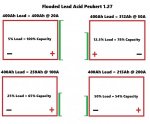
Yep, that is right. However, I can only use that capacity if the discharge rate is not high. If it's high then that remaining 200Ah (50% DOD) can be halfed. A 400Ah bank can supply a 20A load for 20 hours before hitting 10.5V (0% DOD). Loads above the 20 hour rating diminish the capacity of the bank.
07-LiFePO4-On-Boats.jpg

Yes, weight is a big player here too, in case if needed I can still add a secondary lipo battery bank to the system. I don't think I would be able to do this with Lead Acid as that would weight around 250kg (550pounds). That is really a lot to carry around in van.
 
I don't know much about Winstom batteriesand the associated Victron products. However I did think that LIthium batteries ran at up to 4.2 volts charged and more being charged. This gives 16.8v and more on the power bus. So voltage in operation could be too high for many devices needing a DC buck converter to give 12v.
Also I understood all lithium charge controllers need to monitor individual cell voltage for determining charge cut off and discharge cutoff. There don't appear to be any connections to individual cells. Is this cell type different to smaller lithium cells. olewill
 
Passing question why current sensor and shunt ?

Does look complicated unless you have a special need, can you explain aims.

Brian

Current sensor comes as standard with the BMS package and it is also required. The BMS can be accessed via an app where you can monitor the flow. There should be 2 installed (one on the load and one on the charge side) but I do have a hybrid inverter/charger which is why is not possible.

It is indeed complicated. I'm still not 100% sure about the connections...
I'll be living and working in the van full time plus my missus. I wanted something that is stable and provide all the power we need.
 
I don't know much about Winstom batteriesand the associated Victron products. However I did think that LIthium batteries ran at up to 4.2 volts charged and more being charged. This gives 16.8v and more on the power bus. So voltage in operation could be too high for many devices needing a DC buck converter to give 12v.
Also I understood all lithium charge controllers need to monitor individual cell voltage for determining charge cut off and discharge cutoff. There don't appear to be any connections to individual cells. Is this cell type different to smaller lithium cells. olewill

Each cell is 3.2v and 260Ah, they are wired in series so that gives 12.8v. That is ideal and similar to lead acid. Absortion on 14.2v (3.5v per cell). Altough, it has not been tested yet so I will confirm the correct voltage later, this is only a suggestion and theoretical value right now.

There is a BMS in place, there are small PCB boards on each positive terminals and these boards are connected to the negative as well. There is a central unit on the last cell that has a low voltage and a high voltage cut of relay contact. These can be connected to anything really. (relay, contactor, solenoid and supported devices)
 
Last edited:
This http://www.beginningfromthismorning....teries-part-1/ is an interesting blog about using Lithium Batteries as domestic bank in an RV Bus, he decided to use the battery pack from a Nissan Leaf electric car and has configured it give about 500AH at 48V !!
Anyway the blog gives lots of very interesting info about the pro's and con's of Lithium and also gives info about the charging and discharge regimes for max life. It should answer many of your questions.
I have looked into using Lithium (LiFePo) batteries for domestic on our boat - I am convinced that they are definitely cost effective for long term liveaboard use even when you factor in the extra costs of monitoring systems and changing charging parameters etc. Here https://marinehowto.com/lifepo4-batteries-on-boats/ is another article on Li batteries on boats, very detailed and informative but it clearly makes the point that you cannot just swap from lead acid to Li, you have to design and configure the complete electrical system to suit Li batteries - it is not a simple DIY job unless you are an experienced electrician and understand all the factors involved.

The article on marinehowto makes it very clear that you should not "float charge" lithium batteries - once they are fully charged or nearly fully charged you need to turn off all the charging sources until the batteries are at a state where they need charging again.
The Victron kit you are proposing is all designed to work together and will give you all the control you will need to properly manage the lithium batteries.
The alternator currently fitted to the van is probably not very big and not likely to be up to charging lithium batteries since the batteries will cause the alternator to run at max output for long periods - standard alternators will not last long if run at max output!!
You say you will be living in the van for a couple of years and I guess this will mean mains power connection for most of the time - if so then the Victron multiplus is ideal since you can programme it to turn off the charger as required.

You also might want to have a look at this site http://www.rec-bms.com/index.html for an alternative BMS, they also offer high power contactors and very good PC software for monitoring - could be an alternative to some of the Victron kit.
 
Last edited:
Wondering if you completed this project. I'm debating ordering an SmartBMS 123 Gen3 or going with other solid state BMS.

The OP's last contribution to YBW.com was exactly a year ago on the Motor Boat Forum but you could try a PM. I have the Gen3 123SmartBMS on my pack. I'm only three months in so not much of a test but, so far, I haven't come across any of the bugs that seem to have been a feature of the previous iterations- mainly imbalance between end-boards and middle-boards and Bluetooth connection problems. In fact it has behaved perfectly and the cells remain within 0.01volts of each other as they have been since the initial top balance. The app is great and I've had good support from 123 Electric with all enquiries answered within 24 hours. I also have the 125 amp bi-stable relays which are trouble free so far and take next to no power on standby. For marine use I treated all the boards with several layers of conformal coating (Plastik 70) once connections had been made.
 
Last edited:
I've bee wondering on using relays or mosfets. I think we are getting close to the point were mosfets are efficient enough for 250A loads. The cost of the relays is also higher than the mosfets.
 
Seems i missed this thread first time around.

Someone emailed me with a query about the AC connections in the schematic in post #1, which i think deserves a mention here. The question was:

The RCD seems in the wrong place to me, and is only providing protection when connected to shore power?

If the RCBO is the only RCD type device in the installation it is indeed incorrect. It's a good choice of device to fit close to the shore power inlet, to protect the inverter and the cabling between the inlet and inverter, but there absolutely must be a 2nd RCD fitted after the inverter, or there will be no protection when the inverter is supplying AC power.

Zooming on on the AC distribution panel in the schematic, it looks like there might be an RCD in there, but it's not clear and IMO it should be clearly labelled. Any installation that includes an inverter, or any other equipment, between the AC inlet and the consumer unit/RCD must be fitted with at least an RCD as close to the shore power inlet as possible.
 
Top