New awb's.

It's about best practice rather than mass production. The two are not the same thing at all.

A little research reveals the GT35 is built in a similar way to the likes of Oyster, Gunfleet. Resin infused hull and deck with solid laminate below the waterline, lead keel attached to a massive stub which is part of the hull mould, bulkheads bonded and laminated to hull and deck, carbon reinforcements, good ballast ratio, quality resins, oversized chainplates, substantial rudder stock, jefa steering etc.

Stability.. AVS 144, STIX 54 is almost unheard of for a modern 35 footer.

Gut feeling why it hasnt sold: They made a mistake with the size. People nowadays view 35 feet in the same way they viewed 25 feet in years gone by. Had they brought out a 45 footer, they could have marketed it as a long distance global girdler and perhaps found a few buyers prepared to pay big £££.


A very good series of points.

A lot of the naïve banter about "mass production" seems to assume it is a sort of magical offle dust you can sprinkle over a product. All advanced production tooling would achieve in this case, is to lose the owner 10 million instead of one.

As you imply, It is very difficult to make this sort of boat sleek, or distinctive, in the smaller sizes, so a larger boat would have looked more the part and could have cracked it. On refection the MD might have gone down the route of building a boat for a committed buyer and taking it from there - but it is easy to be smart after the event, I believe Mr Cockburn deserves praise, even though it turned out to be a light brigade charge.

A number of boatbuilders produce equally, or very much more, expensive models but they are established names. You know one when you see one and that is the sort of cachet folks are prepared to pay for. It's tough to establish a new company with an up market image right from scratch. Spirit managed it by starting small and doing exceptional work within their niche. In the case of the GT I think it may well have gone down better if they could have resurrected a name with some recognition in the market place. Camper and Nicholson would have been perfect
 
Advanced tools and production techniques in GRP can save a bit of weight, but mostly it's about getting the boat out of the mould faster and reducing the need for skilled labour.
Boatbuilding is a different game when you've got an order book which keeps the mould busy.

Being able to go from a CAD file to a mould or plug cheaply and quickly helps a lot with short run moulding.

Bring back cold-moulded wooden prototypes I say!
 
The pioneer (in production boats) was Jeremy Rogers who built the OOD34 using vacuum moulding/resin infusion.


He was.

Rogers also produced three hulls for the Contessa 39 as a 1979 Admirals Cup challenger: One GRP, one Kevlar with foam sandwich, and one single skin Kevlar with GRP; all were injection moulded on the same moulds.
Eclipse was probably the lightest hull in the fleet with a basic structure of around 1,000kg which included the carbon fibre rudder.


But it's nice to know Bavaria are keeping up :-)
 
A lot of the naïve banter about "mass production" seems to assume it is a sort of magical offle dust you can sprinkle over a product. All advanced production tooling would achieve in this case, is to lose the owner 10 million instead of one.

Indeed. That's not the point, though. The point is that hand-production isn't magic pixie dust either. It's a route you are forced down when you aren't making many of something. Too many people believe that the money you spend on hand construction of anything gets you better quality than machine production. It doesn't/ most of the extra goes on the inevitable inefficiencies.

To adapt an old saying, "good, cheap, penny numbers: choose two".

A number of boatbuilders produce equally, or very much more, expensive models ...

What 35 footers cost more than £320,000?
 
Advanced tools and production techniques in GRP can save a bit of weight, but mostly it's about getting the boat out of the mould faster and reducing the need for skilled labour.

Indeed. When Reliant Motors were the world's largest GRP producer - 25,000 tricycles per annum - they had to leave each bodyshell in the mould in a heated shed for a week to cure. That meant a lot of moulds, a lot of heating and a lot of money.
 
I think some people may be confusing some of the moulding processes.
The various resin infusion processes are in many ways not much superior to what can be achieved with a (gang of) skilled craftsman/men using a 'conventional' vacuum bagging technique.
The big gains are going from brush and bucket solid laminate, to vacuum bagged sandwich. And possibly using different materials.

But for a 35ft AWB, could you actually tell the difference on the water? A well designed brush and bucket boat might only be carrying a few cwt less ballast than the exact same hull built high tech. You'd notice that in one-design racing, but in cruising?

In reality, the mass produced boats tend to have more design time invested to optimise reinforcement, so a lot more weight can be designed out. But we are not really seeing the AWBs get particularly light or gaining ballast ratio AFAIK?

Some of the reality that is forced on designers is about robustness. Nasty low tech GRP is tough, and stands up to abuse like rafting and boatyard handling better than hi-tech built to the same strength.
 
Back on topic, as well as being impressed by the Jeanneau 319, I was also extremely impressed by the new 440.

Two stand out features were the ability to get to the side decks without stepping over anything and the fact that all the double berths are proper square beds like you get at home. I've always being asking the question why berths have to be such uncomfortably odd shapes (usually too narrow at one end or the other) and Jeanneau proves it doesn't have to be like that.

I think the finish was by far the best of the AWBs, which is a turnaround from past years where I thought Bavaria was leading.
 
Well said JumbleDuck. I wonder what the living space would be like on a tour of the western or northern isles?

As others have said they are built for the Mediterranean market, with some of them being sailed to Australia. Some are used for trips like the ARC, but as JumbleDuck said that is a three week ride on the trade winds.

Oh I don't know. Two years living on board on the West Coast as far out as the Outer Hebrides in an AWB went well for us...

We did use that new fangled Eberspacher thing though. And the cockpit tent. And I am sure that I used the bow thruster once when we went into a Marina as we are just big softies really. Didn't use the engine much though.
 
Oh I don't know. Two years living on board on the West Coast as far out as the Outer Hebrides in an AWB went well for us...

We did use that new fangled Eberspacher thing though. And the cockpit tent. And I am sure that I used the bow thruster once when we went into a Marina as we are just big softies really. Didn't use the engine much though.
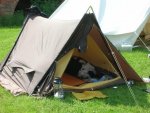
Sounds like you had a great time.

I'm looking forward to getting back to the west coast.

The wonderful thing is we have choices and can buy what we want. Although I don't think my tent would fit over the cockpit ;)

tent.jpg
 
It's just that I don't see the offerings from those that I saw being worth the price. ( I never reached the jeannau stand) And while I'm sure the boats per se are perfectly capable of handling the rough stuff, I really don't think they are the boat I want to be living in when it's rough, because the interiors are not up to that from what I saw.
The living side of things just seems to be so unadjusted to the idea of rough weather.

I would much rather buy an older boat, and pay to have it stripped out, then have a cabinet maker custom build the interior to my own design, with lovely materials. I would be very surprised if I could not do all that for under £100k, then add another 20 for sails, rigging and engine.

+1

I did not view all of the offerings, but did get too see one that had 3 double cabins. I did not find the wet hanging locker but did find the walk in wardrobe presumably for the cocktail dresses and the high heels....

I thought the Hanse offerings were reasonably covered with handholds and fiddles, boats you could walk through when heeled perhaps they are optional extras with other brands.

I have raised this concern with several salesmen and was simply told when its windy the boats dont go out they stay tied up in the marina, maybee many do but is that an acceptable excuse for not desiging in some basic features that will be needed if a boat is sailed well heeled
 

Other threads that may be of interest

Top
