Needles for stitching on rope

Ian_Edwards

Well-Known Member
Joined
9 Feb 2002
Messages
2,222
Location
Aberdeen Scotland
Visit site
I'd like to add come covers to dyneema halyards to help the clutches grip the rope.
I'd like to use the method where you separate out the strands of the plaited cover and stitch them into the halyard, as in this YouTube video:

https://www.youtube.com/watch?v=thyLfoOHe-4

The method involves taking 4 strands of the plaited cover and stitching them into the halyard.

I've got plenty of sail repair needs which work well with waxed twine, but the eyes are too small to get 4 strands of the new cover through the eye.

What have others used? I've looked at large eye darning needles, and they might work.

https://www.jjneedles.com/buy-needl...short-cotton-darners-hand-sewing-needles.html

They need to be strong, they have to work on 12mm D2 ( dyneema core with cover), which will need a palm and pliers to get through the core, when the core starts to get packed with yarns and the sewing gets harder.
 
I use blunt darning needles. The idea being to go between strands, not splits strands and go between fibres.
I will say 99% of the ropework I do is on smaller rope, but getting through the core is not hard if it's not under tension.

Get one of those wire loop needle threading tools, very handy as soon as a strand goes fluffy.
 
And compress the rope through which you are inserting the needle, so don't stretch but compress - it loosens the fibres. I thought you were slicing into the cover not into the core.

Jonathan
 
Neither copper wire or seizing wire are anything like strong enough to go through a 12mm dyneema cored rope which is 12 years old and has seen a significant tension, it's a genoa halyard on a 46.86 square meter (504 square foot) sail.
I'm trying to fix a short length of braided cover over the halyard where it passes through the clutch, to try and stop the halyard from slipping. If you look at the YouTube video in my initial post you'r see what I'm trying to do.
It needs a good quality steel needle, because I'll be pushing it with a sail makers palm and pulling it with a pair of pliers.
I've done this before, more or less, I've put a covers over a similar ropes, to repair it, where just the cover has been damaged. In this repair I really only had to cover the damage, the repair didn't see the kind of service that a clutch will put on the cover, I'm intending to put on the halyard.
In the repair scenario, I used a sail makers needle, and stitched the individual strands of the braided cover into the dyneema rope (D2). This took along time to do (lots of strands), the result wasn't pretty (but it worked) and it was very hard to get the last few strands into the rope.
I tried a darning needle on a gash bit of rope this afternoon and the eye collapsed as I was forcing it through the rope with a palm.
 
12 years is maybe a fair life for a halyard under duress?

If the rope is sun-hardened and uncooperative, it is probably time to find it a new role.

500 sqft, the rope may be strong enough, but it's possibly more than the clutch is really good for at 12mm.
Clutches wear too, not just the obvious bits where the rope slides through, but also all the pivot points wear and change the action subtly for the worse.
 
I tried a darning needle on a gash bit of rope this afternoon and the eye collapsed as I was forcing it through the rope with a palm.

In the similar case when wanting to sew webbing on a reinforced corner of a sail beyond 12mm thick (which the sailrite would not handle), I use a sturdy awl and hammer it down the fabric then pull it out leaving the hole, that leaves room for the needle to go through without breaking.
Rest in peace a few broken fibers.
 
I used a wire "D splicer" kit but opened up the outer covering with a piece of 300 mm long, 2mm diameter silver steel with a slightly tapered end ground onto it.I gripped it with Mole grips. That helped create room for me to get the wire splicer up the covering. I was then able to draw the strands down the gap. I only did a few at a time.
You could possibly do the same with a Marlow splicing tool - the small one one with an eye one end and a loop the other end. Trouble is that the wider end restricts it as the outer covering gets tighter as the strands begin to fill the gap. That is why I used a rod to form a "tunnel" for the splicer to go down.
It is important to milk the cover as much as possible first. Not easy with Dynema rope.
 
Last edited:
Re: Needles for stitching on rope - update

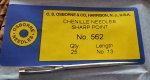
I found some appropriate needles for the rope work I need to do, they are called Chenille Needles. See the photo.
So, anyone is looking for needles with large eyes that's what to search for.
The brief history of the foresail halyard is:
When new, it all worked OK.
After about 10 years I noticed some slip, so I replaced the jaws of the clutch with new high grip jaws (Spinlock XX Clutch Service Kit)
At the end of this season (12 years) it was slipping again.
The rope is warn and shiny, but that's only the cover, the dyneema core is OK, and the core takes almost all of the load in a D2 rope.
I know that the rope will eventually need replacing, but I need about 50m, and D2 is expensive. The Jimmy Green price, just as a guide, is just over £600, I can no doubt improve on that price by shopping around, but I prefer to keep it going for another few years.
 

Attachments

  • Large eye needles.jpg
    Large eye needles.jpg
    313.5 KB · Views: 0
Top